
At TheHealthBoard, we're committed to delivering accurate, trustworthy information. Our expert-authored content is rigorously fact-checked and sourced from credible authorities. Discover how we uphold the highest standards in providing you with reliable knowledge.
What is a Warthin's Tumor?
 Nicole Madison
Nicole Madison
Nicole Madison
A Warthin’s tumor is a growth that forms in a person’s salivary glands. This type of tumor is benign, which means it isn’t cancerous. The tumor usually grows very slowly and is painless. While some benign tumors may eventually develop cancerous cells, this occurrence is extremely unlikely with Warthin’s tumors.
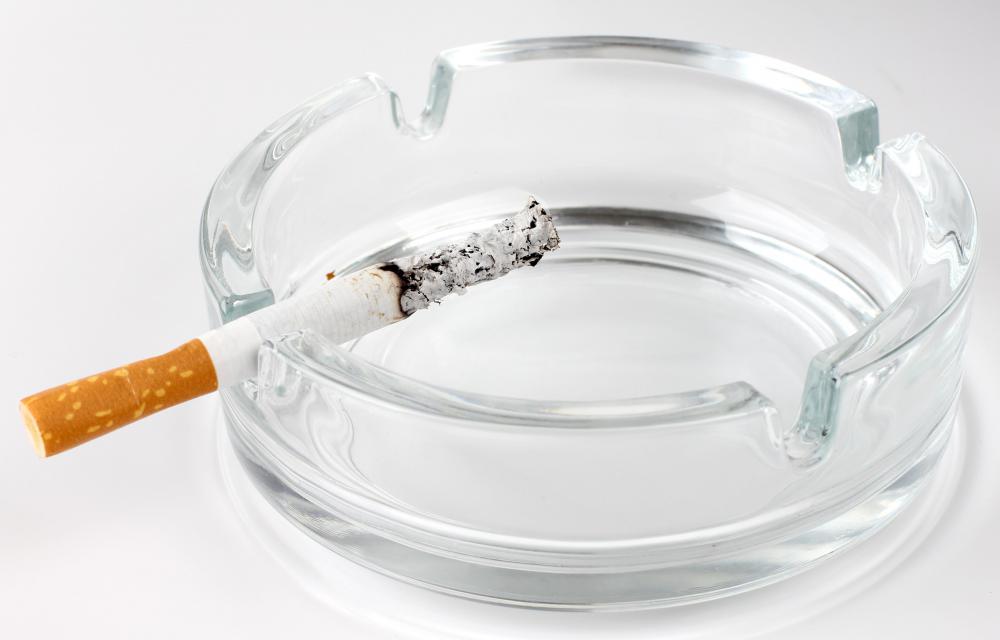
The exact cause of a Warthin’s tumor is unknown. The development of this type of tumor seems to be linked with cigarette smoke, however. People who smoke cigarettes are much more likely to develop this type of tumor than those who do not. In addition to smoking, age seems to play a role in the development of this type of tumor. People older than 60 years of age are more prone to developing them.

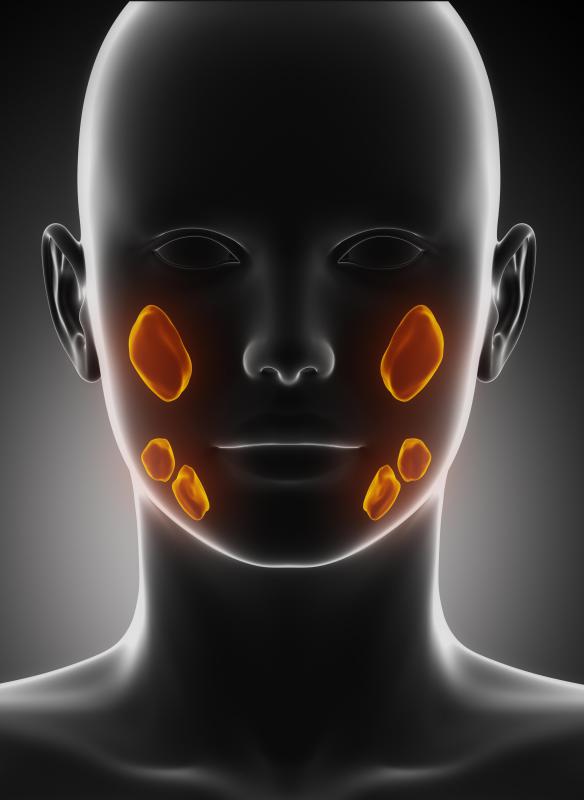
While a Warthin’s tumor may develop in any part of a person’s salivary glands, it is most likely to affect the parotid gland. The salivary glands include the parotid gland, the submandibular gland, and the sublingual gland. Of these three, the parotid gland is the largest, running along the bottom portion of a person’s jawbone and under the earlobe. Though most tumors that affect the salivary glands develop in this gland, the vast majority of them are not cancerous.

Some people with a Warthin’s tumor do not have any symptoms at all. This is called an asymptomatic case. Others develop a range of symptoms, including swollen salivary glands, bulges in the lower jaw, and pain in the jaw. Some people experience a feeling of pressure in the jaw area while others may develop paralysis of the facial nerves. Additionally, some patients experience earaches and problems with hearing, including ringing in the ears.

Diagnosis of a Warthin’s tumor usually includes a physical examination in which a doctor uses his hands to detect abnormal swelling in the neck and jaw area. He may also examine the mouth and look for abnormalities in the facial nerve and altered muscle function. Often, doctors employ diagnostic tests in detecting these tumors as well. For example, a doctor may order x-rays and computerized axial tomography (CAT) scans in an attempt to diagnose his patient. Magnetic resonance imaging tests (MRIs) may be used as well, not only to diagnose patients, but also to figure out exactly where the lumps are located and how large they are.
Treatment for a Warthin’s tumor may depend on the size of the growth and the amount of discomfort it is causing the patient. Often, these tumors are removed surgically. In some cases, it is necessary to remove part of the parotid gland as well.
Nicole Madison
Nicole’s thirst for knowledge inspired her to become a TheHealthBoard writer, and she focuses primarily on topics such as homeschooling, parenting, health, science, and business. When not writing or spending time with her four children, Nicole enjoys reading, camping, and going to the beach.
Learn more...
Nicole Madison
Nicole’s thirst for knowledge inspired her to become a TheHealthBoard writer, and she focuses primarily on topics such as homeschooling, parenting, health, science, and business. When not writing or spending time with her four children, Nicole enjoys reading, camping, and going to the beach.
Learn more...AS FEATURED ON:
AS FEATURED ON:


-
![Symptoms of a Warthin's tumor may include jaw pain.]() By: JPagetRFphotosSymptoms of a Warthin's tumor may include jaw pain.
By: JPagetRFphotosSymptoms of a Warthin's tumor may include jaw pain. -
![Symptoms of a Warthin's tumor may include swollen salivary glands.]() By: auremarSymptoms of a Warthin's tumor may include swollen salivary glands.
By: auremarSymptoms of a Warthin's tumor may include swollen salivary glands. -
![A CAT scan may be conducted to diagnose a Warthin's tumor.]() By: Hakan KızıltanA CAT scan may be conducted to diagnose a Warthin's tumor.
By: Hakan KızıltanA CAT scan may be conducted to diagnose a Warthin's tumor. -
![People older than 60 years of age are more prone to developing a Warthin's tumor.]() By: Andres RodriguezPeople older than 60 years of age are more prone to developing a Warthin's tumor.
By: Andres RodriguezPeople older than 60 years of age are more prone to developing a Warthin's tumor. -
![People who smoke cigarettes are more likely to develop a Warthin’s tumor.]() By: Ðиколай ÐÑигоÑÑевPeople who smoke cigarettes are more likely to develop a Warthin’s tumor.
By: Ðиколай ÐÑигоÑÑевPeople who smoke cigarettes are more likely to develop a Warthin’s tumor. -
![A Warthin's tumor is a growth that forms in the salivary glands.]() By: CLIPAREA.comA Warthin's tumor is a growth that forms in the salivary glands.
By: CLIPAREA.comA Warthin's tumor is a growth that forms in the salivary glands. -
![A physical examination may help diagnose a Warthin's tumor.]() By: corepicsA physical examination may help diagnose a Warthin's tumor.
By: corepicsA physical examination may help diagnose a Warthin's tumor.



Discussion Comments
Just had my second surgery for warthin's tumors. The first time was on the left side, and the doctor removed 5 tumors; my face is still numb. Last month, they did my right side, and removed 4 huge tumors. I haven't been in this much pain since giving birth, except this pain is constant. On the right side, my doctor said that a tumor had begun to attach itself to the jaw muscle and the jaw bone, and this is the reason for the extreme pain. They had to scrape the tumor.
I'm not able to eat solid food yet because my jaw starts to spasm after about three bites. It was a 5 hour surgery to get all of the tumors. I still haven't gotten the pathology report yet, and since I'm already a thyroid cancer survivor I'm a little worried.
I am a 55 year old non smoking female. I found this Wharthin's tumor 5 months ago. My specialist says it's an invasive, risky surgery. He says there are 5 nerves that run from the brain to the face in that area, and if a nerve gets damaged, it can cause permanent paralysis on that side of the face. It takes a minimum of two surgeons to do the surgery. How come I've yet to find anything on the internet about the possibility of facial paralysis? Has no one else's specialist told them about this? We're going to wait another 6 months to see if it grows or not.
Zen master -
Obviously, you'd rather have a benign Warthins tumor than any kind of cancer. However, if you think you'd rather have a parotid cancer versus a prostate cancer, you are absolutely insane. Caught early, prostate cancer is a piece of cake and almost 100% curable.
Any kind of head and neck cancer, while it may be curable, consists of surgery and probably chemo/radiation which can be difficult on a person. If you had to have a cancer, early stage prostate and early stage breast cancer is definitely what you'd want. Head and neck cancer would be way down on the list.
I had Warthin's tumor surgery in 1994 for removal of a double tumor. The tumor had grown and shrunk numerous times during the eight years I'd avoided the surgery. It finally got so large it caused an instance of temporary Bell's Palsy. Surgery was supposed to take 40 minutes; it took a team of doctors six and a half hours to do the surgery. They had to peel one side of my face to get all the runners the two tumors put out. Advice? If you have a Warthin's tumor, get the surgery done sooner rather than later.
My husband is 52, has just been diagnosed with his second Warthin's tumor. The first one was huge, and they had to lay open his face from behind the top of his ear, down behind his ear, and along his lower jawline to get it all out. The second one, two years later, is smaller, but probably because he knew right away what it probably was and went to see the ENT doctor right then. Again, it is growing very quickly. We are seeing the surgeon tomorrow for details, but I'm sure it will mean surgery again. He is really unhappy about the surgery, but not enough to stop smoking, unfortunately.
I have been diagnosed with a warthin's tumor also. I am 47 and I noticed a small lump 10 years ago behind my earlobe that never bothered me until I woke one morning recently with the side of my face swollen and some discomfort.
Fortunately, I work in the medical field in the operating room and was able to ask an ENT surgeon about it. He encouraged me to see his colleague he thought it was a parotid tumor. Taking his advice, I went to see his colleague. I also knew him and he diagnosed me with warthin's. Since then, I've dealt with pain and discomfort for five weeks until it finally went down and was not irritated.
A few weeks after, it became inflamed and caused severe facial pain which was literally unbearable. I was put on steroids and antibiotics and pain meds and this was 11 days before my scheduled surgery date which is next week. I'm still waiting but thankfully feeling better.
I smoke, and by quitting smoking would that help the tumor to go away, and is there any medicine that can be taken to help. I was diagnosed this week an the doctor said that it would keep growing unless it was removed.
thanks for your help.
My Warthin tumor seems to be shrinking. i have not read anything about this kind of thing in the literature. i prefer not to have surgery if it is possible for it to go on its own.
I've just been diagnosed with a warthins tumour. Having it cut out asap!
I wonder how often Wathin's tumors are mistaken for something else, like a tumor in the thyroid, or a lower sinus tumor.
Since everything is so close together there around the face and head, I bet it's kind of hard to diagnose tumors in the area.
Are Warthin's tumors ever connected with GIST tumors?
My father-in-law smokes like a chimney, and he was diagnosed with a GIST tumor about ten years ago.
He had it treated, and is fine now, but since the two are kind of connected (the gastrointestinal tract and the salivary glands, that is) and he is a smoker, I was wondering if you thought he would be at risk for a Warthin's tumor.
What a strange type of tumor. I guess you really can get a tumor pretty much anywhere on the body. I think if it came down to it though, I'd rather have a Warthin's tumor, or even a parotid tumor, than a prostate tumor.
Of course, I don't really want to have any tumor at all, but if I had to make a choice, then I think I'd go with Warthin's.
Post your comments