
At DelightedCooking, we're committed to delivering accurate, trustworthy information. Our expert-authored content is rigorously fact-checked and sourced from credible authorities. Discover how we uphold the highest standards in providing you with reliable knowledge.
What is a Walnut?
 Mary McMahon
Mary McMahon
Mary McMahon
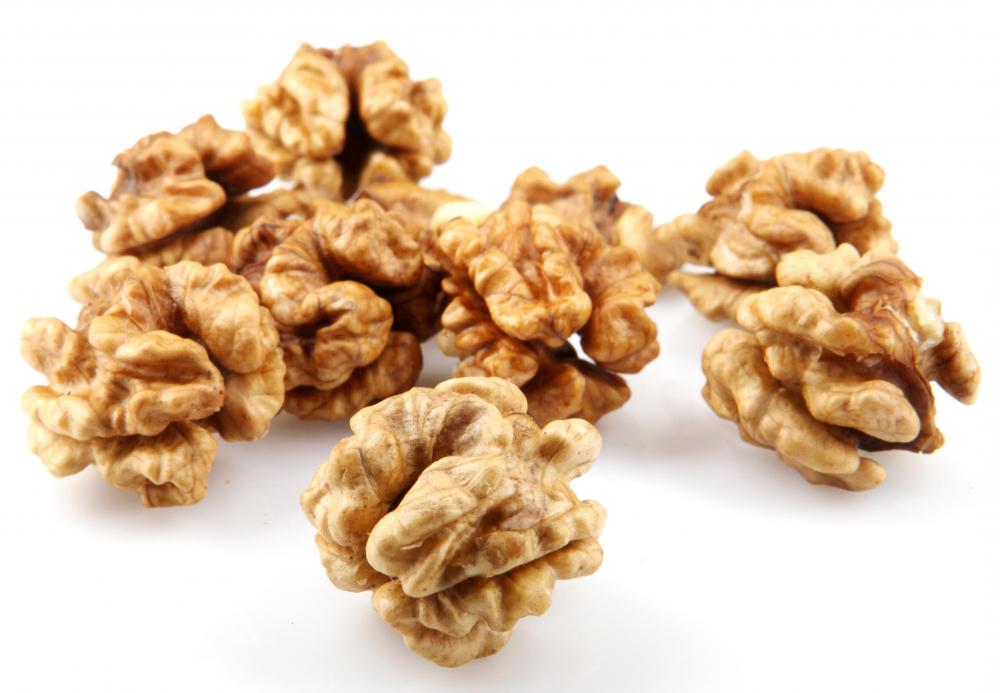
A walnut is a seed from a tree in the genus Juglans. Technically, it is a drupe, not a nut, since it takes the form of a fruit enclosed by a fleshy outer layer that parts to reveal a thin shell with a seed inside. As walnuts age on the tree, the outer shell dries and pulls away, leaving the shell and seed behind. Whether a person calls it a nut or a drupe, these seeds can pose risks to people with allergies, so they should be used with caution in cooking. Chefs should get in the habit of disclosing all of the ingredients in a dish to diners to alert those with allergy concerns and dietary restrictions.
The Juglans genus is extremely large and well distributed. The trees have simple, pinnately compound leaves with resinous spots. The odor of the resin is quite distinctive, and it can be harmful to plants grown underneath the trees, which is why the ground under them tends to be bare. Representative trees can be found all over the world, although they are primarily concentrated in the Northern hemisphere. Walnuts are also found growing in Africa and the Southern reaches of the Americas. The nuts have been used in both sweet and savory dishes for centuries, with some species being more favored than others.

One of the most popular varieties is the Persian or English walnut, which has a large seed and a thinner shell, yielding more edible meat per weight than other species. The Persian walnut came from the Middle East originally, although England established a monopoly on the trade at one point, leading to the associations with both regions of the Earth. Black walnuts are another commonly sold species, as are white walnuts, also called butternuts. Some species are cultivated for their wood as well as the edible drupes.

Commercially, walnuts are available both whole and shelled. Many consumers prefer to purchase the drupes shelled, since they can look for plump, glossy meat. Shriveled ones are not good to eat, and they can lurk inside any type of shell, which can be frustrating. Like many nuts, they can be frozen until use, or stored in a cool, dry, dark place for several months. They are also pressed to yield their dark, rich, flavorful oil.

Walnuts often appear paired with blue cheese in salads, mixed into stuffings, or in Middle Eastern cuisine with ingredients like raisins. They can also be candied for use in desserts, or used plain to provide a bitter contrast to sweet fruits. The uses for the nut are myriad, which explains its enduring popularity as a cash crop.
Mary McMahon
Ever since she began contributing to the site several years ago, Mary has embraced the exciting challenge of being a DelightedCooking researcher and writer. Mary has a liberal arts degree from Goddard College and spends her free time reading, cooking, and exploring the great outdoors.
Learn more...
Mary McMahon
Ever since she began contributing to the site several years ago, Mary has embraced the exciting challenge of being a DelightedCooking researcher and writer. Mary has a liberal arts degree from Goddard College and spends her free time reading, cooking, and exploring the great outdoors.
Learn more...AS FEATURED ON:
AS FEATURED ON:


-
![Three unshelled walnuts, one partially shelled, and one completely shelled.]() By: matesThree unshelled walnuts, one partially shelled, and one completely shelled.
By: matesThree unshelled walnuts, one partially shelled, and one completely shelled. -
![Blue cheese, which pairs well with walnuts.]()
Blue cheese, which pairs well with walnuts. -
![Walnuts can be pressed to produce a rich oil.]() By: margo555Walnuts can be pressed to produce a rich oil.
By: margo555Walnuts can be pressed to produce a rich oil. -
![Walnuts are rich in alpha-linolenic acid.]() By: Nenov BrothersWalnuts are rich in alpha-linolenic acid.
By: Nenov BrothersWalnuts are rich in alpha-linolenic acid. -
![A seasonal platter with walnuts, pears, and cheese.]() By: PaulistaA seasonal platter with walnuts, pears, and cheese.
By: PaulistaA seasonal platter with walnuts, pears, and cheese.



Discussion Comments
I love adding walnuts to pumpkin zucchini bread. This is a slightly sweet bread spiced with cinnamon, nutmeg, and cloves, and walnuts fit right in with the fall flavors.
I also think walnuts taste great in cookies. Chocolate chip cookies made with semi-sweet chips are best with walnuts, because there is a slightly bitter theme throughout.
Walnuts are good in chicken salad, too. They mesh well with the grapes and celery. Some people prefer pecans in their chicken salad, but I think that walnuts give it a stronger flavor.
@seag47 – Does walnut furniture smell like actual walnuts when it's finished? To me, walnuts have a strong, almost bitter aroma. I think it would be cool for chairs and tables to actually smell like walnuts.
Walnut wood is great for building furniture or cabinets. It's tough enough to stand up to wear, but if you have power tools, you can easily cut it.
The best thing about walnut wood is that you don't really need a stain for it. It has a naturally cool, attractive surface, so all you really need is a clear coat.
My dad builds furniture from walnut wood, and he says that it won't swell up like other types of wood when exposed to moisture. This is why it's a good wood to use in flooring.
I like the flavor of the American black walnut. This is what is used to make black walnut ice cream, which has a really rich, distinctive flavor.
Some people say that it tastes like dirt, but I say that it tastes like the air smells after a good rain. It has a very earthy flavor, but I love that about it.
I've heard that some people crack walnuts by running over them in their car! It looks like this would destroy the meat, but I guess it works.
I was always told that nothing would grow under a walnut tree and now I know why. I have a walnut tree in my back yard and finally gave up trying to plant anything under or close to it.
I don't mind walnuts but prefer to eat them in a mixture of other nuts or in baking. For some reason I don't like to eat them with nothing else. I know they have a lot of good health benefits and this is probably the best way to eat them.
Most of the time I am using them in a dessert and by the time you add in the sugar and other fattening ingredients, the walnuts probably aren't doing nearly as much good. I do like to make my own granola bars which include walnuts and almonds. At least this is a healthy and tasty way to get some walnuts in my diet.
We live on a property that has about 10 acres of timber which include several walnut trees. I also have three big walnut trees in my front yard. Sometimes I have thought about cutting the ones in my front yard down, but they squirrels certainly provide a lot of entertainment, especially in the fall. I don't care for the taste of walnuts so have never gathered them up, but the squirrels love to bury them for food in the winter.
I like to purchase my nuts at a bulk warehouse store and have found that the walnuts tend to be more expensive than any of the other nuts I buy. I wonder if it takes more work to get the nuts out of the shell with walnuts.
I like to use walnuts in baking and in my oatmeal in the morning. When I get them home I keep out a small portion and store the rest of them in the freezer. This way they will last me a long time and won't get rancid.
@anon231995-- It is interesting how people have such different tastes. I like about any kind of nut, but don't care for hazelnuts or Brazil nuts! For me, black walnuts are a real treat.
My mother-in-law had some walnut trees in her yard and every year she would gather them in buckets. Once they were dried out she would crack them and spend a lot of time in her basement picking out the nuts. If anyone else has every done this, you know how much time and work is involved.
When she would give us a jar of black walnuts I knew how much effort had gone into that jar. One of our favorite ways to eat walnuts is with some vanilla ice cream with a little bit of chocolate syrup on top.
well, walnuts are nuts, but i like hazelnuts better.
It is almost necessary for good health to eat walnuts every day.
Why is walnuts nutrition so important? It is not only because walnuts are good tasting and filling, but because walnuts also lower cholesterol and keep blood vessels healthier.
Walnuts are a healthy and tasty snack food. Because of their relatively high level of protein and fat, they are filling, so a small amount will go a long way. Walnuts are rich in Omega 3 and as such help fight heart disease.
Walnut leaves and roots contain a substance, juglone, that when washed into the soil, thwarts the growth of other plants. Black walnuts have more of this toxic substance than English walnuts do.
Post your comments