
At WiseGEEK, we're committed to delivering accurate, trustworthy information. Our expert-authored content is rigorously fact-checked and sourced from credible authorities. Discover how we uphold the highest standards in providing you with reliable knowledge.
What is a Ventral Hernia?
 Tricia Christensen
Tricia Christensen
Tricia Christensen
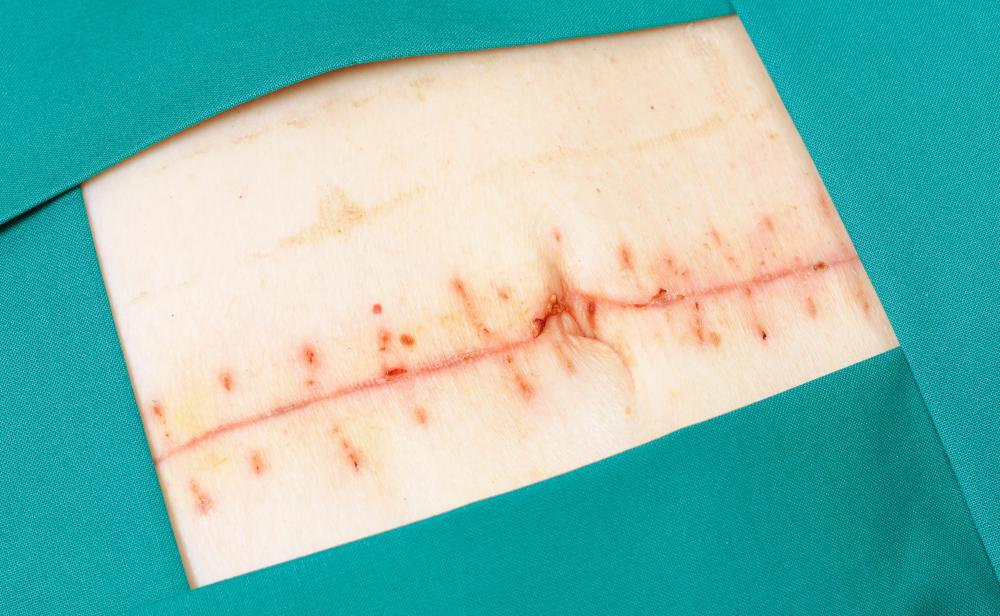
A ventral hernia occurs in the abdomen, and is a fragment of intestines or other organs that push through the abdomen muscle wall. These most often are called incisional hernias because they usually develop along an area where an incision (cut) for surgery has occurred. Some people have ventral hernias that result right after a surgery on the abdomen has taken place and others may develop them years after a surgery.
Common symptoms of a ventral hernia include a perceivable bulge at the stomach. Some people may feel pain at the hernia site when they do things like lifting heavy objects or coughing. Symptoms may be very mild, or they can become greatly complicated and pose a medical emergency. If the hernia becomes strangulated this means it is getting insufficient blood to the protruding tissues or organs. This can cause very severe pain and some people will have vomiting or nausea.
While this type of hernia always deserves medical attention, symptoms of a strangulated hernia require immediate medical care. This is a very serious condition and usually necessitates surgical repair right away.

When a person suspects a ventral hernia, he or she should see a physician, as mentioned. The doctor will probably examine the area, take a medical history, including getting history on prior surgeries, and may order tests like x-rays or other more extensive scans. These tests can give a good sense of the amount of protrusion and the tissue or organs that may be involved in the protrusion.

About 100,000 surgeries are performed to repair ventral hernias in the US alone. Most of these surgeries don’t take place under emergency circumstances, as many people will notice these hernias right away and report them to doctors. Surgery is usually the main treatment for the majority of hernias, because they are likely to worsen if ignored, given the weakness in the muscles of the abdomen caused by prior surgery.

A couple of methods exist for surgical repair. These include doing open surgery on the abdomen to replace the bulging organs and to shore up the abdominal muscles. Some hernia repairs can be performed laparoscopically, which is less invasive. One of the difficulties in repairing ventral hernias is that the skin tissue and muscles that have already been operated upon are weaker. Sometimes people have a surgery, and then require another one if this type of hernia develops after the repair.
Tricia Christensen
Tricia has a Literature degree from Sonoma State University and has been a frequent WiseGEEK contributor for many years. She is especially passionate about reading and writing, although her other interests include medicine, art, film, history, politics, ethics, and religion. Tricia lives in Northern California and is currently working on her first novel.
Learn more...
Tricia Christensen
Tricia has a Literature degree from Sonoma State University and has been a frequent WiseGEEK contributor for many years. She is especially passionate about reading and writing, although her other interests include medicine, art, film, history, politics, ethics, and religion. Tricia lives in Northern California and is currently working on her first novel.
Learn more...AS FEATURED ON:
AS FEATURED ON:









-
![Ventral hernias tend to form along incisions from abdominal surgery.]() By: PavleVentral hernias tend to form along incisions from abdominal surgery.
By: PavleVentral hernias tend to form along incisions from abdominal surgery. -
![If a ventral hernia becomes strangulated, emergency surgery typically must be performed.]() By: dacasdoIf a ventral hernia becomes strangulated, emergency surgery typically must be performed.
By: dacasdoIf a ventral hernia becomes strangulated, emergency surgery typically must be performed. -
![A medical professional examines an X-ray for signs of a ventral hernia.]() By: nyulA medical professional examines an X-ray for signs of a ventral hernia.
By: nyulA medical professional examines an X-ray for signs of a ventral hernia. -
![Symptoms of a strangulated hernia require immediate medical attention.]() By: Monkey BusinessSymptoms of a strangulated hernia require immediate medical attention.
By: Monkey BusinessSymptoms of a strangulated hernia require immediate medical attention. -
![A ventral hernia is a fragment of intestines that push through the abdomen muscle wall.]() By: starasA ventral hernia is a fragment of intestines that push through the abdomen muscle wall.
By: starasA ventral hernia is a fragment of intestines that push through the abdomen muscle wall.




Discussion Comments
i had four ventral hernia surgeries. now i have one more. doctor won't remove it. i lose weight.
Please see your doctor soon, for my son was having a pain in the bottom of the esophagus and it turned out it was serious where the cells in the esophagus' wall were inflamed and abnormal--and this is diagnosed as "pre-cancerous" Had to take strong medication and even change medication throughout the process.
But thanks be to God, that three months later, an endoscopy showed that the esophagus was almost back to normal.
@Motherbear5 -- I really don't know, but I would think that the two conditions could exacerbate each other.
Best thing to do is to ask your doctor, he'll tell you what's going on.
@Charlie89 -- Well, I haven't had a hernia surgery myself, but my son had umbilical hernia repair surgery, so I can kind of tell you what the procedure is.
First, they put the patient under general anesthesia -- that's the procedure for almost every hernia patient.
Then the surgeon has the choice of either operating laparoscopically, which means they cut small holes and operate by means of small tubes placed in the abdomen; they can also do an open hernia surgery, but that is much more invasive.
After surgery, the surgeon will usually put a sterile surgical mesh at the site of the incision, in order to strengthen the abdominal wall and -- hopefully -- prevent further herniation.
What would the procedure be for a ventral hernia surgery?
And what would be the benefit of having one if you're just likely to get another ventral hernia the year after?
Hi, I had an ultrasound last week on my abdomen as I have been having some problems. This is the result: Superior to the umbilicus there is suspicion for a small ventral hernia. A small loop of bowel may herniate through a defect in the anterior abdominal wall. I had a ventral hernia repair 6 months ago and here I go again. What I want to know is how do I tell the difference between acid reflux causing nausea and pain in the pit of the stomach (which I am having) and nausea and pain that may be caused by the hernia? My bowels are also loose like water these past several days on and off. I talk with my doctor on Thursday about the results. Any input please? Thanks!
Post your comments