
At WiseGEEK, we're committed to delivering accurate, trustworthy information. Our expert-authored content is rigorously fact-checked and sourced from credible authorities. Discover how we uphold the highest standards in providing you with reliable knowledge.
What is a Unicornuate Uterus?
 Mary McMahon
Mary McMahon
Mary McMahon
A unicornuate uterus is an unusually shaped uterus caused by errors during embryonic development. In a person with a unicornuate uterus, only half of the uterus has fully formed, with a single “horn” leading to one of the fallopian tubes. This condition is very rare. People can successfully get pregnant with this uterine abnormality, although having a unicornuate uterus does increase the risk of pregnancy complications, including pregnancy loss.
During embryonic development, two structures known as the Mullerian ducts eventually develop into the uterus. In some fetuses, only one duct fully develops. Unicornuate uteri can be variable in appearance. Sometimes, the undeveloped duct creates a sealed partial uterus. In some women, a partial second horn can be observed, although it is usually not connected to the fallopian tube.

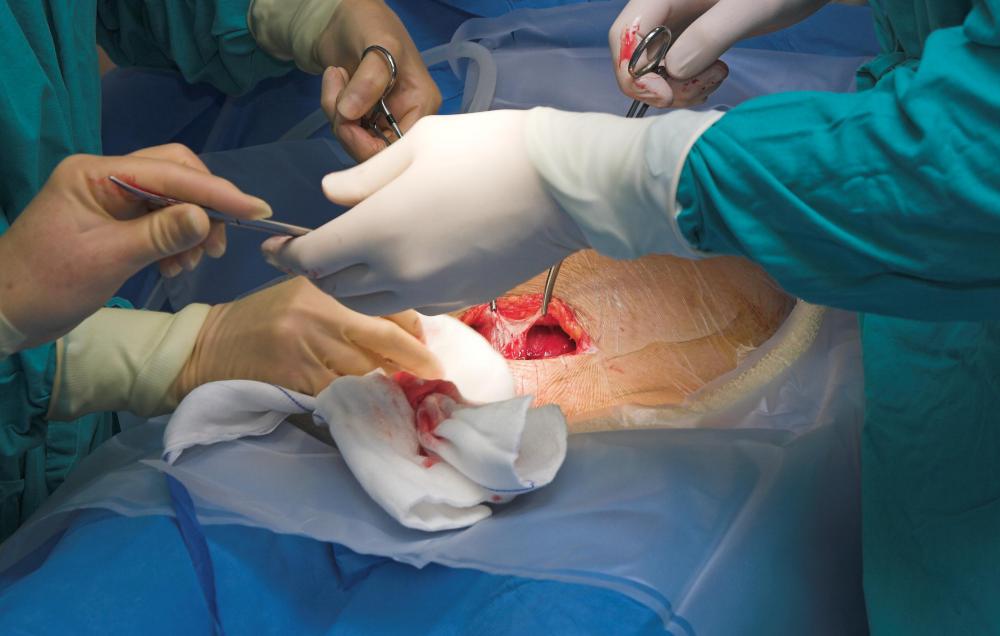
This uterine abnormality is sometimes not diagnosed until a pregnant woman experiences complications and needs a Cesarean section. As soon as she is opened up in the operating room, the unusual shape of the uterus will be readily apparent. In other women, the anomaly may be noted during surgical procedures in the abdomen, including procedures like tubal ligations.

Having a unicornuate uterus can lead to fertility issues. Women who have difficulty conceiving may be run through a series of tests to determine the cause. If these tests include imaging studies of the uterus, the woman's unusually shaped uterus may become visible. However, imaging studies cannot always reliably pick up a unicornuate uterus.
Women with this congenital disorder are at risk of pregnancy complications because the uterus is smaller, and it is possible for the pregnancy to implant in a bad location, potentially leading to rupture. Pregnant women who know they have unicornuate uteri should make sure their obstetricians are aware so plans can be made to keep the pregnancy as safe as possible. Something else to be aware of with this anomaly is that sometimes a kidney is missing or misshapen as well. This can require taking some special precautions to maintain kidney health in the remaining fully functional kidney.

The causes of unicornuate uterus formation are not fully understood. In some cases, environmental exposures during embryonic development can lead to anatomical abnormalities. In other instances, there are no known risk factors for anomalies or it is difficult to identify risk factors because the uterine abnormality is identified so late, it is difficult to get accurate information about environmental exposures during the patient's embryonic development.
Mary McMahon
Ever since she began contributing to the site several years ago, Mary has embraced the exciting challenge of being a WiseGEEK researcher and writer. Mary has a liberal arts degree from Goddard College and spends her free time reading, cooking, and exploring the great outdoors.
Learn more...
Mary McMahon
Ever since she began contributing to the site several years ago, Mary has embraced the exciting challenge of being a WiseGEEK researcher and writer. Mary has a liberal arts degree from Goddard College and spends her free time reading, cooking, and exploring the great outdoors.
Learn more...AS FEATURED ON:
AS FEATURED ON:









-
![A unicornuate uterus may not be detected until a pregnant woman experiences complications and needs a C-section.]() By: Anton BooysenA unicornuate uterus may not be detected until a pregnant woman experiences complications and needs a C-section.
By: Anton BooysenA unicornuate uterus may not be detected until a pregnant woman experiences complications and needs a C-section. -
![A woman who has a unicornuate uterus may be at increased risk for complications during pregnancy.]() By: Radek SturgolewskiA woman who has a unicornuate uterus may be at increased risk for complications during pregnancy.
By: Radek SturgolewskiA woman who has a unicornuate uterus may be at increased risk for complications during pregnancy. -
![A pregnant woman should inform her obstetrician that she has a unicornuate uterus.]() By: Valua VitalyA pregnant woman should inform her obstetrician that she has a unicornuate uterus.
By: Valua VitalyA pregnant woman should inform her obstetrician that she has a unicornuate uterus. -
![Having a unicornuate uterus can lead to fertility issues.]() By: ProMotionHaving a unicornuate uterus can lead to fertility issues.
By: ProMotionHaving a unicornuate uterus can lead to fertility issues. -
![The uterus is part of the female reproductive system.]() By: blueringmediaThe uterus is part of the female reproductive system.
By: blueringmediaThe uterus is part of the female reproductive system. -
![Medical professionals are not wholly sure as to what causes unicornuate uterus formation.]() By: GajusMedical professionals are not wholly sure as to what causes unicornuate uterus formation.
By: GajusMedical professionals are not wholly sure as to what causes unicornuate uterus formation.


Discussion Comments
I was diagnosed with this during a C-section with my second baby. I went on to have two more children for a total of four and am now expecting twins. I've battled infertility for years and suffered 10 miscarriages along the way. My pregnancies resulted in bed rest around 28-30 weeks and I carried to 37. I feel blessed but it has been a long, hard road.
I have UU, diagnosed by accident at 32 years after an explorative bowel scan. I have a left ovary, connected and not blocked fallopian tube and the left half of my uterus. I also have a left hypatrophic kidney and no right kidney. Right ovary yet to be discovered, its there somewhere, i think up under my right rib cage.
My husband and I are on our second cycle of Clomid as my RE is confident we will conceive naturally, but I'm quite anxious about multiples as we have a higher risk with these meds. One day we will bring our child into the world. I'm staying positive about that. Never let having this rare condition get you down. it's just part of what makes you special and different from the rest.
I was diagnosed with a UU after miscarrying several times early in the pregnancies. I was diagnosed through a test called a hystiopiliogram. I was told I could never carry a baby past five months and to look into surrogacy, which we did. I then got pregnant again and carried my first son to 36 weeks. He was and still is perfect. I had three more children, all born via C-section. Do not give up on your dream of having a baby when given this diagnosis. Doctors are learning more and more about how to get these babies to term.
I have this condition. I just found out after having three miscarriages, one ectopic pregnancy, and two healthy, beautiful girls (both by C-section, full term). My girls are now eight and six.
To have my girls, my doctor reconstructed my uterus. He gutted it and blew it up with a balloon for a week, and I got my two girls. I could never carry past four months before this was done. I do have lots of pain where the horn is missing, and from any physical activity. I am not yet sure if I have my right kidney, and shocked that after all this time I am only being told now about this. If I had been told this before, I could have saved myself from getting a lot of tests done.
I have this condition. It does cause my period pains to be worse and can cause pain after sexual contact, other times because I move wrong. Exercising is difficult because too much stretching can hurt. I have three daughters, all of which I had problems during pregnancy and was put on bed rest for all them. Two of them were c-sections after a vaginal delivery that nearly cost both our lives.
If you have this condition, talk to your doctor about a c-section, since the baby may have a hard time getting around the curve in the uterus. With the proper care and knowledge, this condition is normally not much of a problem, just an annoyance with some extra steps to take in care.
I just wanted to say that I have a unicornuate uterus, which was discovered when my son was born by emergency caesarian at 34 weeks (despite complaining of pain on the right side and various ultrasounds, it was not diagnosed) and I then went on to have our daughter, also born by caesarian, with no real problems, except she was induced early at 35 weeks for the same reason.
My only advice would be that if you are pregnant and the baby is all under one side of the ribs, get it checked! It was so obvious with me that the baby was on one side that people in the street felt they could comment on it! It was a relief when I was diagnosed that there was literally one half of the womb for the baby.
Seriously though, it is not a condition that means that you can't have a baby. We have two healthy children to show for it, but I would stress so much that if you have doubts as to the position of your baby, e.g., too much on one side, insist on an examination.
It is a rare condition, and not a serious one, but it is best to get a heads up, so to speak! Also, I only have one ovary and fallopian tube (only having half the full set!) so please don't despair that you can't also have two lovely children as we do! If we knew now what we did then, perhaps we would not have tried, so keep going. You will be lucky.
@panda2006: It absolutely causes pain. From my first period to my partial hysterectomy, nothing could take that pain away. I had a pregnancy in the rudimentary horn, and it plus my tube and ovary and baby were removed. After that time I no longer had pain. I had a functioning rudimentary horn, whereas many women with a UU do not.
@FernValley- I have a friend with this disorder. It usually does not cause pain, and it's hard to even know that you have it unless you are trying to conceive. You might have a cyst, fibroids, or another issue, though.
Is it possible for this to be a cause of uterus pain as well? I have had a lot of issues, both during menstruation and at other times, and am still trying to narrow down causes. Since I have not tried to get pregnant before, my doctor has not checked me for things like this.
@mabeT- I think that you should be able to find this through an ultrasound or MRI. If you have ever had one for another reason, such as menstrual issues or uterus fibroids, they might already have checked for it. However, it wouldn't hurt to ask your doctor and see if another test might be worth it.
My husband and I have had some difficulty in conceiving, and I’ve been looking for solutions everywhere that I can.
Is this a disorder that is routinely tested for, or because of its rarity, is it largely overlooked?
I’m also wondering if there are any other signs or symptoms that a woman might have to indicate such a problem without it actually being visually noted by a physician.
Although we haven’t been trying as long as some people, we certainly are starting to get a little worried and a little scared. Heck, for all I know, it could be the stress of conceiving keeping us from actually getting pregnant!
When my husband and I went through our own fertility issues, I was checked for this abnormality.
Thank goodness, the tests were negative and my uterus is as normal as they come, but it was scary to think of something like that being wrong.
I hear though that many women who have it do have children successfully, and sometimes with little difficulty. While there certainly are more risks involved, it is totally possible to have children and be just fine.
The reason, I think, that it can be harder to get pregnant with this sort of thing is because you’re only getting an egg every other month from the fallopian tube that is attached.
However, there is absolutely no reason that the eggs coming from the attached fallopian tube should not make a beautiful, healthy baby.
Post your comments