
At HomeQuestionsAnswered, we're committed to delivering accurate, trustworthy information. Our expert-authored content is rigorously fact-checked and sourced from credible authorities. Discover how we uphold the highest standards in providing you with reliable knowledge.
What is a Toilet Rough in?
 Hillary Flynn
Hillary Flynn
Hillary Flynn
First time bathroom renovators often overlook or incorrectly record the most important measurement when planning to install a new toilet. That measurement is the toilet rough in. This refers to both the area where the waste outlet hole was placed to sit beneath the toilet, as well as the rough in measurement, which determines which toilets will or will not work in the space.
Replacing a toilet can be confusing, as the logical assumption would be to purchase a new one with a base of similar size to the original toilet. In reality, however, it's actually the distance between the drainage hole and the back of the toilet that's important. To accurately obtain this dimension, renovators should start at the back of the toilet and measure the distance to the center of the waste outlet hole on the underside of the bowl. Usually, this measurement is 12 inches (30.5 cm), but manufacturers also offer toilets to accommodate 10 inch (25.4 cm) and 14 inch (35.6 cm) toilet rough in measurements that may be needed due to construction mistakes or awkward floor joist placement.

Purchased toilets must be compatible with the rough in measurement, or else the toilet won’t match the drainage pipe location. On occasion, renovations will require the toilet rough in be moved, which means the drainage hole must be relocated to another area of the bathroom. If no toilet currently exists in the space, the rough in can be identified by looking for a drainage hole with an external “lip.” This lip is called the flange, and it will have a wax ring surrounding it.

Installing a toilet over an existing rough in is relatively simple, but relocating one can be tricky and should only be handled by someone with prior plumbing knowledge. To do this, the floor must opened up, and if the bathroom is at basement level, this will entail breaking through the concrete. Also, considerations must be made regarding the water line, drainage line, and pipes. Redirecting these could result in plumbing flow problems, plus there are specific plumbing codes that must be followed.
Simply replacing the toilet does not warrant any sort of notification, but any time pipes are altered, permits may be required. It’s essential to follow the plumbing and building code exactly, because a permit may also lead to a required inspection and approval. This is necessary because any time pipes are altered, it could affect the balance between drain and vent segments.
Hillary Flynn
Joining the HomeQuestionsAnswered team has helped to satisfy Hillary’s insatiable curiosity for knowledge. She also manages an electronic publishing business that allows her to develop her skills in technical writing, graphic design, and business development. Hillary has a passion for satirical writing and enjoys traveling, especially to places of historical importance.
Learn more...
Hillary Flynn
Joining the HomeQuestionsAnswered team has helped to satisfy Hillary’s insatiable curiosity for knowledge. She also manages an electronic publishing business that allows her to develop her skills in technical writing, graphic design, and business development. Hillary has a passion for satirical writing and enjoys traveling, especially to places of historical importance.
Learn more...AS FEATURED ON:
AS FEATURED ON:


-
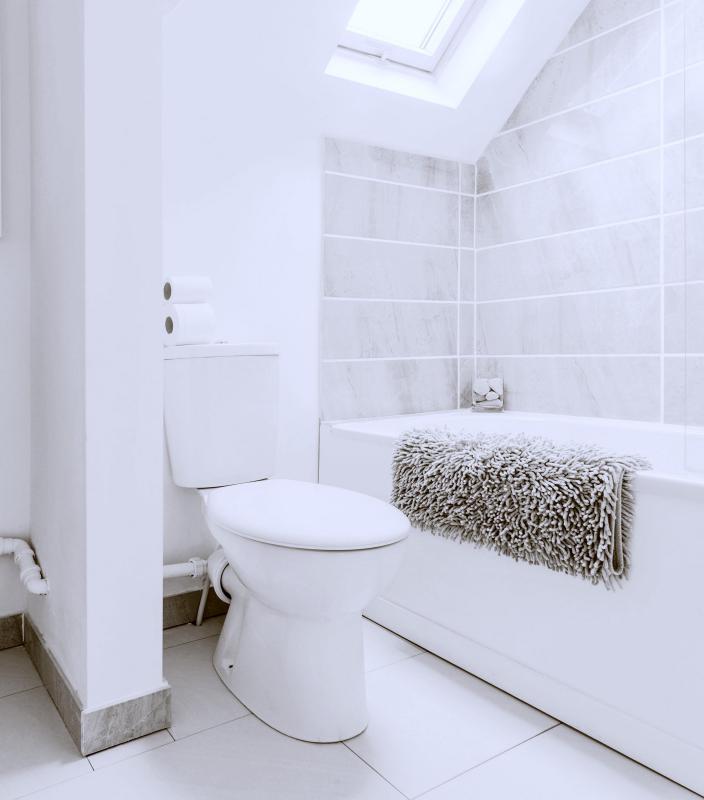
![The distance between the toilet's drainage hole and the back of the toilet is important.]() By: david hughesThe distance between the toilet's drainage hole and the back of the toilet is important.
By: david hughesThe distance between the toilet's drainage hole and the back of the toilet is important. -
![In tight spaces like basement bathrooms, toilet placement is key for making the most of the space.]() By: foto76In tight spaces like basement bathrooms, toilet placement is key for making the most of the space.
By: foto76In tight spaces like basement bathrooms, toilet placement is key for making the most of the space.

Discussion Comments
Would loved to have seen a drawing or photo of the rough in with a tape measure or ruler so we could see exactly how to measure the rough in distance.
So the article talks about rough in for floor drains, but the first pic appears to showcase a macerating toilet. Does the rough in still apply for those?
@lokilove - You are so right! As smart as my fiance is, sometimes he doesn't know -everything- and will measure things too hastily. Imagine my surprised when he was out of the state on business and the toilet we'd ordered wasn't the right fit! Long story short, we bought a new toilet with the right measurements and it fit much better.
If your toilet doesn't fit right on the first or second test, then it will never fit and it's best to find one that will!
Bit of advice, if your toilet doesn't fit, just get another toilet!! Sure it's going to cost you, but believe me, it will cost far less than having to re-open the floor and moving the pipes etc.
Post your comments