
At TheHealthBoard, we're committed to delivering accurate, trustworthy information. Our expert-authored content is rigorously fact-checked and sourced from credible authorities. Discover how we uphold the highest standards in providing you with reliable knowledge.
What is the Thymus Gland?
 Hillary Flynn
Hillary Flynn
Hillary Flynn
The thymus gland is an organ in the upper chest cavity that processes lymphocytes, a type of white blood cell that fights infections in the body. This organ is part of both the lymphatic system, which makes up a major part of the immune system, and the endocrine system, which includes all glands that produce hormones. The thymus is most important in children and young adults, when it programs lymphocytes to attack antigens, like viruses. People who do not have this gland, or in whom it does not function correctly, usually have compromised immune systems and difficulty fighting disease.
Anatomy and Function

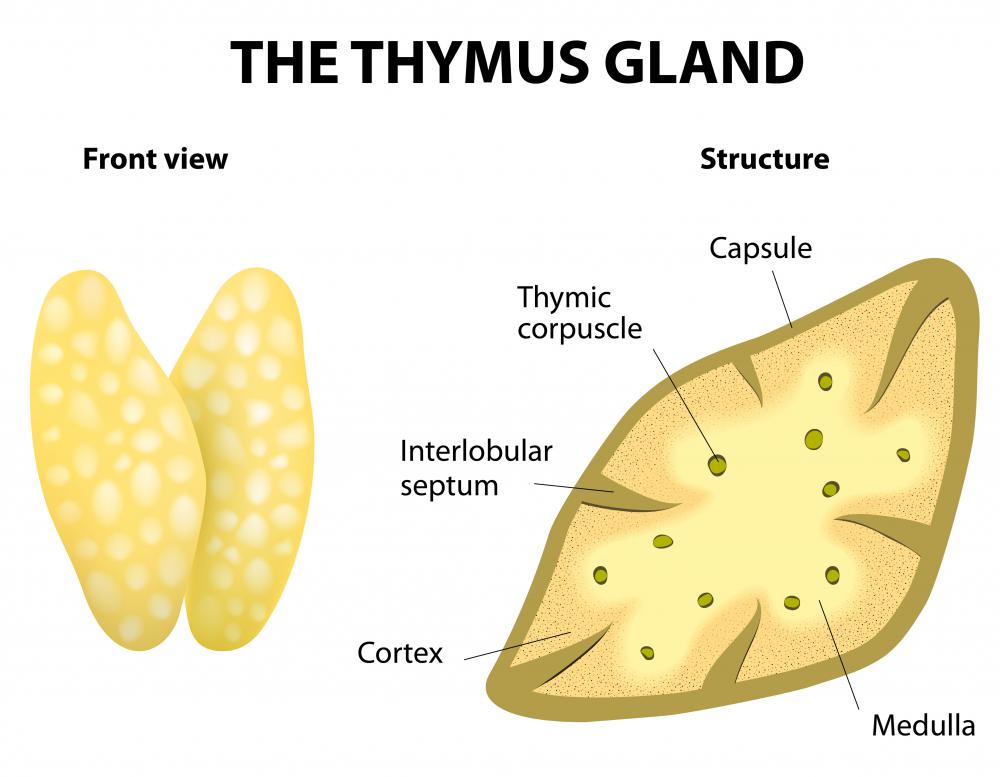
Two irregularly shaped parts make up the thymus, which is located directly just below the throat, behind the sternum. The gland releases a hormone that stimulates the production of a certain type of white blood cell in the bone marrow; these cells, called thymocytes are transported by the bloodstream to the thymus. There, the organ "programs" the cells to attack antigens that invade the body and to not attack normal cells in the body itself. Once matured, these T lymphocytes, or T cells, circulate through the bloodstream and collect in the lymph organs — the spleen and lymph nodes — for future use.

T cells are called into action to fight viruses, tumor cells, and other invaders to help the body fight off disease. They also help in the development of other white blood cells, including B cells, which develop in the bone marrow, and macrophages, which "swallow" foreign cells.
The majority of lymphocyte production happens early in life, so the thymus gland shrinks with age. It's about the size of an apple in children just before puberty, but may become barely discernible from surrounding fatty tissues in the elderly. It is thought that the sex hormones released during adolescence trigger the organ to begin to shut down. Because it's smaller and less active in adults, little was known about the thymus gland until the 1960s, and scientists are still studying exactly how it is related to various diseases and conditions.
Complications and Diseases

If the thymus is removed in infancy or develops improperly, the immune system may be compromised. Much of the body's immune system development happens before birth, so removing the organ even in a young child won't necessarily cause extreme damage to the child's immunity. When the thymus doesn't develop correctly, however, it can cause immune deficiency, making the person much more susceptible to infections.

Cancer is rare in this part of the body, but tumors can develop in the thymus. Called a thymoma, these tumors most often occur in people with other medical conditions including myasthenia gravis and some autoimmune diseases. Symptoms include coughing, wheezing, and chest pain, and treatment can include surgery to remove the tumor along with radiation or hormone therapy. The prognosis for thymoma depends mostly on how far the cancer has progressed.

The thymus is thought to play a role in the development of myasthenia gravis, a condition in which the T cells attack the nerves where they connect to the muscles. The removal of the organ, called a thymectomy, is often performed to relieve the symptoms related to this condition.
Role in Disease Prevention
Research is being conducted to determine whether or not regenerating the thymus gland or preventing its deterioration could improve immunity in older people. Scientists question whether the organ could play a role in fighting cancer and HIV/AIDS, which directly attacks T cells. Numerous autoimmune diseases such as multiple sclerosis, lupus, and diabetes might also be managed more effectively through better understanding the gland's function.
Hillary Flynn
Joining the TheHealthBoard team has helped to satisfy Hillary’s insatiable curiosity for knowledge. She also manages an electronic publishing business that allows her to develop her skills in technical writing, graphic design, and business development. Hillary has a passion for satirical writing and enjoys traveling, especially to places of historical importance.
Learn more...
Hillary Flynn
Joining the TheHealthBoard team has helped to satisfy Hillary’s insatiable curiosity for knowledge. She also manages an electronic publishing business that allows her to develop her skills in technical writing, graphic design, and business development. Hillary has a passion for satirical writing and enjoys traveling, especially to places of historical importance.
Learn more...AS FEATURED ON:
AS FEATURED ON:


-
![The thymus gland is most important to children and young adults as it programs white blood cells to attack antigens.]() By: athomassThe thymus gland is most important to children and young adults as it programs white blood cells to attack antigens.
By: athomassThe thymus gland is most important to children and young adults as it programs white blood cells to attack antigens. -
![Different types of white blood cells programmed within the thymus gland.]() By: apple1Different types of white blood cells programmed within the thymus gland.
By: apple1Different types of white blood cells programmed within the thymus gland. -
![The thymus gland is part of the lymphatic system.]() By: blueringmediaThe thymus gland is part of the lymphatic system.
By: blueringmediaThe thymus gland is part of the lymphatic system. -
![The thymus is located just below the throat, behind the sternum.]() By: designuaThe thymus is located just below the throat, behind the sternum.
By: designuaThe thymus is located just below the throat, behind the sternum. -
![Chest pain may indicate a tumor of the thymus gland.]() By: sumnersgraphicsincChest pain may indicate a tumor of the thymus gland.
By: sumnersgraphicsincChest pain may indicate a tumor of the thymus gland.



Discussion Comments
I was diagnosed with having a thymus tumor in 2009 after having a baby, breathing complications and pulmonary edema. I was told to get a biopsy and maybe remove it. I did not have it removed, as I wanted to be in control of good breathing after what I went through. Two years later, I had another CT scan and they said my mass had shrunk about one inch all over. The doctor said I was good for now and to just get it checked again in another year. I will get it checked again this year. I feel normal and sometimes just have allergies. That's about it.
I had my Thymus gland removed when I was going into eighth grade, so I was like 13-14 years old. They took a biopsy to see if it was a thymoma or something else, but could not get enough to sample before I started getting ready to pass out from the massive biopsy needle.
Anyway, I had surgery in case it didn't shrink as I got older, or got in the way of my lungs. All in all, I have a very strong immune system (knock on wood). I get sick maybe once a year, if that. It's interesting to know more about this though, and how long it really does help shape the immune system in adolescence.
We're doing a project on the thymus gland, and this really helps! Thanks!
Polymyalgia is one of those secret pain disorders. Some people really do have it and some people get diagnosed with it just so they can receive pain medication.
I am just about to start a course of l-ornithine tablets apparently to put the thymus gland in good working order. I am 76 years old. Is this a good idea?
I have witnessed many people die from cancer. I was influenced to study cancer and found by stimulating the thymus gland with reiki, shiitake and matiake mushroom capsules, killer cells would be released. (killer cells are responsible for killing cancer cells). A mixture of 500 milligrams of vitamin C with flavonoids seems to make the mushrooms work better and digest directly into the bloodstream. Friendly bacteria is also wonderful food for the thymus gland to keep it healthy. --James
I have been diagnosed with Polymyalgia. Is the thymus causing this problem?
I've heard that in some cases thymus gland removal is necessary, though.
For instance, in the case of a very enlarged thymus gland, or one that is showing signs of cancer, doctors will often have to remove the gland and then rely on other treatments to keep the patient's immune system up.
Although removing the gland can be dangerous for the patient, I'm sure it's better than the alternative!
@CopperPipe -- They do have thymus gland supplements, many of which are actually made out of the thymus of other animals, oftentimes beef.
The thymus tissue is dried and defatted before being put into pill form.
However, there is little concrete research to show that thymus gland supplements can truly have an impact in preventing thymus gland diseases or disorders, so take the claims on the bottle with a grain of salt.
That's really interesting. I had never heard of the thymus gland, much less knew how important it was to the immune system.
I wonder, are there any thymus gland supplements out there? I bet that would be a good money-maker!
Post your comments