
At AboutMechanics, we're committed to delivering accurate, trustworthy information. Our expert-authored content is rigorously fact-checked and sourced from credible authorities. Discover how we uphold the highest standards in providing you with reliable knowledge.
What Is a Thread Angle?
Thread angle is a measurement of the degree of angle between the individual threads on a screw. These threads consist of teeth or cuts made in the shank of a screw or bolt. By cutting the teeth at an angle, manufacturers can enhance the fastening power of the screw. Changes in thread angle also determine how easily the screw can be installed into certain types of material. Based on these factors, contractors consider the angle when choosing screws to find the best types of fasteners for each application.
Many types of screws are cut to a standard angle, which is based on industry standards for that type of fastener. For example, most screws with a V-shaped thread design are cut at a 60 degree angle to one another. This is true of all fasteners used in the United States. and the United Kingdom, as well as any other countries that rely on the unified thread standard, or UTS. This 60-degree angle is generally identified by the letter M, which can be found on screw packaging and screw identification charts. A 60 degree angle was chosen because it provides a balance between holding power and ease of installation for the wider number of projects.
Most metal and plastic pipes feature a thread angle of 55 degrees, which serves as an industry standard for pipes under the UTS. These pipes feature an angle identification of G, which is associated with a 55-degree angle. Some specialty bolts and fasteners may also utilize a 55-degree angle, which is based on the traditional Whitworth screw identification system. These fasteners are identified by the letter W, and may include screws and bolts used on bicycles and some specialty vehicles.

Screws with a rounded or knuckle-thread design typically feature a 30-degree angle. This shallow angle is also used on Acme or square-toothed threads as well as those with a trapezoidal shape. Buttressed threads, which feature one square side and one sloped side, typically feature an angle between 30 and 45 degrees. All fasteners with completely square threads are considered to have an angle of zero.
Users can measure thread angle using a special tool known as a micrometer. It's also possible to calculate thread angles based on other screw measurements, such as thread diameter or the number of threads per inch. Based on this information, screw makers can determine how many threads are required and where to make cuts along the shank to achieve the desired angle.
AS FEATURED ON:
AS FEATURED ON:









-
![Various nuts, bolts and screws.]()
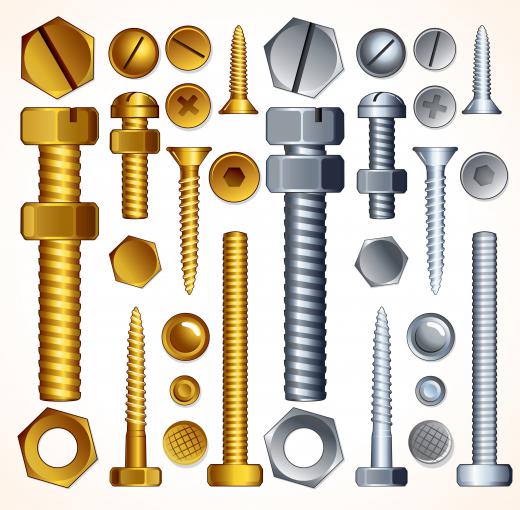
Various nuts, bolts and screws. -
![Most screws with a V-shaped thread design are cut at a 60 degree angle to one another.]() By: BocaMost screws with a V-shaped thread design are cut at a 60 degree angle to one another.
By: BocaMost screws with a V-shaped thread design are cut at a 60 degree angle to one another.


Discuss this Article
Post your comments