
At AllThingsNature, we're committed to delivering accurate, trustworthy information. Our expert-authored content is rigorously fact-checked and sourced from credible authorities. Discover how we uphold the highest standards in providing you with reliable knowledge.
What is a Supervolcano?
 Michael Anissimov
Michael Anissimov
Michael Anissimov
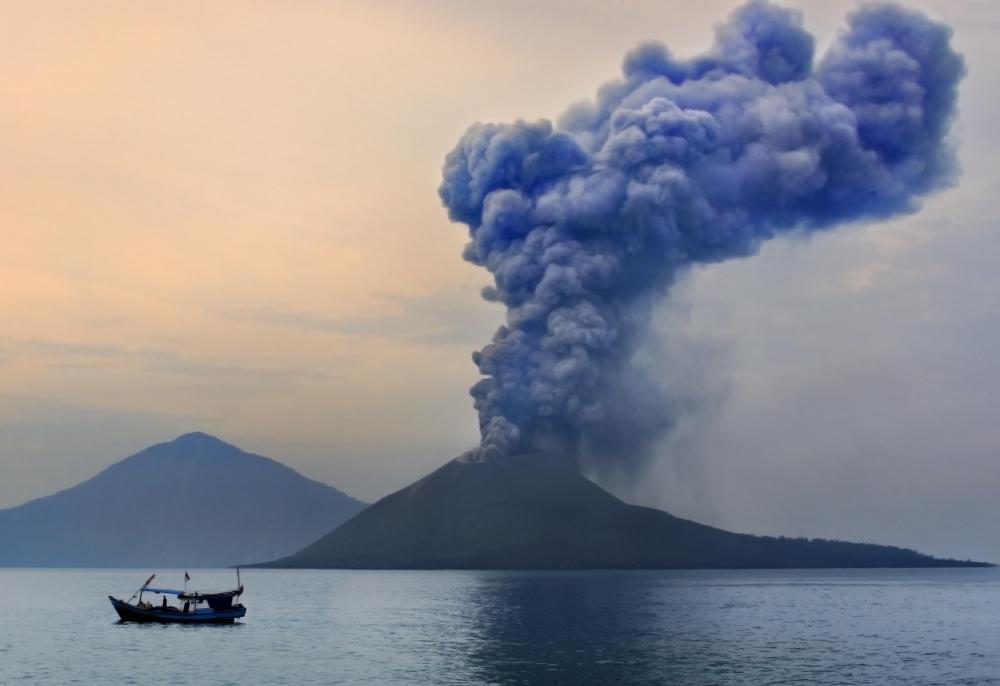
A supervolcano is defined as a volcano that ejects more than a trillion tons of material when it erupts. When one explodes, it can cover an entire continent in ash. This type of explosion is about 30 times stronger than the strongest volcanic eruption in recent history, which occurred at Krakatoa.
The last time a supervolcano exploded was at Toba in Sumatra around 71,000 years ago. Ash blotted out the sun's rays, and humanity likely came close to extinction. Anthropologists estimate that only about 5,000 humans survived to reproduce in the aftermath of this event.

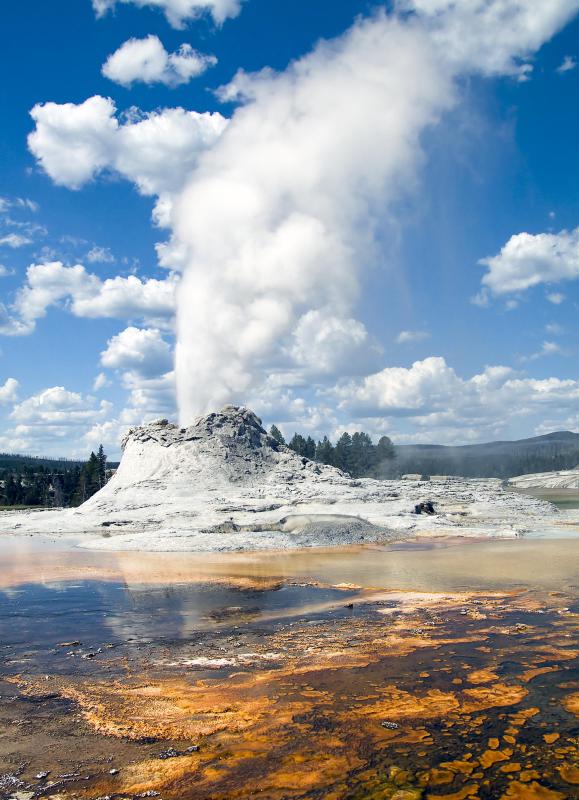
Another famous one is located directly underneath Yellowstone National Park, in the US. The caldera, a depression on top of the volcano, is 25 to 31 miles (40 to 50 km) long, about 12.4 miles (20 km) wide and about 6.2 miles (10 km) thick. It is so large that it is visible from space. This volcano is thought to explode about once every 600,000 years, but it last exploded more than 630,000 years ago.

A supervolcano will send hundreds of cubic miles (where about 240 cubic miles is equal to 1,000 cubic km) of ash into the atmosphere, changing the climate for hundreds to thousands of years. When Yellowstone last exploded, a pack of fossilized rhinos was discovered 621 miles (1,000 km) away from the blast zone, where they choked to death underneath the heavy ash. These massive volcanoes are the most powerful known destructive force on the planet, and only asteroids or other cosmic events are potentially powerful enough to exceed their magnitude.

The difference between regular volcanoes and supervolcanoes is in the way the magma underneath each comes to the surface. In a normal volcano, a thin magma chamber leads to a towering cone, with a relatively thin layer of rock shielding it from the surface. When pressure underneath builds up sufficiently, the magma is shot upwards.
In a supervolcano, magma comes up close to the surface, but a large mass of rock prevents it from breaking free. This rock forms the top of a large depression called a caldera. Over hundreds of thousands of years, magma from beneath builds up in a huge lake of tremendous pressure immediately under the caldera. When this pressure reaches a critical threshold, it blasts the entire thing sky-high, ejecting huge amounts of molten lava.
Frequently Asked Questions
What defines a supervolcano, and how does it differ from a regular volcano?

A supervolcano is distinguished by its ability to produce an eruption with a Volcanic Explosivity Index (VEI) of 8, the highest on the scale. This means it can eject more than 1,000 cubic kilometers of material, enough to cause catastrophic changes to the environment and climate. In contrast, regular volcanoes have smaller eruptions and less overall impact.
How many supervolcanoes exist in the world, and where are they located?

There are about a dozen known supervolcanoes globally. Notable examples include Yellowstone in the United States, Toba in Indonesia, and Taupo in New Zealand. These geological giants are often found at plate boundaries or over hotspots where the Earth's crust is thin, allowing massive magma chambers to form.
What are the potential global effects of a supervolcano eruption?
A supervolcano eruption could lead to a 'volcanic winter,' as the massive amount of ash and sulfur dioxide released into the atmosphere reflects sunlight and lowers global temperatures. According to the US Geological Survey, such an event could disrupt agriculture, leading to food shortages, and affect air travel and health due to ash fallout.
How often do supervolcanic eruptions occur?
Supervolcanic eruptions are rare, occurring approximately every 100,000 years. The last known supervolcanic eruption was the Oruanui eruption of the Taupo Volcano about 26,500 years ago. Their infrequency makes them difficult to predict, but their impacts are profound, shaping the planet's landscape and climate.
Can we predict when a supervolcano will erupt?
Predicting a supervolcano eruption is challenging due to their rarity and the long timescales involved. However, scientists monitor signs like seismic activity, ground deformation, and gas emissions. While these indicators can provide warnings, accurately forecasting the timing of such an event remains elusive.
What measures can be taken to prepare for a supervolcano eruption?
Preparation for a supervolcano eruption involves global cooperation in disaster planning, food security strategies, and public education on emergency response. Governments and organizations work to improve monitoring systems to provide as much advance warning as possible, though the sheer scale of a supervolcano's impact makes mitigation efforts complex and extensive.
Michael Anissimov
Michael is a longtime AllThingsNature contributor who specializes in topics relating to paleontology, physics, biology, astronomy, chemistry, and futurism. In addition to being an avid blogger, Michael is particularly passionate about stem cell research, regenerative medicine, and life extension therapies. He has also worked for the Methuselah Foundation, the Singularity Institute for Artificial Intelligence, and the Lifeboat Foundation.
Learn more...
Michael Anissimov
Michael is a longtime AllThingsNature contributor who specializes in topics relating to paleontology, physics, biology, astronomy, chemistry, and futurism. In addition to being an avid blogger, Michael is particularly passionate about stem cell research, regenerative medicine, and life extension therapies. He has also worked for the Methuselah Foundation, the Singularity Institute for Artificial Intelligence, and the Lifeboat Foundation.
Learn more...AS FEATURED ON:
AS FEATURED ON:









-
![A massive supervolcano rests beneath Yellowstone National Park.]() By: Kenneth KeiferA massive supervolcano rests beneath Yellowstone National Park.
By: Kenneth KeiferA massive supervolcano rests beneath Yellowstone National Park. -
![The prehistoric Toba supervolcano eruption nearly extinquished the human species.]() By: Denis TopalThe prehistoric Toba supervolcano eruption nearly extinquished the human species.
By: Denis TopalThe prehistoric Toba supervolcano eruption nearly extinquished the human species. -
![A supervolcano ejects more than a trillion tons of material during eruption.]() By: nicolasdumeigeA supervolcano ejects more than a trillion tons of material during eruption.
By: nicolasdumeigeA supervolcano ejects more than a trillion tons of material during eruption. -
![The volcanic eruption at Krakatoa in 1883 dwindles in comparison with a supervolcano's potential.]() By: Byelikova OksanaThe volcanic eruption at Krakatoa in 1883 dwindles in comparison with a supervolcano's potential.
By: Byelikova OksanaThe volcanic eruption at Krakatoa in 1883 dwindles in comparison with a supervolcano's potential. -
![Yellowstone has a volcanic site just north of Yellowstone Lake.]() By: DaveYellowstone has a volcanic site just north of Yellowstone Lake.
By: DaveYellowstone has a volcanic site just north of Yellowstone Lake.


Discussion Comments
I have been studying Yellowstone and the reports have come back that there is activity happening down under the caldera, but not nearly enough to blow the whole thing off. However, I do say this caldera is made up of lots of volcanoes but all are connected to the same magma chamber and this pressure could set off one of the smaller volcanoes, which could create a chain reaction which will set off all of them (this being the supervolcano) but nothing is going to happen in our life time. I'm only 20, but there is nothing to worry about for at least another 200 years.
The volcano at Yellowstone would completely mess up all of America and bits of Canada. It would get metres of ashfall 100's of Kilometres from where it erupted and at least 1cm of ash (which is more than enough to stop airports etc) but it will affect the whole world, blotting out the sun for a long, long time. It might even bring us back down to the 5000 people we had 70,000 years back.
You will be safe if your are in brainerd mn and up and east.
Volcanoes are cool.
it's possible the volcano in yellowstone could blow up at the time when we least expect it, but let's pray that it won't blow up for another 1000 years.
yes but it could blow at any time so anyone who has given a timescale is totally wrong, as it could explode in weeks or perhaps in millions of years. That's how unpredictable volcanoes are, and an explosion could send ash all the way around the globe, blocking out light so everyone would be affected. Yes, this could happen. Krakatoa, which wasn't a super volcano, did this.
The biggest super volcano is yellowstone. Even with that it will not cover the earth with ash, at most (and with the slightest chance) it will cover the continent.
Yes, the ash will turn us into a mini ice age because it is so light that it will stay up in the air, blocking most of the suns rays that heat us.
Also, the vulcanologists at Yellowstone say that it will erupt in, give or take, 10,000 years. No one can ever predict when a volcano is going to erupt. Yes they can come close but it's not going to be that soon.
I heard that it would explode in about 500-1,000 years, so even though I'm 12, it won't happen in my lifetime. Most people in the country, and maybe even parts or most of the world will probably die.
I find all of this very interesting. Adelaide Australia had a 3.9 earthquake last night. I remember feeling a tremor back in the 80's but this one woke the whole house up. This volcano could seriously create a blanket of ash over the world?
Apparently, scientists are saying it will blow in the next decade. There's been over 500 earthquakes reported from last week and they're detecting high pressures from under the surface.
if you live in minnesota you will for sure die a horrible death.
While I'm sure the US Geological Survey and related agencies are watching the Yellowstone Caldera/Super-volcano, I'm sure that when it goes, most of the Rockies and Great Plains are toast, literally.
I can remember my Dad telling me about how one of his bosses was killed in the 1959 quake in Yellowstone, by a flood coming down the river valley. My son visited in the summer of 2009 and said he could feel the heat and felt the earth shake when the geysers erupted.
It could blow at any time and when it does it will affect the whole world, it not with the sheer blast and pyroclastic flow, then with the ash fall that happens. This then poisons water supplies and crops grown, not to mention the animals as well.
This then puts strain on the rest of the world, by not getting food transported. Furthermore the ash fall mixed with water will make roofs collapse and when breathed in, it creates a sort of cement in your lungs which will kill you.
The ash also creates acidic rain, making sure crops can't grow on top of it. this then leads to global cooling, famine and generally, the global economy will fail.
It depends where it is, no. 1.
when will it blow and will i get hit if i live in minnesota?
Post your comments