
At DelightedCooking, we're committed to delivering accurate, trustworthy information. Our expert-authored content is rigorously fact-checked and sourced from credible authorities. Discover how we uphold the highest standards in providing you with reliable knowledge.
What is a Sunchoke? Unveiling the Nutritious and Versatile Jerusalem Artichoke

Discover the sunchoke, a versatile tuber that's carving its niche in culinary circles. Native to North America and a staple in indigenous diets long before European settlers arrived, the sunchoke, also known as the Jerusalem artichoke, is not an artichoke at all. According to the Agricultural Marketing Resource Center, it belongs to the Asteraceae family, akin to sunflowers (AgMRC, 2023). With its nutty flavor and satisfying crunch, the sunchoke is gaining popularity for its dietary fiber content, particularly inulin, which supports gut health (USDA, 2023). Whether you're looking to enhance your salads with a raw, crunchy twist or seeking a heartier option like roasted or mashed sunchokes, this root vegetable offers a nutritious and delicious alternative to traditional tubers.
Cultivation

According to historical reports, Native Americans planted and harvested sunchokes for centuries before colonists arrived. While the plants are hardy and relatively easy to grow, they must be cultivated in the appropriate soil in order to result in a high-quality edible tuber. Plants rooted in less than fertile soil often produce unpalatable tubers and can run wild like weeds.

When in bloom, the sunchoke (Helianthus tuberosus) looks much like a miniature sunflower. It is related to the aster and usually has bright yellow flowers. To harvest the edible tuber, however, gardeners must dig up the bulbous root in spring, before the plant has blossomed.
Nutritional Value
While a good source of carbohydrates, the sunchoke stores inulin rather than insulin as its starch for extra energy during winter months. This can be useful, especially for people who limit glucose in their diets, because the inulin breaks down into fructose rather than glucose during digestion. This unique quality can make the tuber a good substitute for other starchy foods like potatoes, particularly for diabetics. Some people experience mild gastrointestinal bloating due to this fructose, however, so some proponents suggest introducing sunchokes to the diet gradually, beginning with small portions.

These vitamin-rich roots are high in thiamin, niacin, and iron. They also contain relatively large amounts of potassium and Vitamin C, while being low in calories. The tubers contain no fat or cholesterol, and only small amounts of sodium. A 1 cup (150 gram) serving of sunchokes contains approximately 110 calories, 3 grams of protein, and 2.4 grams of dietary fiber.
Choosing and Storing Sunchokes

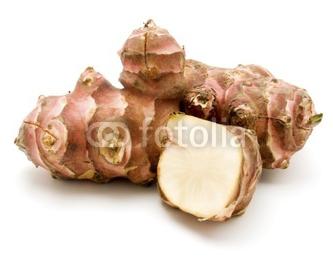
When buying sunchokes, look for those that are smooth and succulent, not dry or wrinkled. With an exterior that is knobby and usually tan in color, they look much like ginger root and can be selected similarly. The unpeeled roots should be refrigerated, and will remain fresh for about a week.
Preparation
There are many recipes that showcase this tuber on its own or with other ingredients. Eaten raw, it is crunchy and very slightly juicy, like water chestnuts or jicama, and is often a welcome addition to salads, crudite platters, and fresh salsas. When cooked, it may be simply tossed with oil and salt and roasted, or boiled and mashed like potatoes. Sunchoke puree is another popular dish, and the tuber is a favorite soup addition, particularly in Europe.

The tuber has been embraced by the home cook and famous chefs for its unique flavor, and as part of a culinary movement to eat locally grown, seasonal ingredients. Many recipes that don't specifically call for a sunchoke may benefit from the addition of the root's texture and flavor. Its taste is frequently described as something between an artichoke heart and a sunflower seed. The vegetable is also popular among vegetarian and vegan cooks looking for variety.
AS FEATURED ON:
AS FEATURED ON:


-
![Sunchokes or Jerusalem artichokes are edible tubers.]() By: Only FabrizioSunchokes or Jerusalem artichokes are edible tubers.
By: Only FabrizioSunchokes or Jerusalem artichokes are edible tubers. -
![Basket of Sunchokes.]() By: Scott DexterBasket of Sunchokes.
By: Scott DexterBasket of Sunchokes. -
![Sunchokes have a sweet flavor and crunchy texture.]() By: helenedevunSunchokes have a sweet flavor and crunchy texture.
By: helenedevunSunchokes have a sweet flavor and crunchy texture. -
![Some people experience mild bloating after consuming sunchokes.]() By: michaeljungSome people experience mild bloating after consuming sunchokes.
By: michaeljungSome people experience mild bloating after consuming sunchokes. -
![Native Americans used to cultivate sunchoke before the arrival of Europeans.]() By: namwar69Native Americans used to cultivate sunchoke before the arrival of Europeans.
By: namwar69Native Americans used to cultivate sunchoke before the arrival of Europeans.




Discussion Comments
When is a good time of the year to plant? How far apart do they tubers need to be planted and how deep in the soil? Do they require any special fertilizer?
I had the plant for three years but did not know it was called a sunchoke until I planted it at my work place and a chinese coworker was telling me about this. I have high blood pressure and a mother who is diabetic, so I'm going to see a doctor and ask her what she thinks of this, if it's going to help me and my mother.
There are several varieties. One, a vigorous bloomer, has many yellow flowers that smell much like chocolate, yummy! The tubers are white or light skinned and regrettably taste somewhat like dirt.
Another variety, which does not flower so readily nor do the flowers smell much like chocolate and which has purple or red skinned tubers has a much better taste, slightly nutty when raw. All the plants grow five to eight feet tall, depending on soil. Very hardy to at least zone 4, some may survive zone 3.
looks very much like ginger root, tannish and misshapen, with little points.
As A diabetic, I would like to try them, but don't know what they look like. where can I find a photo of a sunchoke?
hello
According to Wikipedia
"unlike most tubers, but in common with other members of the Asteraceae (including the artichoke), the tubers store the carbohydrate inulin (not to be confused with insulin) instead of starch. For this reason, Jerusalem artichoke tubers are an important source of fructose for industry. The crop yields are high, typically 16–20 tonnes/ha for tubers, and 18–28 tonnes/ha green weight for foliage. Jerusalem artichoke also has a great deal of unused potential as a producer of ethanol for fuel, using inulin-adapted strains of yeast for fermentation."
According to a NC State leaflet
"The edible portion of this member of the sunflower family is the tuber or swollen end of an underground stem, which in some respects resembles a potato. However, unlike most starchy vegetables, the principal storage carbohydrate in sunchokes immediately after harvest is inulin rather than starch. When consumed the inulin is converted in the digestive tract to fructose rather than glucose, which can be tolerated by diabetics."
Dr. David Ahrend D.C.
Morgantown WV
Post your comments