
At HomeQuestionsAnswered, we're committed to delivering accurate, trustworthy information. Our expert-authored content is rigorously fact-checked and sourced from credible authorities. Discover how we uphold the highest standards in providing you with reliable knowledge.
What is a Stilt House?
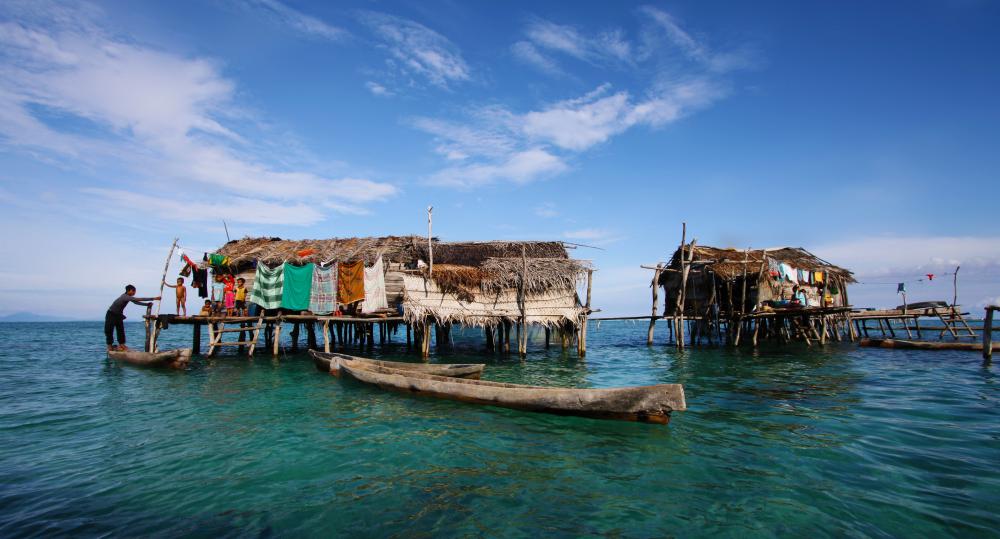
A stilt house is a raised structure that is most commonly built above water, although it also may be built over dirt or sand. It is sometimes called a pile dwelling because it is supported by large stakes, known as piles, that are driven directly into the water or into the shoreline. These structures typically rest 10 - 12 feet (3.5 - 4 meters) off the ground to allow for high tide, and are designed to avoid flooding and water damage. Created from bamboo or other water-resistant timber and reinforced with deck boards and sometimes concrete, stilt houses can be found throughout the world.
This type of house must be built on land or water that is free from rocks or metallic debris. When possible, deep holes are dug and are filled with a concrete mixture to offer additional weight and reinforcement before sturdy posts are added. If digging holes is impossible because of water, then the posts are sharpened on one side and erected, often by a team of men, during low or medium tide. When the necessary posts are in place, a base is built by laying deck boards on top of the posts to create more support. This combination of posts and base forms the "stilts," and the rest of the house can be completed on top of the stilts as desired.

Primarily regarded for its protection from flooding, there are many additional advantages to the stilt house. It is relatively easy to construct, and the design makes use of land that might be otherwise unsuitable for housing. The elevation serves to keep out vermin and offers protection from animals. The space beneath the house may be used for storage, in some cases, and some families can even fish from the front porch.

The stilt house dates back to prehistoric times, but it is still commonly found around the globe, especially in places prone to flooding. In Indonesia, Singapore, and other countries, "kelong" are built for fishing, but may double as offshore housing. The "Nipa hut" is the primary type of housing found in the Philippines, and a similar type of structure is also popular in Papua New Guinea. Thai stilt houses are often built above freshwater, and the "Palafito" is found in the tropical river valleys of South America. These houses are also gaining popularity in the United States, particularly along the Gulf Coast, where the threat of hurricanes is severe.
AS FEATURED ON:
AS FEATURED ON:


-
![Stilt houses are designed to avoid flooding and accommodate high tide.]() By: abstrandStilt houses are designed to avoid flooding and accommodate high tide.
By: abstrandStilt houses are designed to avoid flooding and accommodate high tide. -
![Stilt houses are popular throughout the world, sometimes built to be used for fishing.]() By: didoiStilt houses are popular throughout the world, sometimes built to be used for fishing.
By: didoiStilt houses are popular throughout the world, sometimes built to be used for fishing. -
![Stilt houses are sometimes built on land.]() By: simon gurneyStilt houses are sometimes built on land.
By: simon gurneyStilt houses are sometimes built on land. -
![Stilt houses are designed to resist storm surges caused by hurricanes.]() By: razlomovStilt houses are designed to resist storm surges caused by hurricanes.
By: razlomovStilt houses are designed to resist storm surges caused by hurricanes.



Discussion Comments
@ Babalaas- I saw a television special about Eco friendly homes in the Netherlands. These weren't your typical beach houses on stilts, rather they were floating homes that architects attached to concrete pylons. The houses were free to float up and down these pylons at the tidal surge came and went. These homes are being built as a remedy to rising sea levels that are starting to affect the Netherlands. The design is incredible. I recommend an internet search for pictures.
I love contemporary design, and I have noticed that many contemporary homes are partially or completely perched on stilts. Why this is I am not sure, but I think it has to do with having as little impact on the land as possible. These homes can use smaller plots of land that may not be suitable for a conventional home. They also do not require the removal of old growth trees or natural landscape features.
One stilt home that left a particularly clear impression was a home built on the edge of a drop-off (I want to say it was in Boston). The home has two huge steel pillars that run vertically through the middle of the house. The entire home slides over these pillars, and is held in place by a systems of steel cables, weights, and pulleys. The house is situated in a sort of cantilever balance at the edge of this steep hill, and none of the trees had to be cut down to build it. This is an example of ingenious stilt house design.
Stilt houses are common in parts of the United States. In fact, I used to live in a stilt house in Hawai'i. Stilt houses also work well away from shore.
In Hawai'i, home sites are almost always on a slope, tropical rains create torrential downpours, and flash flooding is a reality. A stilt home protects houses and personal property from all of these things. Stilt homes also eliminate the need for air conditioning, since wind can cool the home beneath the floor.
The home I grew up in was a beautiful custom home with a 17-foot ceiling, an open floor plan, and completely build site. On the mountain side of the build site, the home was about four feet off the ground, but on the ocean side, the home was about eight or nine feet from the ground. This allowed for natural drainage and extra storage (on pallets of course). The stilts also prevented the need for flood insurance since we were above the flood plain, and the torrential rains would run under the house, draining to the nearby gully. Building a stilt house has its benefits.
One of the more impressive archaeological finds in the 1990's is the sunken stilt village of "La Marmotta" in Lake Bracciano north of Rome, Italy.
This village, which had a peak population of around 400, seems to have been a major trading center in the prehistoric Mediterranean.
It was abandoned fairly rapidly, possibly because the bottom of the lake was sinking (it's a volcanic crater lake, and volcano crater floors often move.) Additional evidence of this is the fact that the lake level has risen 8 meters--but the outflow point has not changed.
The find is an excellent example of the usefulness of routine monitoring of construction sites for archaeological artifacts.
Post your comments