
At AllThingsNature, we're committed to delivering accurate, trustworthy information. Our expert-authored content is rigorously fact-checked and sourced from credible authorities. Discover how we uphold the highest standards in providing you with reliable knowledge.
What is a Starfish?
 Mary McMahon
Mary McMahon
Mary McMahon
Starfish, or sea stars, are echinoderms in the class Asteroidea, characterized by their distinctive bodies, which look rather like stars. Despite what the familiar name suggests, they are not fish. Many people have a soft spot for starfish, thanks to their unusual shape and the bright array of colors that these marine creatures come in. They are also popular with people since they are easy to see and observe, preferring the intertidal zone near the seashore. People who want to see these creatures in person can visit a tide pool near the ocean, which should yield a broad assortment.
There are around 1,800 species of starfish, ranging from the sunflower star, a species with a multitude of arms, to the bat star, one with five connected arms that looks a little like a pentagonal coaster. They come in an array of colors, shapes, and sizes, and they eat a wide assortment of marine life. These creatures are also popular food sources for many marine animals and some humans as well.

The physical structure of a starfish is quite interesting. They exhibit radial symmetry, meaning that they are symmetrical around a central axis, rather than bilaterial symmetry, a form of biological symmetry that may be more familiar to most people, given that many organisms including humans are bilaterally symmetrical, having two distinct halves. Starfish are also capable of regenerating arms that have broken off, and in some cases a new one can generate from a severed arm. Some species use this trait as a defensive tactic, dropping their arms when threatened.
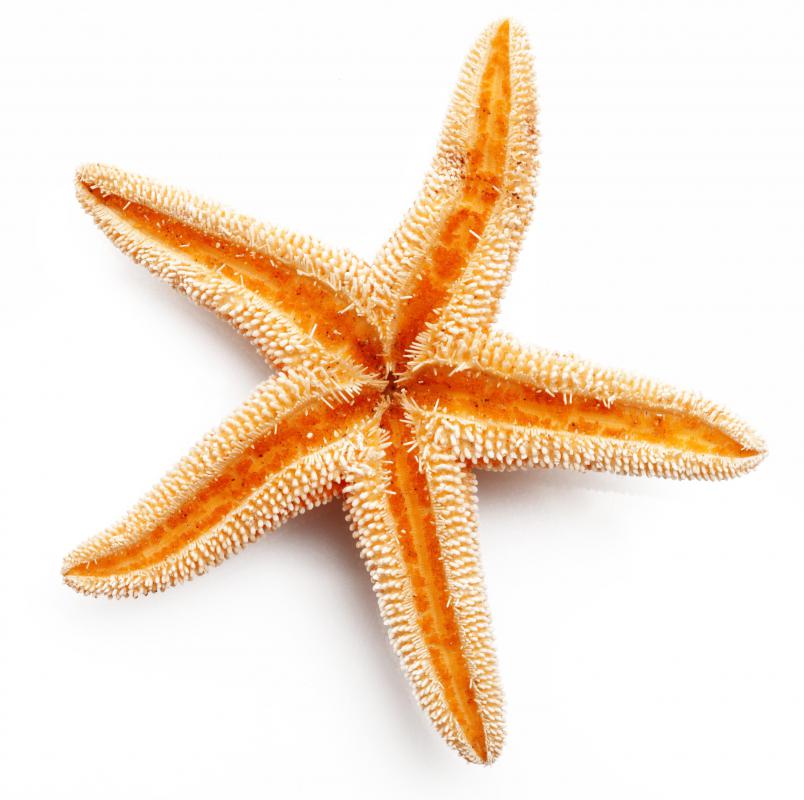
The body of a starfish is covered in flexible protective plates. Anyone who has ever touched one may have noticed that the animals feel slightly leathery. The bottom is covered in tiny tube feet that the animals use to move around and to hunt. The tube feet also help starfish glue themselves to rock, another way to protect the animals from predators.
As if this wasn't enough, the starfish has a few tricks up its sleeve. These animals are capable of everting their stomachs, which means that they can literally turn their stomachs inside out to wrap them around prey. This biological adaptation allows them to eat animals much larger than them, and some people find it quite fascinating to watch.
Starfish species range in size from around 0.5 inch (a little over 1 centimeter) to 3 feet (1 meter) in diameter, and they can have between five and 25 arms. Because they are such well-known sea creatures, they are commonly on display at aquariums and touch pools, for the benefit of those who cannot get to the ocean.
Frequently Asked Questions
What exactly is a starfish?
A starfish, or sea star, is a marine invertebrate belonging to the class Asteroidea. Contrary to popular belief, they are not fish but echinoderms, closely related to sea urchins and sand dollars. Starfish typically have a central disc and five arms, although some species can have more. They have a unique water vascular system for movement and feeding.
How do starfish move?
Starfish move using hundreds of tiny tube feet located on their underside. These feet are filled with sea water pumped through their water vascular system, allowing them to grip surfaces and move in a coordinated manner. This system is not only crucial for locomotion but also for feeding and respiration.
Can starfish regenerate lost limbs?
Yes, starfish are renowned for their regenerative abilities. If an arm is lost, a starfish can regrow it over time, a process that can take several months to years, depending on the species and environmental conditions. Some species can even regenerate an entire new starfish from a single severed limb, provided it contains part of the central disc.
What do starfish eat?
Starfish are mostly carnivorous and have a diverse diet that includes mollusks like clams and oysters, as well as other invertebrates. They have a unique feeding mechanism where they can extend their stomachs outside their body to digest food externally before pulling it back inside to complete digestion. This allows them to tackle prey larger than their mouths.
How do starfish reproduce?
Starfish can reproduce both sexually and asexually. In sexual reproduction, they release eggs and sperm into the water, where fertilization occurs. Some species also practice brooding, where eggs are fertilized and developed on or near the parent's body. Asexually, starfish can reproduce through regeneration, where a new individual grows from a part of the parent.
Are starfish important to their ecosystems?
Starfish play a critical role in their ecosystems as both predators and prey. They help maintain the balance of marine life by controlling the population of their prey species. Their predation can also influence the distribution and abundance of other organisms, making them keystone species in some environments. Their presence indicates a healthy, biodiverse ecosystem.
Mary McMahon
Ever since she began contributing to the site several years ago, Mary has embraced the exciting challenge of being a AllThingsNature researcher and writer. Mary has a liberal arts degree from Goddard College and spends her free time reading, cooking, and exploring the great outdoors.
Learn more...
Mary McMahon
Ever since she began contributing to the site several years ago, Mary has embraced the exciting challenge of being a AllThingsNature researcher and writer. Mary has a liberal arts degree from Goddard College and spends her free time reading, cooking, and exploring the great outdoors.
Learn more...AS FEATURED ON:
AS FEATURED ON:









-
![Starfish are invertebrates with multiple radiating arms.]() By: Giuseppe PorzaniStarfish are invertebrates with multiple radiating arms.
By: Giuseppe PorzaniStarfish are invertebrates with multiple radiating arms.
Discussion Comments
@anon177537 - National Geographic had a video about starfish facts and I think the only ways they communicate are through a sense of touch (like when something swims near them, they can sense the water moving).
Starfish also notice the signals of other starfish who are ready to reproduce and they gather in large groups at this time.
For a creature without brains or blood, they are pretty interesting as well as beautiful. Except when they turn their stomachs outside their body to catch their prey. I've never seen this in real life - maybe one day (or not)!
i need to know how they communicate.
They are called Sea Stars. They are not fish. They are invertebrates, echinoderms.
They have no blood, theirs is water. They have tubular feet and many "arms". Reproduction and eating are also completely different.
Post your comments