
At TheHealthBoard, we're committed to delivering accurate, trustworthy information. Our expert-authored content is rigorously fact-checked and sourced from credible authorities. Discover how we uphold the highest standards in providing you with reliable knowledge.
What is a Spinal Schwannoma?
Spinal schwannoma is a type of slow-growing tumor that appears on the nerve sheath. Shwannomas make up between a quarter to a third of all spinal tumors. In most cases, these tumors appear as isolated lesions, but some patients experience multiple schwannomas of the spine. It is difficult to determine which patients may develop spinal schwannoma, as there is no clear cause for this condition. The tumors can compress nerves, causing pain and loss of function—they are usually benign, but still often require surgery.
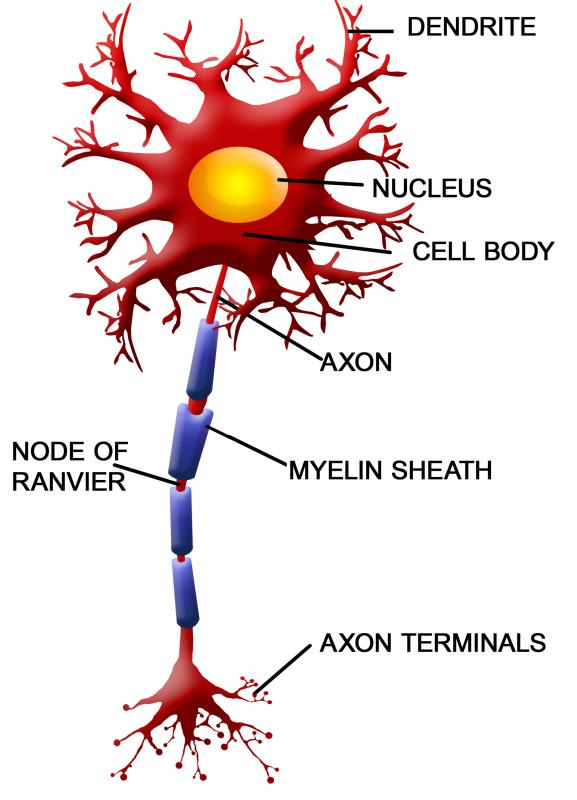
This condition impacts Schwann cells in the peripheral nervous system. These cells form the myelin sheath that covers nerve cells outside of the brain. When functioning normally, Schwann cells protect the nerve cells and help ensure fidelity in impulse conduction. Spinal schwannoma is considered to be an intradural, soft-tissue tumor.

It is often difficult to pinpoint the cause of a spinal schwannoma. Some research points to environmental radiation exposure or radiation treatment as a potential cause for this condition. This condition affects women slightly more often than men. Tumors usually appear in middle age. Those who experience schwannoma at younger ages often have genetic predispositions to neural lesions.

The symptoms of spinal schwannoma typically develop gradually since it may take months or years for these tumors to grow. Early cases often have no symptoms. Once the lesion has grown to a point where it causes pressure on a nerve, a patient may experience pain, numbness, or weakness. Many patients suffer from incontinence or other loss of muscle control. These symptoms usually diminish or reverse completely after treatment.

Comprehensive testing is required to diagnose a spinal schwannoma. The evaluation usually begins with a doctor measuring the patient's vital statistics and reflexes. If the doctor suspects a tumor, he or she will order a Magnetic Resonance Imaging (MRI) scan to ascertain its size and location. This procedure is followed by a biopsy to determine if the lesion is cancerous.

Surgery is the recommended treatment in most cases of spinal schwannoma. Although the tumors are non-cancerous, they can cause significant disruption to sufferers. If a biopsy reveals that the schwannoma is malignant, the surgeon will remove healthy tissue in the surrounding area in an attempt to keep the cancer from spreading. Surgeons may have difficulty completely removing the tumors, and the surgery may result in nerve damage. In some cases, the schwannoma may regrow after it has been removed.
AS FEATURED ON:
AS FEATURED ON:


-
![Spinal schwannomas apear on the nerve sheath.]() By: Balint RaduSpinal schwannomas apear on the nerve sheath.
By: Balint RaduSpinal schwannomas apear on the nerve sheath. -
![There is no clear cause for spinal shwannoma.]() By: Kirsty PargeterThere is no clear cause for spinal shwannoma.
By: Kirsty PargeterThere is no clear cause for spinal shwannoma. -
![If a biopsy reveals that the schwannoma is malignant, the surgeon will remove healthy tissue in the surrounding area.]() By: nandyphotosIf a biopsy reveals that the schwannoma is malignant, the surgeon will remove healthy tissue in the surrounding area.
By: nandyphotosIf a biopsy reveals that the schwannoma is malignant, the surgeon will remove healthy tissue in the surrounding area. -
![Early cases of spinal schwannoma often have no symptoms.]() By: Syda ProductionsEarly cases of spinal schwannoma often have no symptoms.
By: Syda ProductionsEarly cases of spinal schwannoma often have no symptoms. -
![Testing a patient's reflexes is an important part of diagnosing spinal schwannoma.]() By: Photographee.euTesting a patient's reflexes is an important part of diagnosing spinal schwannoma.
By: Photographee.euTesting a patient's reflexes is an important part of diagnosing spinal schwannoma. -
![An MRI help diagnose a spinal schwannoma.]() By: EPSTOCKAn MRI help diagnose a spinal schwannoma.
By: EPSTOCKAn MRI help diagnose a spinal schwannoma. -
![Patients with a spinal schwannoma may experience urinary incontinence.]() By: Photographee.euPatients with a spinal schwannoma may experience urinary incontinence.
By: Photographee.euPatients with a spinal schwannoma may experience urinary incontinence. -
![Radiation treatment may be a cause of spinal schwannoma.]() By: jovannigRadiation treatment may be a cause of spinal schwannoma.
By: jovannigRadiation treatment may be a cause of spinal schwannoma.





Discussion Comments
My sister and I both have a lot of spine issues. She has a 15 mm bulge, and a very large schwannoma but the docotr said if he removes it she could be paralyzed. I have a lot of osteo and rheumatoid arthritis. About to have a lumbar nerve stimulator. Would that help her, too?
@ddljohn-- I'm a nurse and my husband is a surgeon. As far as I know, no, a spinal schwannoma (or neurofibroma) may remain at a constant size for a long time but the issue is that it's not predictable. So it may grow two millimeters per year for two years, stop growing completely for another three years and then suddenly grow ten millimeters in one year.
So the answer to your question is, it depends. Doctors have to keep an eye on it so the patient has to go in for regular MRIs to see how it's doing.
Now, if the patient is experiencing problems because of the schwannoma like pain or numbness, doctors may decide to operate even though it's benign. It all depends on the specific situation.
It's also difficult for doctors I think because spinal schwannomas are rare. There are not that many doctors who have experience with these kind of tumors.
So does a benign schwannoma require surgery?
Do all schwannomas grow or are there some that remain the same size? Because if it's benign and doesn't grow or cause any complications, it doesn't need to be removed right?
My instructor showed us a short video of a malignant spinal schwannoma surgery in class. It was unbelievable, this person had a huge schwannoma in a nerve sheath, it was like two fists put together. In the surgery, they basically cut open the nerve sheath, removed the schwannoma and stitched the nerve back up. So there was no damage done to the nerve and it was a relatively easy surgery.
It's just unbelievable how a tumor so big can develop inside a nerve. And the nerve was so stretched out because of the tumor, it almost looked it was going to snap. The patient would have probably had some serious problems had it not been removed when it was.
A biopsy should never be done. the tumor should be monitored by mri's or removed.
Post your comments