
At Sports&Hobbies, we're committed to delivering accurate, trustworthy information. Our expert-authored content is rigorously fact-checked and sourced from credible authorities. Discover how we uphold the highest standards in providing you with reliable knowledge.
What is a Snorkel?
A snorkel is a breathing tube that allows a swimmer who is swimming along the surface of the water to breathe normally, even though the swimmer's face is just below the surface, peering down into the water.
In the past, a traditional design for snorkels was a U-shaped tube with one side of the U much longer than the other. The short end had a mouthpiece, while the long end extended above the surface of the water like the periscope of a submarine.
Today's designs are much more exotic and also more comfortable. The U-shape at the bottom has been straightened with a mouthpiece that simply juts off the main body. Below the mouthpiece is a purge valve used for clearing the tube of water.
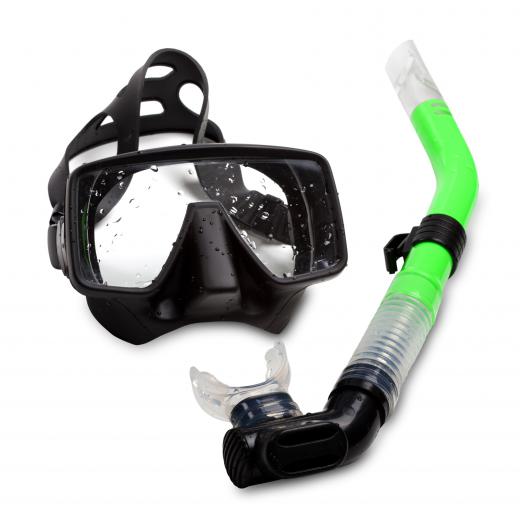
Innovation has also taken place in the neck of the snorkel. Some have a divided tube with an aortic valve to separate dead air, or exhaled air, from fresh air. The exhaled air travels out through one tube, while fresh air is drawn in through the other. Both tubes are embedded in a single neck.
Various cap designs can discourage surface water from entering into the snorkel, but unless you have a dry snorkel, you'll occasionally have to purge the breathing tube of water. This is normally done by pushing a burst of air through the tube to clear it, though some models have purge valves that can be manually activated to get rid of the water.
In short, there are three basic snorkel designs:
- Purge snorkels, which easily fill with water and need to be purged often while in use.
- Semi-dry snorkels, which have a deflector cap designed to discourage water from entering, but will still need occasional purging.
- Dry snorkels, which have a cap design that automatically closes when submerged, then opens when it breaks surface. These should not need purging.
Innovations don't stop with purging. If you'd like to listen to some tunes while snorkeling, there's even model with a built-in FM radio receiver that transmits sound directly to the inner ear.

The name "snorkel" comes from a breathing tube device used on World War II U-boats to funnel air below the surface to feed the submarines. But history finds mention of breathing tubes as far back as 4th century B.C. in the works of Aristotle; 320 A.D. China from Pao Plw Tzu; and in Leonardo da Vinci's notebooks from 1488 that include illustrations of the now familiar U-shape. So while the innovations we enjoy today are modern, the desire to breathe under the sea is clearly an ancient one.
AS FEATURED ON:
AS FEATURED ON:


-
![A typical snorkel and diving mask.]() By: BSANIA typical snorkel and diving mask.
By: BSANIA typical snorkel and diving mask. -
![Two girls having fun while snorkeling on vacation.]() By: Iuliia SokolovskaTwo girls having fun while snorkeling on vacation.
By: Iuliia SokolovskaTwo girls having fun while snorkeling on vacation. -
![Snorkelers in the Caribbean may see coral and other reef plants.]() By: deepwrecksSnorkelers in the Caribbean may see coral and other reef plants.
By: deepwrecksSnorkelers in the Caribbean may see coral and other reef plants. -
![Leonardo da Vinci's notebooks from 1488 include illustrations of the U-shape snorkel.]() By: JuulijsLeonardo da Vinci's notebooks from 1488 include illustrations of the U-shape snorkel.
By: JuulijsLeonardo da Vinci's notebooks from 1488 include illustrations of the U-shape snorkel. -
![Ancient Greek philosopher Aristotle wrote about breathing tubes.]() By: PanosAncient Greek philosopher Aristotle wrote about breathing tubes.
By: PanosAncient Greek philosopher Aristotle wrote about breathing tubes.


Discussion Comments
How important are snorkeling fins if you are going on a snorkeling expedition. This is the first time I will be doing this and my friend told me to save the room in my suitcase and not pack any fins. Are the fins something you really need, or would they just take up valuable space and I could get along OK without them?
We like to take an underwater camera with us when we snorkel. You can buy these disposable waterproof cameras pretty cheap and they make a great souvenir from your trip. I have been snorkeling many times, but still like to take a camera with me when I go. You never know what you are going to see, and the surroundings are always different no matter where you are.
I never knew they made snorkels with a built in radio. While this might be a nice feature for some, I would prefer the peace and quiet of the water and feel like music would detract from the experience.
I can see this feature being something my son would enjoy though. He likes to have music playing most of the time and for him, having music playing while he was snorkeling would probably enhance the experience rather than detract from it.
The first time I ever went snorkeling was when I went to Hawaii. I am not all that crazy about water but knew I didn't want to miss out on all the underwater sea life that I wouldn't be able to see above the water.
I went to the store and bought a cheap snorkel set because I didn't want to spend much money on this if I would never do it again. We took a snorkeling expedition and I was the last one off the boat and into the water because I was so nervous.
Once I put my head under the water and saw all the beautiful sea life and the bright colors I was hooked. I must have had a semi-dry snorkel because I had to purge quite often, but it was an absolutely wonderful experience.
@browncoat - You can use snorkels in deeper water though, if you are out there to swim with something. I've been swimming with dolphins and humpback whales and I used a snorkel each time. The whole point is to be able to see them when they are near the surface and they dive too quickly to be able to use scuba (since you can't really dive with scuba, you have to go up and down slowly to be safe).
I used to use snorkeling masks and fins in the ocean when I was a kid, even though we didn't live by a reef or anything special. Just to look at the anemones and the fish and even the seaweed. I actually think it would be pretty good for a kid who was nervous of the ocean, since it's easier to be brave when you can see what's under the surface.
I love snorkeling. It's so peaceful to just drift along watching the fish and other going's on under the water. I find it much less scary than scuba, both because you aren't having to rely on so much gear and because generally you aren't going to be in deep water. Snorkeling equipment is easy to master.
I don't use a special kind of snorkel though. Even though I like diving a bit to see the more interesting creatures. I find as long as you breath out sharply through the snorkel when you surface, expelling the water, you should be fine.
I really recommend it. It's my favorite kind of exercise because hours go by without realizing it when you've got a good spot in the ocean.
I had no idea that there were so many snorkel designs! My only snorkeling experience was with a cheap plastic one that my mom bought me when I was a kid.
It had the old U-shaped mouthpiece, and it attached to a pair of matching goggles on the side. I had to be careful not to submerge myself beneath the level of the snorkel at its top, or else I would take in water.
As long as I took a deep breath and held it before going under, this was easy. The air in my lungs acted as a float and kept my body near the surface. If I exhaled before going under, though, I would sink to the bottom.
I just got back from an extended trip to Hawaii. We visited both Maui and Oahu. I have to say, if you ever have the opportunity to go snorkeling, by all means, jump at the chance.
Of course, some places are more interesting than others, and the conditions can vary greatly. Nonetheless, there is something very intriguing about the whole experience.
Maybe it is about breathing underwater, or maybe it's instantly seeing this entire new world right when you drop your face below the water. Whatever it is, snorkeling is both intriguing and relaxing at the same time. I strongly recommend that you give it a try!
Post your comments