
At EasyTechJunkie, we're committed to delivering accurate, trustworthy information. Our expert-authored content is rigorously fact-checked and sourced from credible authorities. Discover how we uphold the highest standards in providing you with reliable knowledge.
What is a Sine Wave?
 Michael Anissimov
Michael Anissimov
Michael Anissimov
A sine wave, or sinusoid, is a mathematical construct (specifically a function) used to model and predict a variety of cyclic phenomena, including the rise and fall of tides, the oscillation of a spring, the incident light hitting the ground from the Sun over the course of a day, the intensity of a sound wave, and millions of other examples. This wave is usually the first function that students learn when studying pre-calculus (trigonometry). The most basic way of writing a sine function is f(x) = sinx, where "sin" means "sine," and x is the variable being operated on.
Practically everything in reality oscillates. All electromagnetic energy, including visible light, microwaves, radio waves, and x-rays, can be represented by a sine wave. At the lowest level, even matter oscillates like a wave, but for macroscopic objects, these oscillations are so minimal are to be impossible to measure. Sound waves can be represented as sine waves, and the up-and-down waves on an oscilloscope may be the most widely known representation of these waves. The study of sine and related functions is the most basic kind of higher (post-algebra) mathematics.
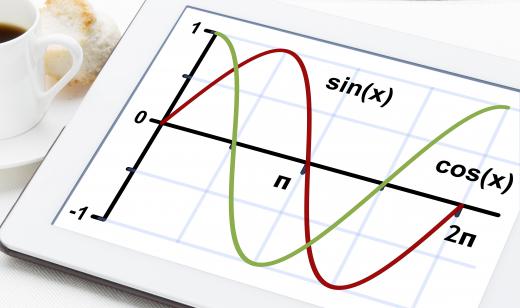
Besides appearing in sound waves, light waves, and ocean waves, the sine wave is also very important in electronics, as it can be used to model the intensity of an alternating current. The current of a direct current full-wave rectification system, used to convert AC into DC, can be modeled using an absolute value sine wave, where the wave is similar to a normal sine wave because the value always stays above the x-axis, but has twice as many peaks. Along with the sine wave is its cousin, the cosine wave, which is exactly the same except displaced to the right by half a cycle.

In 1822, French mathematician Joseph Fourier discovered that any wave could be modeled as a combination of different types of sine waves. This applies even to unusual waves like square waves and highly irregular waves like human speech. The discipline of reducing a complex wave to a combination of sine waves is called Fourier analysis, and is fundamental to many of the sciences, especially those involving sound and signals. Fourier analysis is central to signal processing and the analysis of time series, where seemingly random sets of data points are studied to elucidate a statistical trend. Fourier analysis is also used in probability theory, where it is used to prove the central limit theorem, which helps to explain why bell curves, or normal distributions, are ubiquitous in nature.
Michael Anissimov
Michael is a longtime EasyTechJunkie contributor who specializes in topics relating to paleontology, physics, biology, astronomy, chemistry, and futurism. In addition to being an avid blogger, Michael is particularly passionate about stem cell research, regenerative medicine, and life extension therapies. He has also worked for the Methuselah Foundation, the Singularity Institute for Artificial Intelligence, and the Lifeboat Foundation.
Learn more...
Michael Anissimov
Michael is a longtime EasyTechJunkie contributor who specializes in topics relating to paleontology, physics, biology, astronomy, chemistry, and futurism. In addition to being an avid blogger, Michael is particularly passionate about stem cell research, regenerative medicine, and life extension therapies. He has also worked for the Methuselah Foundation, the Singularity Institute for Artificial Intelligence, and the Lifeboat Foundation.
Learn more...AS FEATURED ON:
AS FEATURED ON:









-
![A sine wave is a mathematical function used to model and predict a variety of cyclic phenomena.]() By: MarekA sine wave is a mathematical function used to model and predict a variety of cyclic phenomena.
By: MarekA sine wave is a mathematical function used to model and predict a variety of cyclic phenomena. -
![Sine waves can be used to measure the incident lighting that hits the ground from the Sun over the course of a day.]() By: frentaSine waves can be used to measure the incident lighting that hits the ground from the Sun over the course of a day.
By: frentaSine waves can be used to measure the incident lighting that hits the ground from the Sun over the course of a day. -
![Sound waves are sine waves.]() By: itestroSound waves are sine waves.
By: itestroSound waves are sine waves. -
![An oscilloscope allows users to look at the changes in waves over time.]() By: motorlkaAn oscilloscope allows users to look at the changes in waves over time.
By: motorlkaAn oscilloscope allows users to look at the changes in waves over time.




Discussion Comments
Can anybody tell me how a change in oscillation alters the function of real-life sine waves like radio waves or light waves? I have a math paper due and I'm trying to wrap my head around this whole sine thing. Can anybody help out?
There is a: "A note about the definitions of "sine/cosine wave", "sinusoidal/co-sinusoidal signal” and the "simplest band limited signals"." Maybe that will help someone.
Post your comments