
At AllThingsNature, we're committed to delivering accurate, trustworthy information. Our expert-authored content is rigorously fact-checked and sourced from credible authorities. Discover how we uphold the highest standards in providing you with reliable knowledge.
What is a Sea Arch?
 Diane Goettel
Diane Goettel
Diane Goettel
A sea arch is a natural arch or bridge made of stone that has been created when water wears away the underside of a rock, leaving just the top behind. They commonly form where cliffs meet the sea.
Natural arches are created through the process of land, wind, or water erosion, or some combination of these methods. They are often made by the meeting of two types of rock, with the harder substance on the top of the arch, which forms the bridge. When the bottom rock is a softer type of stone, it will erode away more quickly, leaving behind an arch.

A sea arch is created when the natural erosive forces of water break through a slice of rock and leave behind an arch. Water, after all, is one of the most powerful forces on the planet. It has the power to destroy cities, but it also has the power to make stunning sculptures in the earth, such as the Grand Canyon.
Beautiful sea arches exist all around the world. One particularly well known one named "London Bridge" was located near Victoria, Australia, but collapsed into the water in 1990. Others include the Durdle Door and the Stair Hole on the coast of southern England.
These arches are often formed out of former caves. In many instances, a limestone cave full of sinkholes will begin to collapse, leaving behind what was once the mouth of the cave. This former entrance then becomes an arch.

Because each sea arch is the result of erosion, many of them will eventually collapse, like Australia’s London Bridge. Depending on the age and structure of the arch, it may look sturdy and everlasting or frail, about to fall in on itself. As one falls to rubble at the edge of the ocean, however, another will likely take its place when a cave collapses in on itself or a sliver or weak rock finally gives way to allow the passage of wind and water through the stronger arch above.
Frequently Asked Questions
What is a sea arch and how is it formed?
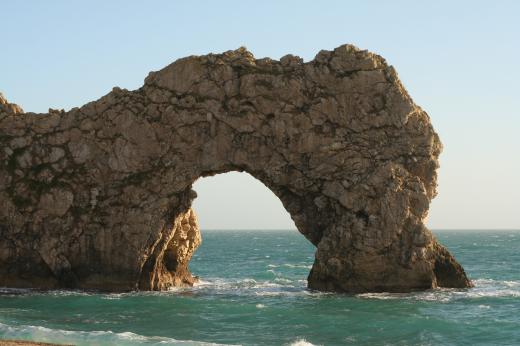
A sea arch is a natural rock formation where an archway has been formed by the erosive power of water. It occurs when waves repeatedly crash against a rocky coastline, exploiting cracks and weaknesses in the rock. Over time, the force of the water enlarges these cracks, eventually creating a hole and then an arch. The process can take thousands of years, showcasing the relentless power of the ocean.
Can you find sea arches all over the world?

Yes, sea arches can be found along coastlines all over the world, particularly in areas with cliffs made of erosion-resistant rock. They are more common in places with strong waves and tides which contribute to the erosion necessary to form these structures. Notable examples include the Durdle Door in England and the Arch of Cabo San Lucas in Mexico.
Are sea arches permanent features?
No, sea arches are not permanent. They are temporary geological features in the context of geological time scales. The very forces that create sea arches continue to wear them down. Eventually, the arch may collapse due to further erosion or the weight of the unsupported rock, leaving behind sea stacks or isolated pillars of rock.
What types of rock are most likely to form sea arches?
Sea arches are most commonly formed in rocks that are resistant to erosion, such as sandstone, limestone, and basalt. These types of rock can withstand the pounding of waves long enough for an arch to form. Softer rocks tend to erode too quickly to form stable arches before collapsing.
How long does it take for a sea arch to form?
The formation of a sea arch is a slow process that can take thousands to millions of years, depending on the rock type, climate, and wave activity. The rate of erosion is influenced by the rock's resistance to weathering, the force and frequency of waves, and the presence of natural faults or joints in the rock.
What is the difference between a sea arch and a natural bridge?
A sea arch is specifically formed by the erosive action of the ocean's waves, while a natural bridge can be formed by other erosive forces, such as flowing water from rivers or streams. Natural bridges are typically found inland, whereas sea arches are found along coastlines. Both are types of arches, but their formation processes and locations differ.
Diane Goettel
In addition to her work as a freelance writer for AllThingsNature, Diane is the executive editor of Black Lawrence Press, an independent publishing company based in upstate New York. She has also edited several anthologies, the e-newsletter Sapling, and The Adirondack Review. Diane has a B.A. from Sarah Lawrence College and an M.A. from Brooklyn College.
Learn more...
Diane Goettel
In addition to her work as a freelance writer for AllThingsNature, Diane is the executive editor of Black Lawrence Press, an independent publishing company based in upstate New York. She has also edited several anthologies, the e-newsletter Sapling, and The Adirondack Review. Diane has a B.A. from Sarah Lawrence College and an M.A. from Brooklyn College.
Learn more...AS FEATURED ON:
AS FEATURED ON:









-
![The Azure Window is a sea arch located in Malta.]() By: ReginaQThe Azure Window is a sea arch located in Malta.
By: ReginaQThe Azure Window is a sea arch located in Malta. -
![Australia's London Bridge sea arch collapsed in 1990.]() By: Christopher MederAustralia's London Bridge sea arch collapsed in 1990.
By: Christopher MederAustralia's London Bridge sea arch collapsed in 1990. -
![The Durdle Door is one of the sea arches of southern England.]() By: Dariusz AndersenThe Durdle Door is one of the sea arches of southern England.
By: Dariusz AndersenThe Durdle Door is one of the sea arches of southern England. -
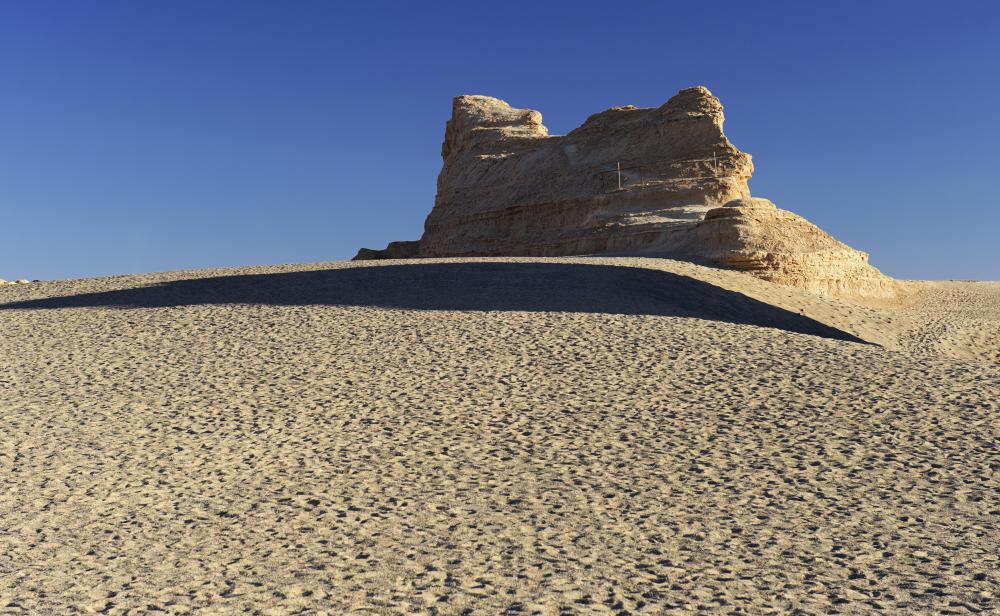
![Sea arches are formed in a similar way as the crests and ridges of a yardang.]() By: Jack.QSea arches are formed in a similar way as the crests and ridges of a yardang.
By: Jack.QSea arches are formed in a similar way as the crests and ridges of a yardang.


Discussion Comments
Sometimes, part of the rock formation will collapse while leaving another part intact. I saw a photo of the London Bridge after it collapsed, but there was still another sea arch out to the side that appeared to be in good shape.
@kylee07drg – I do love capturing moments in time with my camera, especially the ones of vulnerable things like sea arches that may not be there the next year. I'm glad that so many people are interested in documenting natural formations like this, because we will have plenty of photos to remember them by when they are gone.
I've often wanted to take a boat through a sea arch. I've seen some beautiful ones in movies that I would love to cross under.
I wouldn't be too afraid of a sea arch falling on my head as long as it didn't look too frail. It is made of strong rock, after all, and unless there is a major storm brewing at the time, it isn't likely to collapse all at once.
I would definitely avoid sea arches when a hurricane is approaching, though. The strong wind and waves could cause one to fall, and they could also cause your boat to crash against the surrounding rock.
It's tragic that these beautiful formations are just destined to fall apart. It's important to visit things like sea arches while they last and to take plenty of photographs.
@ GenevaMech- I have explored the volcanoes national park in the big island. It is one of the most beautiful and surreal places I have ever been. You can see beautiful colorful birds, outlandish trees and flowers, volcanic steam vents, lava tubes, groups of wild boar, endless expanses of lava, and lava covered with vegetation in this park.
I have also seen some of the coolest looking bugs I have ever seen. Glow in the dark spiders, giant spiders that look like yellow and black walking sticks, huge centipedes, and the colorful crab spiders that weave thick webs in dark corners.
Probably my most memorable experiences were hiking across the Kilauea caldera and crater, and walking through the tree fern forests. My family enjoyed watching the hula dancing at the visitor center, and the drive down the chain of craters road.
I used to live in the small town of Volcano Hawaii on the big Island. At the end of Chain of Craters Road, which runs through the Hawaii Volcanoes National Park to the coast, are the Black volcanic cliffs and the Holei Sea Arch. The arch is a giant arch that sticks out from the side of the sea cliffs.
The arch must be about 80 or 90 feet tall, and on windy days, you can feel the spray from the waves splashing into the cliffs.
If you ever visit the big island of Hawaii, the Crater Rim Road and Chain of Craters road are must-sees. At the end of the chain of craters road you can enjoy a picnic on top of the sea cliffs. You will be able to gaze at what seems like an endless south pacific ocean.
Post your comments