
At SmartCapitalMind, we're committed to delivering accurate, trustworthy information. Our expert-authored content is rigorously fact-checked and sourced from credible authorities. Discover how we uphold the highest standards in providing you with reliable knowledge.
What is a Savings Account?
 Tricia Christensen
Tricia Christensen
Tricia Christensen
A savings account typically refers to an account in which a person places money to earn a small amount of interest. Unlike a 401k or an IRA, the funds are usually easily accessible, though some banks do charge for withdrawing money early. In most cases, people can withdraw money from the account at any time, at least at any time the bank is open or the bank’s ATM is available.
The term "bank" is used here generally, since credit unions and money market fund companies can offer savings accounts to customers. In addition to earning interest on deposits, the account also provides a safe place for people to put their money, and it's far better than stowing it in the mattress or the cookie jar.

In the US, if the bank declares bankruptcy, is the target of embezzlement, or mismanages its funds, the Federal Deposit Insurance Corporation (FDIC) insures all accounts, up to $100,000 US dollars (USD). In fact, people who bank in the United States should always look for an account that is FDIC insured. Most banks, credit unions, and money market funds do offer this protection.

Consumers also need to shop around for a savings account that offers the best interest rates. In the past, it was often the case that banks offered a slightly higher interest rate than did credit unions. This is because credit unions attempt to confer lower interest rates than bank rates to their customers borrowing money. Now, credit unions are often quite competitive in rates. Money market funds tend to be the most changeable in rates, since interest earned will depend on the stock market.

When a person puts money into a savings account, he is actually lending his money to the financial institution. In return for this loan, the bank offers the account holder part of the interest rate it charges customers. As a result, the bank and the account holder both make a profit.
Sometimes, people might keep their money in an interest checking account, but if they really plan not to spend the money for a few months, it makes sense to use a savings account instead. Interest checking accounts typically pay much less interest and normally require a relatively high minimum balance, about $1,000 USD. If this balance is not maintained, the checking account may actually charge the account holder a fee for using the account, which nullifies any potential interest earned.
Most savings accounts require a minimum deposit, usually $100 USD. Most financial institutions make an exception for accounts opened for children, who often have one as their first bank account. Banks are very accommodating to children because it is a way to build its future base of customers. Usually kids can open an account with about $5 USD.
Tricia Christensen
Tricia has a Literature degree from Sonoma State University and has been a frequent SmartCapitalMind contributor for many years. She is especially passionate about reading and writing, although her other interests include medicine, art, film, history, politics, ethics, and religion. Tricia lives in Northern California and is currently working on her first novel.
Learn more...
Tricia Christensen
Tricia has a Literature degree from Sonoma State University and has been a frequent SmartCapitalMind contributor for many years. She is especially passionate about reading and writing, although her other interests include medicine, art, film, history, politics, ethics, and religion. Tricia lives in Northern California and is currently working on her first novel.
Learn more...AS FEATURED ON:
AS FEATURED ON:









-
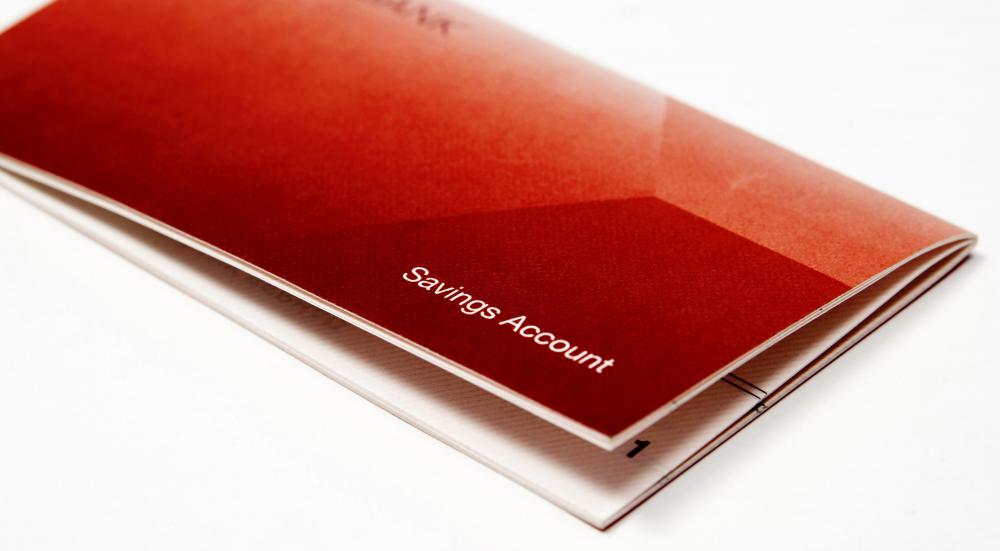
![Some savings accounts use a passbook to keep track of transactions, others issue paper statements and many keep records entirely online.]() By: vickySome savings accounts use a passbook to keep track of transactions, others issue paper statements and many keep records entirely online.
By: vickySome savings accounts use a passbook to keep track of transactions, others issue paper statements and many keep records entirely online. -
![Consumers need to shop around for a savings account that offers the best interest rates.]() By: Vladislav KochelaevsConsumers need to shop around for a savings account that offers the best interest rates.
By: Vladislav KochelaevsConsumers need to shop around for a savings account that offers the best interest rates. -
![An ATM may be used to withdraw money from a person's savings account.]() By: WavebreakmediaMicroAn ATM may be used to withdraw money from a person's savings account.
By: WavebreakmediaMicroAn ATM may be used to withdraw money from a person's savings account.


Discussion Comments
How is a savings account different from a checking account?
@jackesho: A "conventional" savings account rate is in the 0.05 - 0.25 percent. You will find some higher, but this is a good rule of thumb. Online savings accounts on the other hand typically start at 1 percent and go up to just under 2 percent. They used to be much higher, but the current economic climate has kept them relatively low and probably will for the foreseeable future.
what is the current interest rate that an individual would earn if they opened a saving account? please replay ASAP!
What are mode of financing for a commercial bank? How do they finance themselves?
Post your comments