
At AllTheScience, we're committed to delivering accurate, trustworthy information. Our expert-authored content is rigorously fact-checked and sourced from credible authorities. Discover how we uphold the highest standards in providing you with reliable knowledge.
What is a Satellite?
 Tricia Christensen
Tricia Christensen
Tricia Christensen
A satellite can be defined as any object, either manmade or naturally occurring, that orbits around something else. For example, the moon orbits around Earth, so meets this definition. The Earth is a satellite of the sun. Other naturally occurring examples include comets, stars, asteroids, and other planets.
Orbit is determined by the gravitational pull of the object around which the other body circles. The thing around which a satellite circles is called the primary object. Primary objects are also affected by their satellites, however, and feel some of their gravitational pull. In some cases, when two objects have a similar size and mass, and a similar gravitational pull, they may be called binary systems. Some argue that the moon Charon and Pluto represent a binary system instead of a primary object and satellite, since both have similar mass.

Most are more familiar with the term in relationship to the many satellites that circulate the earth. Sputnik was the first artificial satellite, launched in 1957 by the Soviet Union. The launching of Sputnik is almost analogous for the beginning of the Space Race that followed between the US and the USSR. In today’s climate, however, many countries have found that a cooperative effort is more successful in space exploration and studies. The International Space Station, which orbits earth, is currently the largest manmade satellite in Space, and represents the cooperative effort of numerous countries.

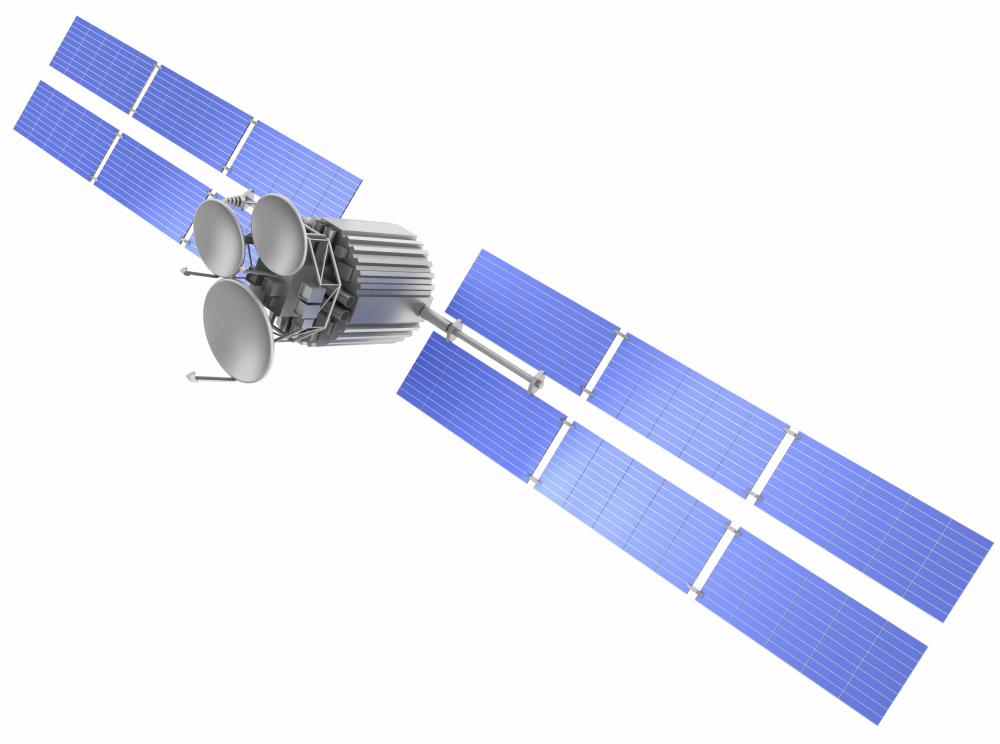
Manmade satellites are classified by types, and there are over ten types. Some of the main types used today include astronomical, communication, Earth observation, and weather satellites, and space stations. Others include those used to monitor Earth from a military standpoint, and biosatellites, which may carry animals or other lifeforms for the purpose of research on earth lifeforms in space. Navigational satellites are now popular and form a vital part of the global positioning system (GPS) now available in many cars.

These objects may also be classified by the height at which they orbit earth or another body. A low Earth orbit satellite circles the planet at a height of 0 to 1,240 miles (1,995.59 km). High earth orbits can be as far away as 22,240 miles (35,791.81 km). Medium earth orbits represent the distance in between high and low earth orbits.
Further distinctions exist to describe the type of orbit it has; for example, Pluto has a slightly elliptical orbit. It may also be classed by what primary object it orbits. A satellite that circles the Earth has a geocentric orbit, for example. The Earth and the planets in this solar system are classed as having a heliocentric orbit since they circle the sun.

A manmade satellite can serve many purposes. People currently use many different systems to track things like weather, to make cellphones work, to find out how to get somewhere, and to gather more information about Earth and about the galaxy. About 5,000 manmade satellites currently orbit earth, and on clear dark nights, it’s often possible to see one in the night sky. Of course, the planets, stars, and comets are also satellites. People should also remember that Earth is not stationary in the sky, as it orbits the sun.
Tricia Christensen
Tricia has a Literature degree from Sonoma State University and has been a frequent AllTheScience contributor for many years. She is especially passionate about reading and writing, although her other interests include medicine, art, film, history, politics, ethics, and religion. Tricia lives in Northern California and is currently working on her first novel.
Learn more...
Tricia Christensen
Tricia has a Literature degree from Sonoma State University and has been a frequent AllTheScience contributor for many years. She is especially passionate about reading and writing, although her other interests include medicine, art, film, history, politics, ethics, and religion. Tricia lives in Northern California and is currently working on her first novel.
Learn more...AS FEATURED ON:
AS FEATURED ON:









-
![Manned spacecraft can be referred to as "satellites" when they're in orbit around the Earth.]() By: MechanikManned spacecraft can be referred to as "satellites" when they're in orbit around the Earth.
By: MechanikManned spacecraft can be referred to as "satellites" when they're in orbit around the Earth. -
![Sputnik, the first artificial satellite, was launched by the Soviet Union in 1957.]() By: axellwolfSputnik, the first artificial satellite, was launched by the Soviet Union in 1957.
By: axellwolfSputnik, the first artificial satellite, was launched by the Soviet Union in 1957. -
![High performance fighter aircraft like the F-22 Raptor can carry ASAT missiles that can hit orbiting satellites.]() By: dreamnikonHigh performance fighter aircraft like the F-22 Raptor can carry ASAT missiles that can hit orbiting satellites.
By: dreamnikonHigh performance fighter aircraft like the F-22 Raptor can carry ASAT missiles that can hit orbiting satellites. -
![Planets like Earth and Mars are satellites of the Sun.]() By: DaevidPlanets like Earth and Mars are satellites of the Sun.
By: DaevidPlanets like Earth and Mars are satellites of the Sun. -
![As a satellite, the moon orbits around the Earth.]() By: styleuneedAs a satellite, the moon orbits around the Earth.
By: styleuneedAs a satellite, the moon orbits around the Earth. -
![Satellites are used to track weather patterns over a large area.]() By: NASA Goddard Space Flight CenterSatellites are used to track weather patterns over a large area.
By: NASA Goddard Space Flight CenterSatellites are used to track weather patterns over a large area. -
![Communications satellites are used for telecommunication and television broadcasting.]() By: yuriyCommunications satellites are used for telecommunication and television broadcasting.
By: yuriyCommunications satellites are used for telecommunication and television broadcasting. -
![Sputnik, launched by Russia, was the first satellite.]() By: Marcin WicharySputnik, launched by Russia, was the first satellite.
By: Marcin WicharySputnik, launched by Russia, was the first satellite. -
![The International Space Station is the largest man-made satelite orbiting the Earth.]() By: Global PanoramaThe International Space Station is the largest man-made satelite orbiting the Earth.
By: Global PanoramaThe International Space Station is the largest man-made satelite orbiting the Earth.




Discussion Comments
I think it's so sad that poor animals were sent into space as test subjects. Many of them had to die because the equipment was faulty.
I understand that they were only sent so that researchers could figure out how humans were likely to be affected biologically in space, but it still seems wrong. Satellites are no place for animals who have no idea what is going on and are likely scared out of their minds.
As a satellite, the Earth is sucked into orbit by the sun, and our moon is attracted to our planet in much the same way. We get our source of light during the day by what we orbit, and we get our light at night from something that orbits us.
The moon's light is a whisper compared to the scream of the sun's light. It offers us just a reflection of light from the object that we orbit, yet it can still make many things visible at night. That just goes to show the intensity of the sun.
@lighth0se33 – It's amazing how much they have gone down in size over the years. Today, we can position our small satellite dishes on our rooftops, and we don't even have to worry about mowing around them.
I have a satellite receiver box in two rooms of my house. That way, my husband and I can watch different channels and even record different programs at the same time.
The only problem I've ever had with satellite dish TV is that the signal goes out when there is a bad storm. The super thick clouds of thunderstorms block the signal, and I'm forced to watch local television until the storm has passed.
I remember those huge satellite dishes from the early nineties. My dad installed one in our back yard, and it was nearly as big as a trampoline!
Different channels got their signals from different satellites, so we sometimes had to switch between them. This meant that we would have to wait a few minutes as the satellite dish in our backyard slowly turned to face a different spot in the sky.
How are PCMCIA cards used with GPS?
why did they make the satellites, and what will happen when satellites are made faster and there are more satellites?
how does a satellite phone work?
I was wondering if you could tell me a bit about the different types of satellites and if the differences in the style and covering of the satellite matters for the different jobs. i would appreciate it if you could reply before the 5th of october. thank you.
how is a satellite made ?
Post your comments