
At MyLawQuestions, we're committed to delivering accurate, trustworthy information. Our expert-authored content is rigorously fact-checked and sourced from credible authorities. Discover how we uphold the highest standards in providing you with reliable knowledge.
What is a Private Right of Way?
 Mary McMahon
Mary McMahon
Mary McMahon
A private right of way is an easement allowing a person or entity to pass through a property in a specific location for transport or other purposes, like utility lines. The classic example is a driveway allowing a person on a neighboring parcel who is not connected to a public road to access the street. Without such a right of way, the parcel would be effectively landlocked and impossible to reach by foot or vehicle.
This differs from a public easement, where a person allows members of the general public to pass over a property, as in cases where people allow beach or park access through private land. Access to the private right of way is limited to parties who need access. Utilities can request one to bring lines over or under property, making it easier to deliver utility services. Likewise, people may set it up to allow for bringing livestock through a property, or in some other special circumstances.

When a private right of way is set up, the property owner may be compensated for the trouble, and the parties work out the terms, including the precise location and other matters. The property owner can use the right of way as long as his use does not interrupt that of the beneficiary. Thus, people are welcome to garden under utility poles, or to use a private driveway to access part of their property, but they cannot do something like installing a swimming pool on top of buried gas lines.

The easement is permanently attached to the land. When the property owner sells, the private right of way goes with the sale, and the new owner must honor its terms. Legally, people must disclose the existence of easements and other attachments to a deed at the time of sale, so people can decide if they want to move forward with the sale. Some people may not want to purchase property with a private right of way, and can choose to seek real estate elsewhere.

Maintenance of the easement is the responsibility of the person receiving the benefit. The property owner cannot do anything to interfere with access to the right of way such as adding fencing or gates, changing property drainage to flood the area, and so forth. If a dispute over the land arises, the parties can go to court to discuss the matter if they cannot reach an amicable resolution.
Mary McMahon
Ever since she began contributing to the site several years ago, Mary has embraced the exciting challenge of being a MyLawQuestions researcher and writer. Mary has a liberal arts degree from Goddard College and spends her free time reading, cooking, and exploring the great outdoors.
Learn more...
Mary McMahon
Ever since she began contributing to the site several years ago, Mary has embraced the exciting challenge of being a MyLawQuestions researcher and writer. Mary has a liberal arts degree from Goddard College and spends her free time reading, cooking, and exploring the great outdoors.
Learn more...AS FEATURED ON:
AS FEATURED ON:


-
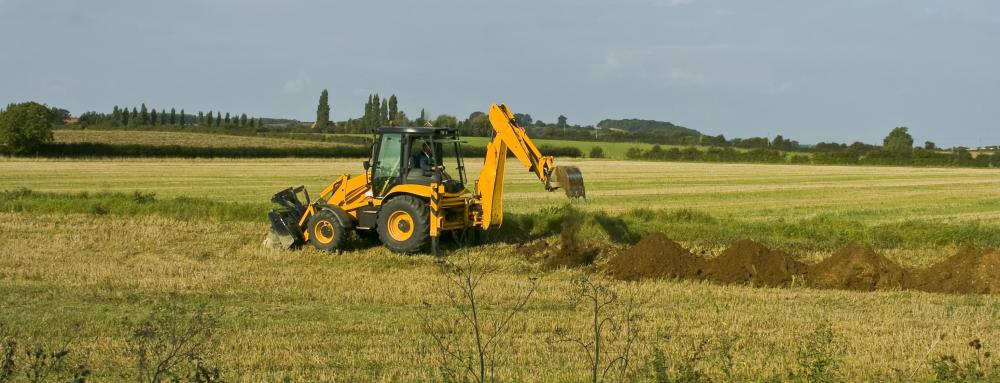
![A private right of way may be granted to install utility lines on a property.]() By: Barbara HelgasonA private right of way may be granted to install utility lines on a property.
By: Barbara HelgasonA private right of way may be granted to install utility lines on a property. -
![A private right of way easement may be necessary for work to be done on utility lines.]() By: Greg PickensA private right of way easement may be necessary for work to be done on utility lines.
By: Greg PickensA private right of way easement may be necessary for work to be done on utility lines. -
![Property owners cannot regrade the soil or build structures on or near a drainage easement because it could impede the free flow of water over the property.]() By: david hughesProperty owners cannot regrade the soil or build structures on or near a drainage easement because it could impede the free flow of water over the property.
By: david hughesProperty owners cannot regrade the soil or build structures on or near a drainage easement because it could impede the free flow of water over the property.


Discussion Comments
I own a parcel of land in front of my house. It is a private portion used as access to my neighbor's place, and access to a car park for four flats, which, on the deeds, say is authorized by the venders of my property. Now the neighbor wants to build another property on his garden. Will that property have the right of access without our permission?
My property has a 25 foot right of way for access. Only 12 feet of that is actual pavement. We have troublesome neighbors and aside from their threats, they are taking it upon themselves to maintain the grassy area on each side of the 12 foot road. We do not wish for them to do this and have asked them not to. Do we have legal grounds to keep them off of the grassy area even though it is part of the 25 foot right of way? They are not land owners on this road, but are the children of the beneficiaries.
My property has a 25 foot easement or right of way for access. Only 12 feet of that is actual pavement. Does that mean the beneficiaries must mow or maintain the grass on each side of the 12ft road?
my grandmother left me her home and land. before she died, she gave my uncle right of way to use her land to get to his. it's been over 10 years since she did this and he has now sold his land. do the new owners have any rights to use my land? there are other ways for them to get to their home and land.
If you are in a situation where there are right of way laws that you need to consider, I would encourage you to do as much homework as possible before making a purchase.
One thing that we have learned from past experience is to ask around, if possible, to get an idea of what the neighborhood (and the neighbors) are like.
Having good neighbors is always a good plus, but in situations where you may have an easement issue, it is crucial if you want to keep on good terms with your neighbors.
I lived in a rural area most of life and it is very common where I live to have public right of way agreements for our livestock.
When we have to move cattle from one location to another it would make it very hard if we did not have these agreements. Most all of neighbors have cattle too, so in this type of situation it benefits everybody.
They also need to get their cattle moved from one location to the next without worrying about always getting permission to be on land that belongs to someone else.
My nephew purchased some land and began building a new house. They ran into some trouble with a neighbor because their land was landlocked. They were trying to set up their utilities, but one neighbor was complaining about their property right of way.
It ended up being quite a battle and they had to pay extra money to get everything done. If they had realized ahead of time how much hassle this was going to be, they would have purchased land somewhere else.
Post your comments