
At TheHealthBoard, we're committed to delivering accurate, trustworthy information. Our expert-authored content is rigorously fact-checked and sourced from credible authorities. Discover how we uphold the highest standards in providing you with reliable knowledge.
What Is a Posterior Cervix?
In medicine, if a part of the body is posterior, it means that it is situated towards the back. The cervix is the tube that connects the uterus to the vagina, and it can be angled towards the back of the body in a posterior direction. Most commonly, though, it's angled forward. It can also change its position from anterior to posterior and back again, and this commonly happens throughout pregnancy and labor. Medical professionals can use the position of the cervix during labor to help assess the progress of the birth.
Variations in Cervix Position

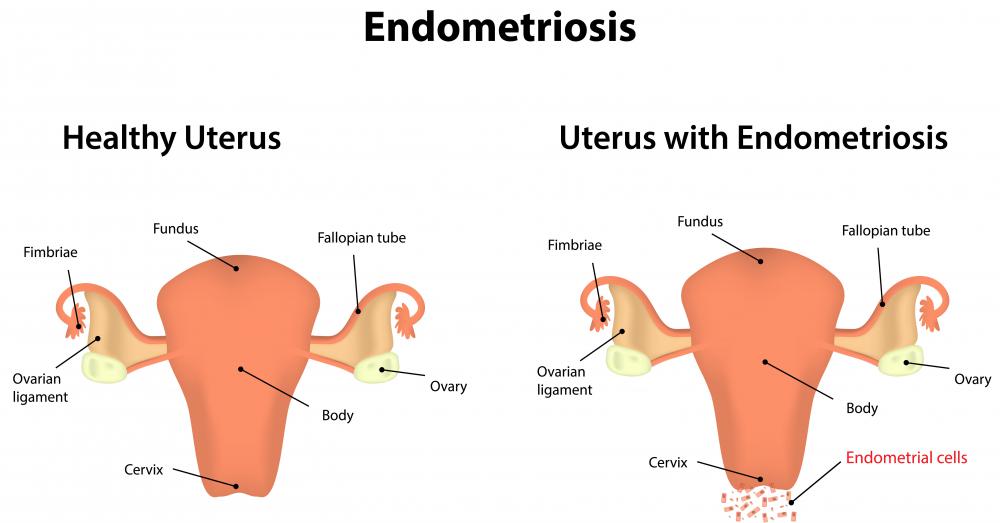
Some women, even before becoming pregnant, naturally have a cervix located more toward the posterior than usual. Medical professionals used to think that this unusual positioning affected fertility, but studies have shown that this is not an issue, so women with a naturally posterior cervix need not worry. It is not generally considered a medical condition, although in rare cases, endometriosis can both cause the unusual backward tilting as well as fertility problems. A posterior cervix can also be less accessible than usual for routine procedures such as smear tests.
Cervical Position During Pregnancy

Most often, a woman who isn't pregnant has a cervix angled towards the front of the body. When she becomes pregnant, it changes its angle and moves towards the back of the body; the cervix also is much firmer and less elastic than usual. In this position, the baby's head does not have a direct passage to the birth canal. Only just before labor, or when labor begins, does the cervix change position to angle towards the birth canal, giving the baby a more direct way out of the body. The woman cannot feel this change happen; a vaginal exam is needed to determine if the position has changed.
The Cervix During Labor

In most cases, the cervix will tilt on its own during the progression of labor, and begin to soften and open up to prepare to let the baby out. Medical professionals can tell where it is angled by performing a vaginal examination on the laboring woman, and this can provide some information as to how far along the labor is. If the cervix has not angled towards the front (anterior cervix), and is still in a relatively posterior position, then the woman is still at the beginning of her labor. A stubbornly posterior cervix, which is not changing to an anterior position as it should, can also be an indication that an intervention such as an induction or Cesarean section may be necessary. This is not always the case, however, and a medical professional needs to have this determination.
Cervix Changes During Menstrual Cycle

A cervix moves in ways other than posterior and anterior. It can also go high or low and experience texture changes throughout the menstrual cycle. Other changes that occur are in the cervical mucus and basal body temperature. Monitoring these changes can be a great way to track fertility and can help decide the optimal time pregnancy can occur.
The cervix produces a bodily fluid called cervical mucus which can help sperm reach an egg during ovulation. The texture change and amount of this fluid throughout the menstrual cycle can also help determine fertility. The more fluid there is, the easier it is to become pregnant.

Before ovulation, the cervix remains low, hard, and slightly open. When it is time for ovulation, the cervix will begin to rise and soften, and the cervix will be almost unreachable. If trying to get pregnant, this is the best time for a couple to try, when the cervix is soft, high, open, and wet.
If implantation occurs, the cervix will remain high, soft and will close. If trying to become pregnant, do not be discouraged if your cervix changes do not happen right away. These changes may not occur until after a confirmed pregnancy.
If a pregnancy does not occur during ovulation, the cervix will lower and harden again, awaiting menstruation. At this point, the cycle continues. It will rise again for ovulation, and either remain high due to pregnancy, or return to a lower position for menstruation.
The position of the cervix can also change due to intercourse. To avoid an inaccurate result, do not check before or after sex.
How To Check The Position Of Your Cervix
There are some precautionary steps to take when checking the cervical position. The first step is to use the restroom. A full bladder can cause the cervix to be higher up in the vagina, making it harder to reach. To avoid an infection, it is important to always use clean hands before beginning the cervical check.
With an empty bladder and clean hands, get into a comfortable position that gives easy access to the cervix. Propping one leg up on either the toilet or stool can allow for better access, while others may prefer a squatting position, or sitting on a toilet.
Once in a comfortable position, use either your index finger or middle finger to reach up high into the vaginal canal to reach your cervix. The texture of the vaginal canal is softer and spongy. The cervix is harder and smoother, although this can change a little throughout the menstrual cycle.
There is a slight indent, or opening, located in the middle of the cervix called the internal OS.
This opening is what determines if the cervix is considered open, slightly open, or closed. The cervix may always feel open if a previous pregnancy occurred (including a miscarriage). The cervical opening, as well as the texture and position of the cervix can help track the menstrual cycle and fertility.
Discuss any new bumps or abnormal changes in the texture of the cervix with a gynecologist or other health care provider. Although it is usually unlikely to be hurt during a self-examination of the cervix, there are times a self-examination should be avoided.
When To Not Check Your Cervix
Performing a self-check of the cervix is not recommended during pregnancy, or when an infection is present.
When pregnant, it may be more of a struggle to perform a self-check of the cervical position. It is already a difficult task for Healthcare providers. It is generally even harder for someone with a womb in the way to reach well enough to get an accurate result. It is not just more difficult, but it is also riskier.
Reaching inside the vagina during pregnancy can cause bleeding and can also introduce bacteria and risk infection. The risk is especially high if the waters have already broken. With the risks that are involved, it is best to leave the exams to the health practitioner.
Do not perform a self-exam if an infection is present, whether pregnant or not. To avoid irritation and pain, allow time to fully heal before putting anything inside the vagina.
It is not necessary to self-check the cervix, but it can be a useful tool to maintain control of one's health. Discuss anything abnormal or painful with a doctor.
AS FEATURED ON:
AS FEATURED ON:


-
![Pregnancy and childbirth are usually the only times when a posterior cervix becomes a medical concern.]() By: tan4ikkPregnancy and childbirth are usually the only times when a posterior cervix becomes a medical concern.
By: tan4ikkPregnancy and childbirth are usually the only times when a posterior cervix becomes a medical concern. -
![The cervix is normally angled toward the front of the body.]() By: Alila Medical MediaThe cervix is normally angled toward the front of the body.
By: Alila Medical MediaThe cervix is normally angled toward the front of the body. -
![A posterior cervix that does not change to an anterior position could signal the need for a C-section.]() By: Anton BooysenA posterior cervix that does not change to an anterior position could signal the need for a C-section.
By: Anton BooysenA posterior cervix that does not change to an anterior position could signal the need for a C-section. -
![In rare cases, endometriosis can be the cause of of a posterior cervix.]() By: joshyaIn rare cases, endometriosis can be the cause of of a posterior cervix.
By: joshyaIn rare cases, endometriosis can be the cause of of a posterior cervix. -
![Fertility is not affected by a posterior cervix.]() By: WavebreakMediaMicroFertility is not affected by a posterior cervix.
By: WavebreakMediaMicroFertility is not affected by a posterior cervix.




Discussion Comments
I have two children and never been told anything before, but today I went for a check up and was asked if I've ever been told my cervix faces backwards and I was confused. I'm just doing some investigating before I book an appointment to find out more.
I have a posterior cervix and each pregnancy it has gotten worse. My first labor it moved mostly anterior on it's own. During my second pregnancy, it was behind my baby's head and not under it and my cervix had to be manually pulled out the last cm. With my third baby, my cervix stayed so far back my entire labor that it had to be pulled manually from 8-10cm after being stuck there for hours. I'm worried it's just going to keep getting worse until I need a c-section.
I was born with a posterior cervix and have conceived on our first try with both of our children.
I was also told that I had a posterior cervix during my pregnancy. (Apparently that's part of why I've always found my annual exams so uncomfortable.) It's not really a big deal usually. They mentioned it at my checks in late pregnancy but when I went into active labor, it moved forward. It is something that a lot of women will experience and being told you have a posterior cervix doesn't necessarily mean anything. It's like being told you're only one centimeter dilated--that could mean you're going to be a mom in twelve hours of next month!
@previous poster - I think's it just that we're all put together differently! I, for instance, have a second toe that's slightly longer than my big toe.
I think it's pretty normal to have a posterior cervix that moves to a more anterior position late in pregnancy. During a vaginal exam when I was pregnant with my first, the midwife told me that I was about a centimeter dilated and 70% effaced but "still a bit posterior," as if she expected it to move more toward the front. (I have no idea if it did--I didn't have any more checks during pregnancy and no one mentioned it during my labor. My labor stalled, baby was quite stuck, and I had a C-section.)
i have had three children and never had this mentioned before but went for a smear test the other day and the nurse could not do it. she tried for 40 minutes. she said it was because my cervix was very posterior. why would this be? does anyone know?
Post your comments