
At Sports&Hobbies, we're committed to delivering accurate, trustworthy information. Our expert-authored content is rigorously fact-checked and sourced from credible authorities. Discover how we uphold the highest standards in providing you with reliable knowledge.
What is a Perfect Game in Baseball?
A perfect game in baseball is a game in which none of the batters on one of the teams gets on base. It is one of the rarest feats that can be accomplished in baseball. Not only must one team's pitcher or pitchers not allow any hits or walks or hit a batter with a pitch, that team's fielders must not commit any errors while also turning every ball hit into fair territory into an out. Typically, this feat is discussed in terms of a pitcher's performance; that is, the pitcher is credited with throwing a perfect game, even though other players must play flawlessly as well.
Length Requirements
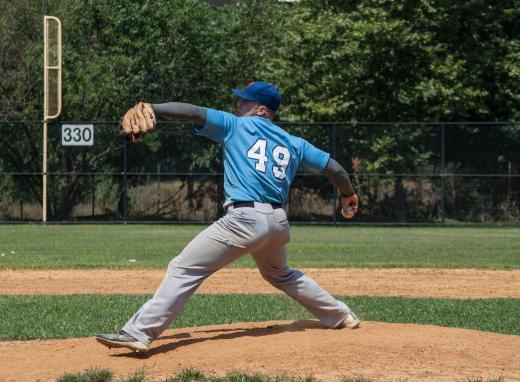
In some baseball leagues, games must last for a certain number of innings to qualify as perfect games. For example, in Major League Baseball, the premier professional league in the world, perfect games must last for a minimum of nine innings, the standard length of a game. Games that are called before nine innings are finished, such as those that are shortened by rain, do not qualify. Those that last more than nine innings can be perfect games only if they end without any batters on one team reaching base. Youth leagues or other leagues that play shorter games, such as five innings or seven innings, might not have a minimum innings requirement.
No-Hitters

By definition, a perfect game is also a no-hitter — a game in which one team does not get a hit. No-hitters, however, are not always perfect games, because in no-hitters, batters may still get on base in other ways, such as walks or errors. It also is possible for a team to throw a no-hitter and lose the game, which cannot happen in a perfect game — the opponent cannot score a run if none of its batters get a hit or even get on base.
Common Components
To throw a perfect game, a pitcher must have good control of his or her pitches to avoid walking or hitting any batters. The pitcher's defense also must play very well. In addition to the fielders playing error-free baseball, many perfect games feature one or more defensive plays in which a fielder turns a near-hit into an out with a diving catch, long throw or similarly impressive play. Many people consider luck to play a role as well, because poorly hit balls often land or roll where fielders cannot reach them in time to record an out, and such a hit would prevent a perfect game.
Major League History
As of 2012, there had been 23 perfect games thrown in Major League Baseball. Among them are three that were thrown during the 2012 season, setting a record for the most in one season. Each of these perfect games was thrown by a single pitcher rather than having another pitcher replace the starter during the game for some reason. The only time this has been accomplished in a postseason game was on 8 October 1956 by Don Larsen of the New York Yankees in Game 5 of the World Series against the Brooklyn Dodgers. No major league pitcher has thrown more than one perfect game.
Frequency
Although perfect games remain one of the rarest feats in Major League Baseball, they have occurred more frequently since the 1980s. Larsen's perfect game was the first in 34 years and just the sixth since 1880 — a span of 76 years. Only three more were thrown in the next 24 years, for a total of nine in 101 seasons. In the 32 seasons from 1981 to 2012, however, there were 14 perfect games — three during the 1980s, four in the 1990s, one in 2004, one in 2009, two in 2010 and three in 2012.
|
||||
Pitcher |
Date |
Team |
Pitches |
Opponent |
| John Lee Richmond | 12 June 1880 | Worcester Worcesters | n/a | Cleveland Blues |
| Monte Ward | 17 June 1880 | Providence Grays | n/a | Buffalo Bisons |
| Cy Young | 5 May 1904 | Boston Pilgrims | n/a | Philadelphia A's |
| Addie Joss | 2 October 1908 | Cleveland Naps | 74 | Chicago White Sox |
| Charlie Robertson | 30 April 1922 | Chicago White Sox | 90 | Detroit Tigers |
| Don Larsen | 8 October 1956 | New York Yankees | 97 | Brooklyn Dodgers |
| Jim Bunning | 21 June 1964 | Philadelphia Phillies | 90 | New York Mets |
| Sandy Koufax | 9 September 1965 | Los Angeles Dodgers | 113 | Chicago Cubs |
| Catfish Hunter | 8 May 1968 | Oakland A's | 107 | Minnesota Twins |
| Len Barker | 15 May 1981 | Cleveland Indians | 103 | Toronto Blue Jays |
| Mike Witt | 30 September 1984 | California Angels | 94 | Texas Rangers |
| Tom Browning | 16 September 1988 | Cincinnati Reds | 102 | Los Angeles Dodgers |
| Dennis Martinez | 28 July 1991 | Montreal Expos | 95 | Los Angeles Dodgers |
| Kenny Rogers | 28 July 1994 | Texas Rangers | 98 | California Angels |
| David Wells | 17 May 1998 | New York Yankees | 120 | Minnesota Twins |
| David Cone | 18 July 1999 | New York Yankees | 88 | Montreal Expos |
| Randy Johnson | 18 May 2004 | Arizona Diamondbacks | 117 | Atlanta Braves |
| Mark Buehrle | 23 July 2009 | Chicago White Sox | 116 | Tampa Bay Rays |
| Dallas Braden | 9 May 2010 | Oakland Athletics | 109 | Tampa Bay Rays |
| Roy Halladay | 29 May 2010 | Philadelphia Phillies | 115 | Florida Marlins |
| Philip Humber | 21 April 2012 | Chicago White Sox | 96 | Seattle Mariners |
| Matt Cain | 13 June 2012 | San Francisco Giants | 125 | Houston Astros |
| Felix Hernandez | 15 August 2012 | Seattle Mariners | 113 | Tampa Bay Rays |
AS FEATURED ON:
AS FEATURED ON:


-
![If a pitcher retires all 27 batters without allowing someone to reach base they will pitch a perfect game.]() By: 56426358If a pitcher retires all 27 batters without allowing someone to reach base they will pitch a perfect game.
By: 56426358If a pitcher retires all 27 batters without allowing someone to reach base they will pitch a perfect game. -
![Perfect games in baseball rely largely on the pitchers' ability to prevent batters from walking or successfully hitting the ball.]() By: CPonderPerfect games in baseball rely largely on the pitchers' ability to prevent batters from walking or successfully hitting the ball.
By: CPonderPerfect games in baseball rely largely on the pitchers' ability to prevent batters from walking or successfully hitting the ball.


Discussion Comments
If a pitcher walks a batter but then that batter is thrown out stealing second base and therefore the pitcher only faces the minimum 27 batters in nine innings, is that a perfect game?
People, a perfect game is 27 batters strike out looking or swinging. it has not happened. kerry wood is the only one who has come close, with one hit batter and 20 strikeouts.
What is the difference between a perfect game and a no hitter? If I'm right, a perfect game is where there are no walks and such, and a no hitter is just no hits but there can be walks.
Is a game that goes more than 9 innings a perfect game?
In 2007, Mark Buehrle threw a no-hitter, not a "perfect game"
Actually, it is 19 games because Mark Buehrle threw a perfect game in 2007 also.
Better make this 18 Perfect Games. Congratulations to Chicago White Sox and pitcher Mark Buehrle. (July 23,2009)
Post your comments