
At TheHealthBoard, we're committed to delivering accurate, trustworthy information. Our expert-authored content is rigorously fact-checked and sourced from credible authorities. Discover how we uphold the highest standards in providing you with reliable knowledge.
What is a Parapharyngeal Abscess?
A parapharyngeal abscess is a collection of infected, swollen, inflamed tissue deep within the neck. Abscesses provide a space for bacteria to thrive and potentially spread to nearby blood vessels and lymph nodes. In most cases, these abscesses arise as a consequence of a severe tonsil, throat, or respiratory tract infection. Treatment in the form of oral antibiotics is usually enough to cure small abscesses before they cause complications. Large pus-filled cysts may need to be surgically drained to prevent airway obstruction and body-wide infection.
The parapharyngeal space is an empty triangular space that is situated between the pharynx, the carotid artery, the internal jugular vein, and several small neck muscles. Most abscesses in the parapharyngeal space are preceded by bacterial infections of the tonsils or pharynx. Pathogens spread through broken, irritated tissue and form cysts in the area. Many different types of bacteria can cause abscesses to develop, including common streptococcus and staphylococcus strains.

A person of any age can develop a parapharyngeal abscess, though the problem is most commonly seen in children and adolescents. Adults who have weakened immune systems are also at an increased risk. The first symptoms of a parapharyngeal abscess are similar those of common throat infections, including a sore throat, difficulty swallowing, mild fever, and fatigue. A growing abscess can cause noticeable swelling in the neck and significant airway obstruction. If the carotid artery or jugular vein is involved, a person may have a very high fever, mental confusion, and dangerous internal hemorrhaging.

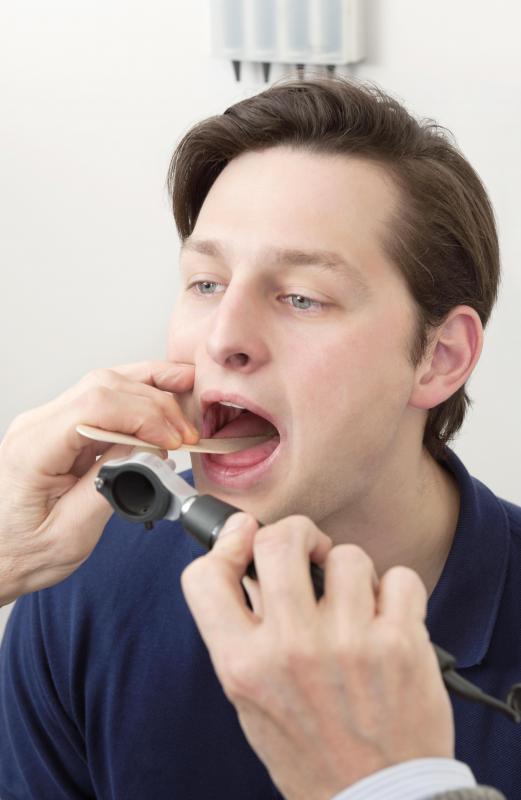
It is important for parents to contact a pediatrician when their child shows possible symptoms of a parapharyngeal abscess. A doctor can inspect the throat and tonsils to look for signs of infection. Computerized tomography scans are useful in visualizing the parapharyngeal space and looking for abnormal swelling. After confirming the diagnosis, blood and mucus samples can be collected to check for the specific bacteria involved.

When a parapharyngeal abscess is detected early, it can usually be treated with a four- to six-week course of oral antibiotics. A doctor may decide to drain a growing abscess using a needle that is either inserted through the mouth or through a small cut made in the front of the neck. If airway constriction is present, a patient may need to be admitted into the hospital so specialists can provide oxygen and surgically open the pharynx. A cyst may need to be excised with a scalpel if it is likely to rupture and spread bacteria to blood vessels.
AS FEATURED ON:
AS FEATURED ON:


-
![Oral antibiotics may be prescribed to treat a parapharyngeal abscess.]() By: blackboard1965Oral antibiotics may be prescribed to treat a parapharyngeal abscess.
By: blackboard1965Oral antibiotics may be prescribed to treat a parapharyngeal abscess. -
![A parapharyngeal abscess may occur as a result of a tonsil infection.]() By: designuaA parapharyngeal abscess may occur as a result of a tonsil infection.
By: designuaA parapharyngeal abscess may occur as a result of a tonsil infection. -
![Symptoms of a parapharyngeal abscess may include sore throat and difficulty swallowing.]() By: ka2shkaSymptoms of a parapharyngeal abscess may include sore throat and difficulty swallowing.
By: ka2shkaSymptoms of a parapharyngeal abscess may include sore throat and difficulty swallowing. -
![A fever is often present with a parapharyngeal abscess.]() By: Thomas PerkinsA fever is often present with a parapharyngeal abscess.
By: Thomas PerkinsA fever is often present with a parapharyngeal abscess. -
![A scalpel is a small, sharp knife that is used for performing surgeries.]() By: iofotoA scalpel is a small, sharp knife that is used for performing surgeries.
By: iofotoA scalpel is a small, sharp knife that is used for performing surgeries. -
![A doctor will need to inspect the throat and tonsils of a person suspected of suffering from a parapharyngeal abscess.]() By: corepicsA doctor will need to inspect the throat and tonsils of a person suspected of suffering from a parapharyngeal abscess.
By: corepicsA doctor will need to inspect the throat and tonsils of a person suspected of suffering from a parapharyngeal abscess. -
![Parapharyngeal abscesses are most commonly seen in children and adolescents.]() By: Dmitry NaumovParapharyngeal abscesses are most commonly seen in children and adolescents.
By: Dmitry NaumovParapharyngeal abscesses are most commonly seen in children and adolescents. -
![The lymph nodes may be impacted by a parapharyngeal abscess.]() By: auremarThe lymph nodes may be impacted by a parapharyngeal abscess.
By: auremarThe lymph nodes may be impacted by a parapharyngeal abscess. -
![An ear infection can cause an abscess to form in the neck.]() By: Von SchonertagenAn ear infection can cause an abscess to form in the neck.
By: Von SchonertagenAn ear infection can cause an abscess to form in the neck.




Discussion Comments
I had this at the age of 41. They thought I had strep (it wasn't), told me I was very sick and ignored signs like severe swelling. Finally, one night when I could no longer swallow my own saliva (I was inhaling it instead) and felt so much pressure in my head I thought my head would explode, I took myself to the ER. I came out of sedation and off of a ventilator five days later. My trach healed a few weeks later. It was a scary, scary event.
Don't mess around with this. From the time that my throat first started hurting to my airway closing in the ER requiring an emergency tracheostomy, it was only five days.
Recently my son had this problem of parapharyngeal abscess. taken CT scan on every fifth day while continuing medicine under guidance of an ENT specialist. Lastly a very senior specialist of ENT (throat and neck) advised me to stop CT scan and medicine as it is recovered and there is no more abscess.
Uhm. I wonder that what is the management of choice in surgery approach between intraoral and extraoral drainage?
I had this when I was about eight. It was awful. I didn't get medical attention until the last minute, when I had a 105 degree fever. I was hospitalized for two weeks, and they said if we waited an other day I probably would have died. Please, if you have any symptoms get to a doctor immediately. (I got it from a abscessed tooth).
Post your comments