
At WiseGEEK, we're committed to delivering accurate, trustworthy information. Our expert-authored content is rigorously fact-checked and sourced from credible authorities. Discover how we uphold the highest standards in providing you with reliable knowledge.
What is a Parachute?
 Mary McMahon
Mary McMahon
Mary McMahon
A parachute is a device made of fabric — usually silk or nylon — that is designed to slow descent by providing drag, causing a falling object to slow down. Parachutes are used for both people and cargo, and they have a range of applications, from recreational parachuting to delivery of humanitarian relief in areas which can only be reached by aircraft. There are also a number of different types designed for specific applications.
Credit for the discovery of the parachute belongs to the Chinese, who were apparently making them as early as the ninth century BCE to use as toys. The trend spread to the Middle East, and by the Middle Ages, several variations had been realized on the drawing pads of inventors, with many people understanding that the device could be a key to manned flight. In the late 18th century, the modern form as it is known today was developed.

The basic design of a parachute includes some form of “wing” to provide drag, attached to rigging which firmly secures the device on the parachutist or load being delivered. The material is folded and rigged in a very specific way so that, when a cord is pulled during descent, it unfolds and deploys. Many people use backup parachutes to ensure that the failure of the main chute is not fatal.

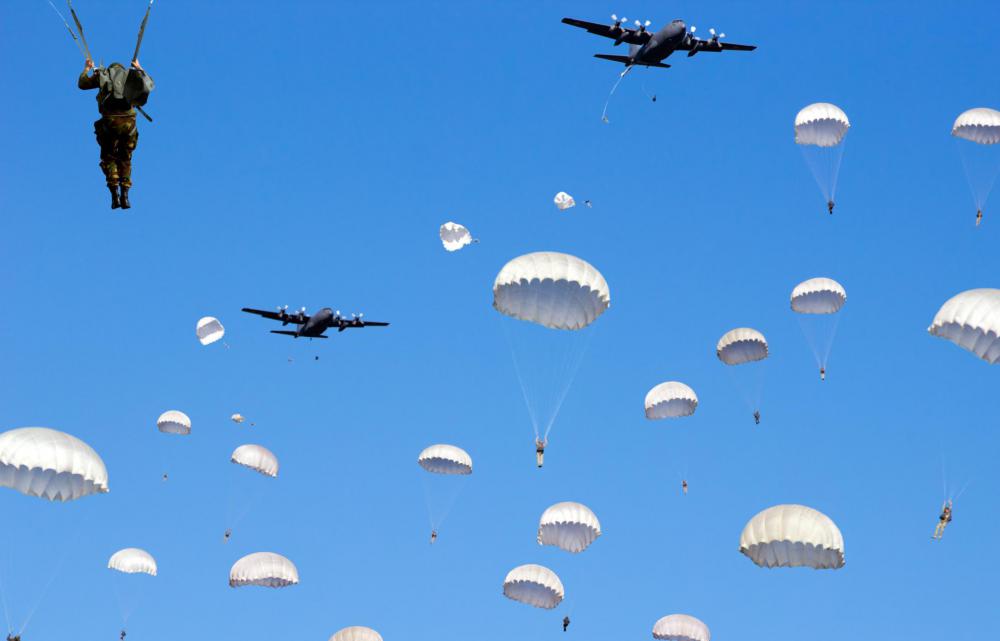
The earliest parachutes were simple designs of the round or square type. They were carefully packed and worn on the back, and released with the use of a ripcord, distinguishing them from earlier designs and initiating the more modern forms. By choosing the time of deployment of the chute, people could control their descent. They couldn't steer with this basic design, however, which made timing of the deployment critical. Early parachutes were touted as safety devices for people using hot air balloons. This type is still used in equipment drops.

Over time, more complex designs of the parafoil or ram-air type were developed. These are made from filled cells of nylon, silk, or other materials and they include rigging that allows the parachutist to steer. Most parachutists use parafoils, because they want to be able to control their descent more effectively, and this design allows the user to steer to a specific location on the ground. In fact, flying with a parafoil is a recreational sport in some regions of the world, with participants leaping from great heights or jumping out of aircraft and then steering their way slowly back to ground.
In addition to these two basic types, it is also possible to find drogue parachutes. This type is designed for deployment at high speeds. They are small and narrow, providing less drag, but the reduction in drag prevents a drogue from blowing apart when it is deployed at speed. Some parachutists use them as “pilot chutes” to partially slow their descent and trigger the deployment of a secondary chute. Drogues are also used to slow some aircraft and rockets for landings.
Mary McMahon
Ever since she began contributing to the site several years ago, Mary has embraced the exciting challenge of being a WiseGEEK researcher and writer. Mary has a liberal arts degree from Goddard College and spends her free time reading, cooking, and exploring the great outdoors.
Learn more...
Mary McMahon
Ever since she began contributing to the site several years ago, Mary has embraced the exciting challenge of being a WiseGEEK researcher and writer. Mary has a liberal arts degree from Goddard College and spends her free time reading, cooking, and exploring the great outdoors.
Learn more...AS FEATURED ON:
AS FEATURED ON:









-
![A parachute provides a soft, safe landing for sky divers.]() By: ArrowsA parachute provides a soft, safe landing for sky divers.
By: ArrowsA parachute provides a soft, safe landing for sky divers. -
![A skydiver wearing a parachute.]()
A skydiver wearing a parachute. -
![The earliest parachutes were simple designs of the round or square type.]() By: VanderWolf ImagesThe earliest parachutes were simple designs of the round or square type.
By: VanderWolf ImagesThe earliest parachutes were simple designs of the round or square type.


Discussion Comments
The one designed by da vinci was made of waxed canvas.
What materials were early parachutes made of? I need to know for my website.
Post your comments