
At EasyTechJunkie, we're committed to delivering accurate, trustworthy information. Our expert-authored content is rigorously fact-checked and sourced from credible authorities. Discover how we uphold the highest standards in providing you with reliable knowledge.
What is a Network Interface Card?
A Network Interface Card (NIC) is a device that allows computers to be joined together in a network, typically a Local Area Network (LAN). Networked computers communicate with each other using a particular protocol or agreed-upon language for transmitting data packets between the different machines or "nodes." The network interface card acts as an interpreter, allowing the machine to both send and receive data on a LAN. Information Technology (IT) specialists often use these cards to setup wired or wireless networks.
Function and Purpose of an NIC
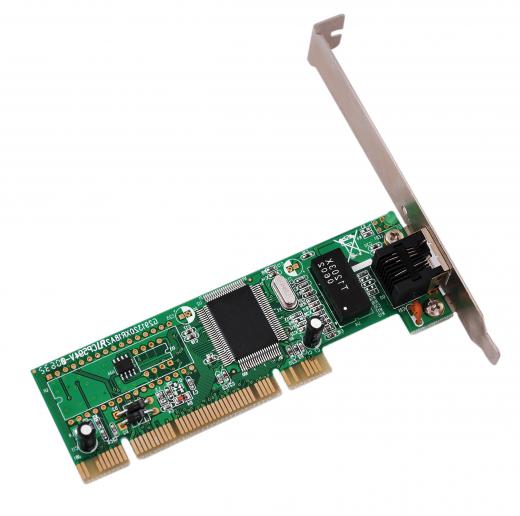
One of the most common languages or protocols used with a LAN is Ethernet. There are also other, lesser-used protocols such as Token Ring. When building a LAN, a network interface card is installed in each computer on the network and each one must use the same architecture. For example, all the cards must be Ethernet cards, Token Ring cards, or an alternate technology.

An Ethernet network interface card is installed in an available slot inside the computer, typically on the motherboard. The NIC assigns a unique Media Access Control (MAC) address to the machine, which is used to direct traffic between the computers on a network. Network cards also change data from a parallel format, used by computers, to a serial format necessary in data transfers; and then back again for received information.
Wired Networks

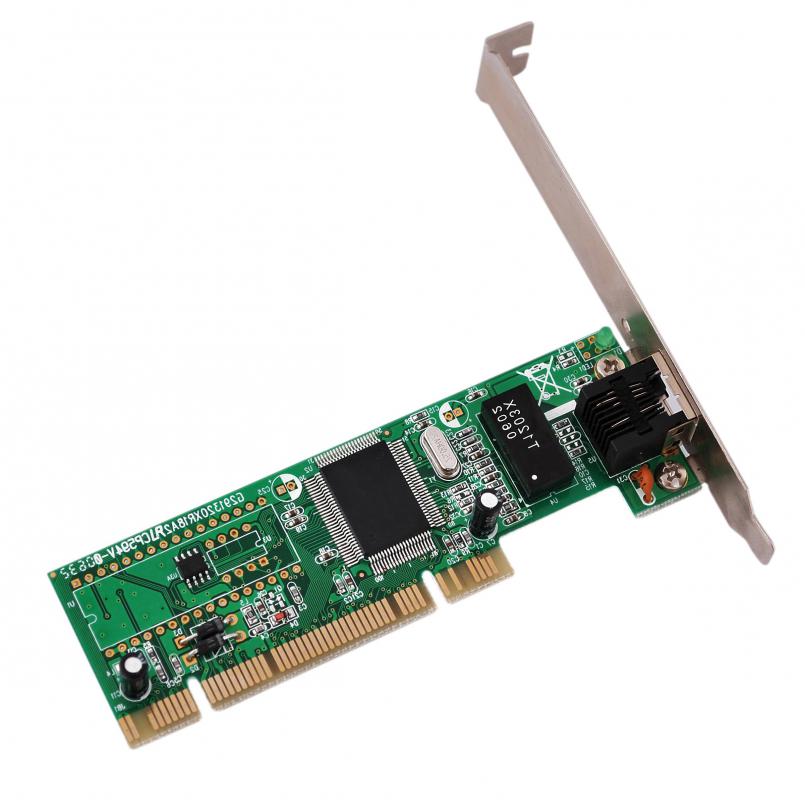
A card's back plate features a port that fits a data cable, such as an Ethernet cable, which runs from each NIC to a central hub or switch. The hub acts like a relay, passing information between computers using their MAC addresses and allowing them to share resources like printers and scanners. In a wired network, a cable physically connects each computer to each other or to a hub.
Wireless Networks
A network interface card does not have to be hard-wired with physical cable. Wireless cards are installed like their wired counterparts, but rather than a port for a cable, the card features a small antenna. The NIC communicates with a central wireless switch or hub via radio waves. Wireless LANs are often convenient, but may have some restrictions depending on the material a building is made from. For example, lead in walls can block wireless signals between the network interface card and a hub or switch.
Choosing the Right NIC
When buying components for a LAN, it is important to make sure the NICs and hub or switch have the same capabilities. The entire network should be either wired or wireless, unless components are specifically chosen that have both functionalities. In addition, newer versions of hardware often support more features and greater data speeds than older equipment. It is important to make sure a central switch or hub is just as good as the individual cards used in a network.
Wide Area Networks and NICs
Computer users can also connect LANs located in different areas of a city, region, or country, through Asynchronous Transfer Mode (ATM) and the creation of a Wide Area Network (WAN). LANs are built with a network interface card in each computer, but ATM uses Internet connections to link multiple LANs to an online switch, making each one part of a network. This type of WAN is referred to as an "Internetwork," as the larger WAN consists of individual nodes that are each a smaller LAN.
AS FEATURED ON:
AS FEATURED ON:









-
![Network interface card (NIC).]()
Network interface card (NIC). -
![The back of a network interface card features a port for an Ethernet cable.]() By: angellodecoThe back of a network interface card features a port for an Ethernet cable.
By: angellodecoThe back of a network interface card features a port for an Ethernet cable. -
![Most computers still allow users to directly plug in Ethernet cables to connect to the Internet.]() By: ArtemSamMost computers still allow users to directly plug in Ethernet cables to connect to the Internet.
By: ArtemSamMost computers still allow users to directly plug in Ethernet cables to connect to the Internet.


Discussion Comments
What makes an NIC a network component?
Someone said that we can access NIC by using the command IPCONFIG. Is this true or not? Here we get Ethernet information, etc. Please tell me.
I need help about the components and how they operate with block diagram. Can anybody help?
How does a network card work with other components?
NIC is a very important part of machine because if you want to connect your multiple pc through the LAN, then each machine has to be installed with same kind of NIC with same architecture.
How can I determine what kind of NIC card is installed in my computer, I have windows XP, thanks
is there any way to check if your nic is working or not? actually i am trying to access the internet on ubuntu, but it's showing some errors. could there be any problem with my nic?
Actually as posted by someone NIC converts Parallel Data into Serial data and Vice Versa so it is like modem.
One said that the NIC "translates parallel digital computer data into serial signals appropriate for transmission along the network medium and serial signals into parallel digital computer data for incoming network data."
I would like to confirm whether the above claim is correct or not.
Thanks a lot.
Post your comments