
At TheHealthBoard, we're committed to delivering accurate, trustworthy information. Our expert-authored content is rigorously fact-checked and sourced from credible authorities. Discover how we uphold the highest standards in providing you with reliable knowledge.
What is a Morbilliform Rash?
Morbilliform rash, or "measles-like" maculopapular skin eruption, is commonly caused by certain drug reactions or viral diseases. Maculopapular rashes are skin eruptions that exhibit both the characteristics of a macule and papule. Macules are small, circumscribed and discolored spots on the skin. The diameter of a macule is not more than .4 inches (10 mm). Papules, on the other hand, are eruptions on the skin, which can look something like a pimple. Morbilliform rashes, therefore, are raised, discolored spots that spread symmetrically across the body.
These rashes may occur due to bacterial infections, drug reactions, and specific or non-specific viral exanthems, also known as viral rashes. A viral exanthem is non-specific if there is no exact information on the virus that has caused the rash. In such a case, the clinician identifies the presence of the virus that is likely to have caused the rash.

Morbilliform rash is a "late drug rash." It appears on the skin of the affected individual after one to two weeks of exposure to drugs, such as antibiotics or barbiturates. Drug-caused rashes of this kind are usually associated with penicillin, cephalosporins, sulphonamides, and anticonvulsants.
Morbilliform rashes often occur in children affected by viral diseases such as measles, Rubella, Roseola, and Erythema infectiosum. In adults, these rashes are usually non-specific viral rashes. This type of rash is also frequently seen in patients who administer ampicillin for the treatment of mononucleosis caused by Epstein-Barr virus or cytomegalovirus. People with human immunodeficiency virus (HIV) tend to develop an acute morbilliform rash when treated with sulfa drugs.

This rash can also appear as a consequence of certain viral diseases. If antibiotics have been started for the patient during the early stages of the viral disease, then the appearance of a morbilliform rash may lead to confusion in diagnosis. Once a drug-induced morbilliform rash is diagnosed, the doctor may ask the patient to discontinue the use of a particular drug.

Usually, oral antihistamines or topical corticosteroids are prescribed for treating these types of rashes. Oral corticosteroids are avoided, as there are chances of the rash to worsen during the steroid therapy, which may lead to the wrong diagnosis. A drug-induced morbilliform rash will usually subside within almost two weeks after the discontinuation of the particular drug. When this type of rash heals, the affected skin sheds or peels, which is also known as skin desquamation.
AS FEATURED ON:
AS FEATURED ON:


-
![Morbilliform rashes are raised, discolored spots that spread across the body.]() By: defunMorbilliform rashes are raised, discolored spots that spread across the body.
By: defunMorbilliform rashes are raised, discolored spots that spread across the body. -
![Macules are small discolored spots on the skin.]() By: Alexander RathsMacules are small discolored spots on the skin.
By: Alexander RathsMacules are small discolored spots on the skin. -
![Morbilliform rashes may occur as a result of an allergic reaction to penicillin.]() By: blasMorbilliform rashes may occur as a result of an allergic reaction to penicillin.
By: blasMorbilliform rashes may occur as a result of an allergic reaction to penicillin. -
![A child affected by measles may also be afflicted with a morbilliform rash.]() By: NatUlrichA child affected by measles may also be afflicted with a morbilliform rash.
By: NatUlrichA child affected by measles may also be afflicted with a morbilliform rash. -
![People with HIV tend to develop an acute morbilliform rash when treated with sulfa drugs.]() By: designuaPeople with HIV tend to develop an acute morbilliform rash when treated with sulfa drugs.
By: designuaPeople with HIV tend to develop an acute morbilliform rash when treated with sulfa drugs. -
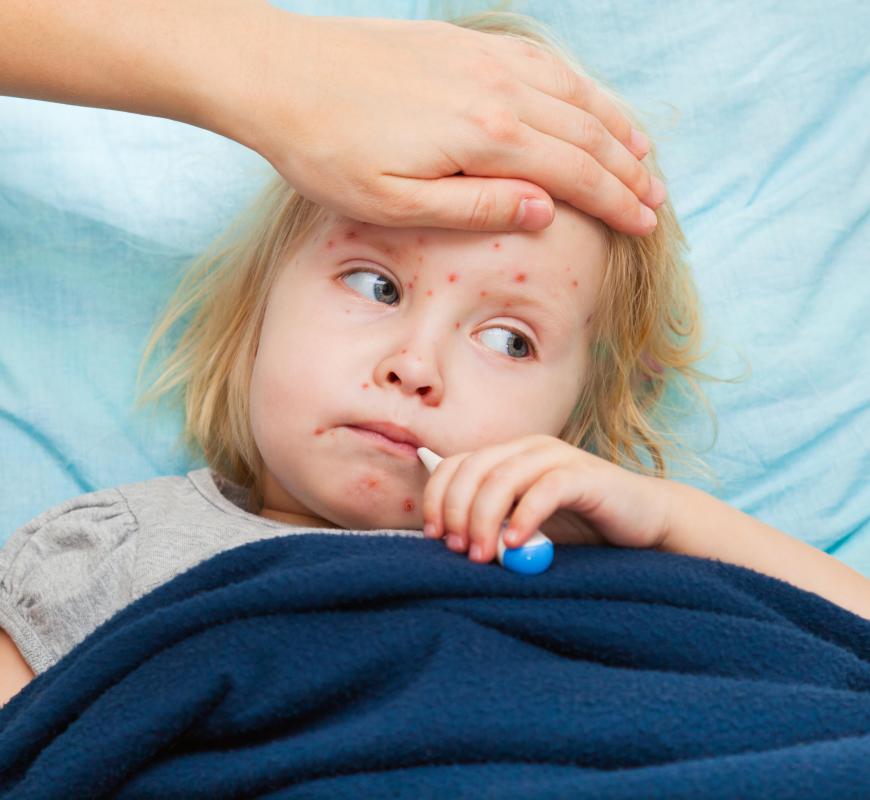
![Fever may accompany a morbilliform rash.]() By: Gina SandersFever may accompany a morbilliform rash.
By: Gina SandersFever may accompany a morbilliform rash. -
![Health care workers are at a high risk of developing rubella.]() By: michaeljungHealth care workers are at a high risk of developing rubella.
By: michaeljungHealth care workers are at a high risk of developing rubella. -
![People recovering from rashes will experience desquamation.]() By: phasinphotoPeople recovering from rashes will experience desquamation.
By: phasinphotoPeople recovering from rashes will experience desquamation. -
![Morbilliform rashes may develop as a result of a virus.]() By: Renata OsinskaMorbilliform rashes may develop as a result of a virus.
By: Renata OsinskaMorbilliform rashes may develop as a result of a virus.





Discussion Comments
@SarahGen-- This is true. In adults, the most common cause is drugs. In children, the most common cause is a viral infection.
I have sensitivity to certain groups of antibiotics, mainly penicillin. I have developed a morbiliform rash twice due to antibiotic treatment. Interestingly, the rash did not show up immediately after starting the drugs in my case. The rash appeared one week later.
It's difficult for us to look at a rash and categorize it though. My doctor told me that I should always get checked out because many rashes mimic one another. There are some chronic conditions that cause rashes similar to morbiliform.
In children, I think it's easier to pinpoint since it's almost always caused by a virus.
@literally45-- Have you seen your doctor about it?
I think the most common cause of the morbiliform rash in adults is a drug reaction. Did you start taking any new medications recently?
You can't guess about these things however. Morbiliform rashes can occur in adults due to infections as well. So you need to see your doctor. A physical exam and testing is necessary for a diagnosis. At least call your doctor and tell him or her about the rash. If you started a drug recently, your doctor may give you new directions about using the drug or may tell you to stop taking it. Don't stop taking anything on your own without doctor supervision however.
What is the most common cause of a morbiliform rash in adults?
I developed this rash two days ago. I still don't know what caused it. Could it be an infection?
Post your comments