
At WiseGEEK, we're committed to delivering accurate, trustworthy information. Our expert-authored content is rigorously fact-checked and sourced from credible authorities. Discover how we uphold the highest standards in providing you with reliable knowledge.
What is a Mannequin?
 Mary McMahon
Mary McMahon
Mary McMahon
A mannequin is a model of a human being, or of a large part of a human body. The construction materials used to make these models vary widely, as do their size and realism. They are probably most famous for their use in the fashion industry, but they are also used in medical training, art, and dressmaking. They can be purchased from specialty shops or through auctions; another great source is a struggling department store, which may be willing to give away its mannequins or sell them at a low cost if it goes out of business.
The spelling "manikin" is also correct, and it is derived from the same root word, the Dutch mannekijn, which means "little person." Originally, the Dutch used the term to refer to dwarfs, but over time it was also used in reference to jointed artist's models of the human body which were used when real people were not available. By 1570, English speakers were using "manikin" to talk about artists' models, and in 1902, the modern spelling was picked up from the French to describe models used to display clothing at department stores.

A department store mannequin is typically made life-size, although its measurements may be rather small and sometimes even disproportionate. Clothes and accessories can be displayed on them to make these items more appealing; depending on the store, they may or may not have heads. Some people find the faces — or lack thereof — a bit unsettling or odd, leading many stores to display clothing on headless bodies or torsos. Other stores need heads to display accessories like hats and headbands, or choose to use them to make a display feel more realistic.

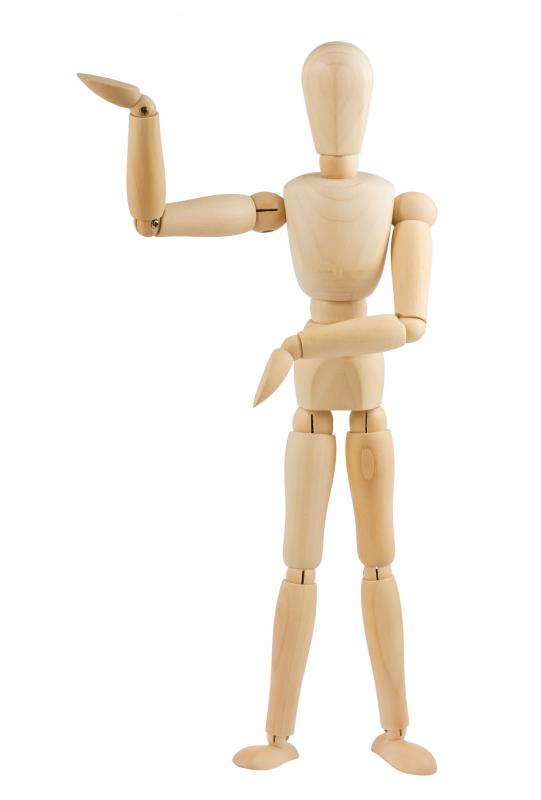
High-end department store mannequins are jointed so that they can be put into varying positions, and they come in a range of skin tones. Less costly versions are cast in plastic in a generic pose. An artist's mannequin, on the other hand, is usually fully jointed, so that the artist can pose it as needed. These models also come in a range of sizes, from hand-sized to life-sized. Many graduates of art school have used them as tools to learn about anatomy, perspective, and other aspects of their craft.

Mannequins are also sometimes called dummies or lay figures, depending on the region of the world they are in. Medical professionals and engineers often refer to their models of people as dummies, since they use specialized models with articulated joints and other features to make them behave more like real human bodies. In medical training, advanced models are used to practice intubation skills, the placement of IV needles, and patient management; extremely sophisticated ones can even be programmed to demonstrate various symptoms and respond to treatment.
Mary McMahon
Ever since she began contributing to the site several years ago, Mary has embraced the exciting challenge of being a WiseGEEK researcher and writer. Mary has a liberal arts degree from Goddard College and spends her free time reading, cooking, and exploring the great outdoors.
Learn more...
Mary McMahon
Ever since she began contributing to the site several years ago, Mary has embraced the exciting challenge of being a WiseGEEK researcher and writer. Mary has a liberal arts degree from Goddard College and spends her free time reading, cooking, and exploring the great outdoors.
Learn more...AS FEATURED ON:
AS FEATURED ON:









-
![A fully jointed artist's mannequin.]() By: mbongoA fully jointed artist's mannequin.
By: mbongoA fully jointed artist's mannequin. -
![Two department store mannequins modeling clothes and accessories.]() By: SergiosTwo department store mannequins modeling clothes and accessories.
By: SergiosTwo department store mannequins modeling clothes and accessories. -
![Mannequins can sometimes be used in medical training.]() By: wellphotoMannequins can sometimes be used in medical training.
By: wellphotoMannequins can sometimes be used in medical training.


Discussion Comments
I have worked at a clothing store in the past and I can say that they have had mannequins there that look very life like and they are incredibly creepy.
I know that I am not alone in this strange fear I have and I am wondering if there is some type of official phobia that is associated with mannequins and if this is unreasonable or not?
Are skeleton dummies (the ones they use at schools to teach the names of bones) or the dummies that show internal organs considered mannequins?
Or do they have a separate name?
I don't mind headless mannequins but sometimes mannequins in general startle me when I'm shopping. When they're just standing there with clothes on and I don't pay attention, I think it's a real person and get startled when I realize it isn't. Retail store mannequins look like real people and most of them are taller than me!
I think mannequins that just portray above the torso are better. I find them less scary. They have a bunch of head mannequins at the hair school where I get my hair done.
@Kristee-- Yea, I agree. My mom was teaching a first aid class for a while and she used a dummy to teach CPR to her students. They learned how to do heart massage and how to do mouth to mouth properly.
But I'm not sure how students can use how to place needles with these dummies because it's not like they have veins. Perhaps they learn how to hold the needle and how to look for veins on the dummy.
@giddion – Don't feel bad about it. I actually prefer the mannequins with heads to the mannequin torsos that so many stores see fit to use instead.
Some of the higher end department stores still use the ones that have heads, hair, and realistic skin tones. I think that many stores have probably switched to the headless kind without any skin tone to save money.
It is much more pleasant to see an entire mannequin wearing the outfit that I am considering buying than to see it on some half body. It doesn't really bother me the way it bothers you, but I get where you are coming from.
Is it strange that headless mannequins really freak me out? They just seem so wrong!
I hate going into a clothing store and seeing these headless forms with human arms, hands, and torsos wearing dresses. Their skin is always plaster white, so they make me think of dead people who have been decapitated.
I may be the only one who feels this way. However, I just can't get over this squeamishness.
My sister used a cosmetology mannequin while she was in school to become a hairdresser. This mannequin was just a neck and head with hair, though.
The one she used had a blend of human and synthetic hair. I think that the ones with 100% human hair were probably too expensive.
She worked on everything from coloring techniques to cuts and perms with this mannequin head. It helped ease her fear about making the transition to working on actual human heads.
There sure are a lot of different mannequin forms! I had only ever heard of the kind used to display clothing.
I guess it's good that medical students have something to practice on besides actual humans at first. Also, art students who might feel uncomfortable working with an actual nude model could benefit from using a mannequin.
Post your comments