
At DelightedCooking, we're committed to delivering accurate, trustworthy information. Our expert-authored content is rigorously fact-checked and sourced from credible authorities. Discover how we uphold the highest standards in providing you with reliable knowledge.
What is a Maitre d': The Essential Guide to Mastering Dining Etiquette
 Editorial Team
Editorial Team
Editorial Team

In the world of fine dining, the role of a Maitre d'Hotel, commonly known as a Maitre d', is pivotal. As the orchestrator of service excellence, a Maitre d' ensures seamless coordination between the kitchen and the dining room..

These professionals not only manage the wait staff and address customer concerns with finesse but also bring a touch of theater to the dining experience, often doubling as sommeliers or providing tableside culinary flair. In establishments that prioritize a sophisticated dining experience, the Maitre d' is the cornerstone of customer satisfaction and operational harmony.

In an establishment that uses a Maitre d', he or she is the first person guests of the restaurant interact with when they walk in the door, and often when reservations are made as well. It is this person's job to create a positive and welcoming impression for guests while deciding where on the restaurant floor to seat them. Seating choices are largely predicated by the number of available wait staff. Waiters are typically assigned sections of the dining area, and the headwaiter tries to seat customers evenly, so that waiters will not be over or underloaded with customers. In addition to being more fair to the staff, this ensures better service for customers.

The Maitre d' also manages the wait staff, establishing schedules, assigning sections, and dealing with issues that come up in the workplace. He or she also serves as the liaison between the kitchen and the floor, communicating with runners, chef, and other kitchen staff to keep things running well. While supervising house staff, he or she may also make hiring and firing decisions, in consultation with other members of upper management such as the executive chef and the owner.

In addition, the headwaiter often handles customer complaints, both in the form of issues that arise on the floor and when customers write formal written complaints. This requires a high level of tact, sensitivity, and sensibleness. In smaller establishments, the owner may serve in this role, or alternate with a hired professional, which is something important to keep in mind if a problematic situation arises in the restaurant.

Tipping is not required or expected when dealing with a Maitre d', but guests are welcome to tip if he or she provides exemplary service, such as securing a particularly fine table, making special arrangements to cope with food allergies, or performing some other small service. When tips are offered, it should be done so discreetly and at the end of the evening, and attempts to bribe or buy the person's service are generally viewed as tactless.
Editorial Team
Our Editorial Team, made up of seasoned professionals, prioritizes accuracy and quality in every piece of content. With years of experience in journalism and publishing, we work diligently to deliver reliable and well-researched content to our readers.
Editorial Team
Our Editorial Team, made up of seasoned professionals, prioritizes accuracy and quality in every piece of content. With years of experience in journalism and publishing, we work diligently to deliver reliable and well-researched content to our readers. AS FEATURED ON:
AS FEATURED ON:


-
![The maitre d' (or headwaiter) is a top staffer at a quality restaurant.]() By: auremarThe maitre d' (or headwaiter) is a top staffer at a quality restaurant.
By: auremarThe maitre d' (or headwaiter) is a top staffer at a quality restaurant. -
![A well-trained maitre d' can offer table side finishing food services like flaming creme brûlée.]() By: mayamoA well-trained maitre d' can offer table side finishing food services like flaming creme brûlée.
By: mayamoA well-trained maitre d' can offer table side finishing food services like flaming creme brûlée. -
![A maitre'd at a restaurant may act as a sommelier and also offer wine pairings for different foods.]() By: chiyacatA maitre'd at a restaurant may act as a sommelier and also offer wine pairings for different foods.
By: chiyacatA maitre'd at a restaurant may act as a sommelier and also offer wine pairings for different foods. -
![A maitre d will work closely with the chefs and kitchen staff to ensure the restaurant is running smoothly.]() By: ollyA maitre d will work closely with the chefs and kitchen staff to ensure the restaurant is running smoothly.
By: ollyA maitre d will work closely with the chefs and kitchen staff to ensure the restaurant is running smoothly. -
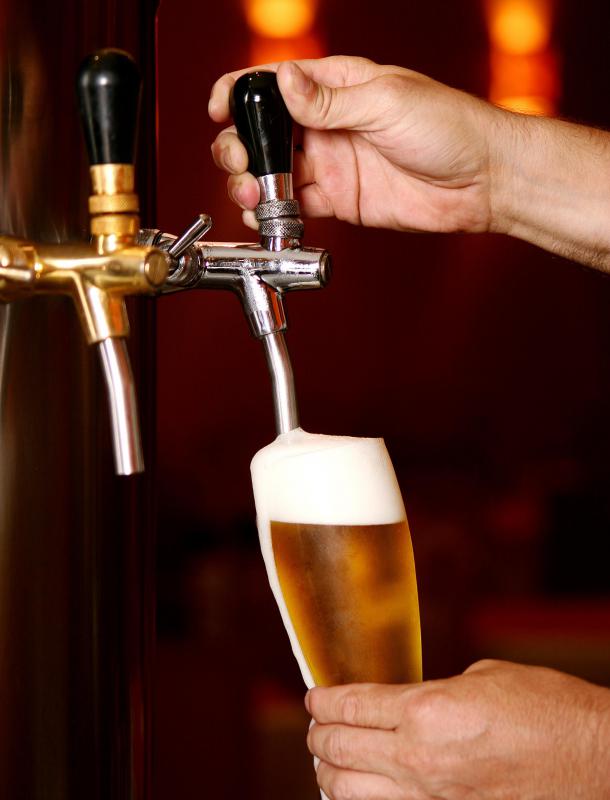
![A maitre d' might be able to recommend different drinks.]() By: Alejandro CatalanA maitre d' might be able to recommend different drinks.
By: Alejandro CatalanA maitre d' might be able to recommend different drinks.


Discussion Comments
@ anon81608: That's great. I have been in the restaurant field for over ten years, and being only 31, I would love to find a Maitre d' position. I at first, was a little skeptical because I have only worked at corporate restaurants.
I do think that in some very top notch restaurants however, it is customary to tip the Maitre d' before sitting down or immediately after sitting down. People like to do this to ensure the best service, or maybe to get particular seating in a restaurant.
This might not be part of the official rules and a lot of this probably takes place discreetly. But it is part of the culture so to speak.
Should a Maitre d' be given more tip in comparison to a regular server? How much more?
@anon81608-- That's not surprising because there is currently a shortage of Maitre d's in the restaurant business. And the most important qualifications for this position are communication, problem-solving and organizational skills. The rest-- which is basically knowledge of menu and wines-- can be learned on the job.
Of course, experience helps, but like I said there is a shortage. So if anyone who has these skills is looking for a job in the restaurant business, this is a great option.
@anon99657: I work as a maitre'd and you want to know if you are under managers or they are under you. The answer is that you are under them any decision you make you tell them before you take action against something or somebody.
I still don't understand where the Maitre d' stands in a five star hotel's organisational chart. Is it a higher position than restaurant manager or similar?
I have been offered this position in the hotel where each restaurant has its own manager but I am offered much better pay than all the restaurant managers.
I am now confused whether i need to work under those managers or they are under me. I wanted to know before joining the position to reduce confusion between the managers and me.
you know this has helped me a lot. I have just received a job offer as maitre'd of a restaurant/hotel with no former experience but the people and communication skills i have.
Post your comments