
At TheHealthBoard, we're committed to delivering accurate, trustworthy information. Our expert-authored content is rigorously fact-checked and sourced from credible authorities. Discover how we uphold the highest standards in providing you with reliable knowledge.
What is a Kidney?
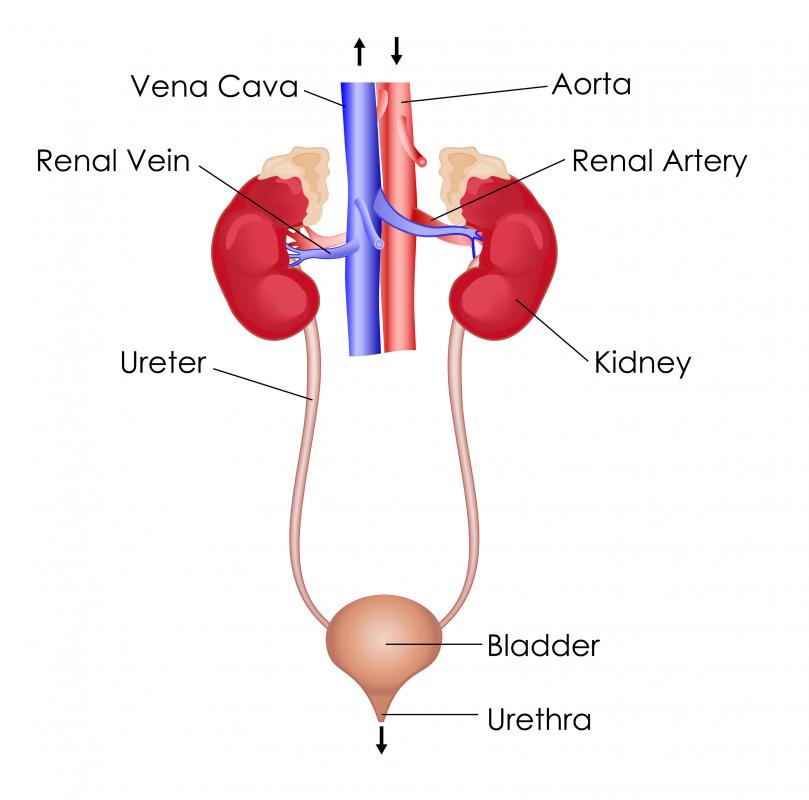
The kidneys are a pair of small organs located in the lower back in humans, and they are vital to life. They are found within many types of animals and play a crucial role in the urinary system of these animals. Other functions that they perform relate to homeostasis within the organism, electrolyte balance, and blood pressure.
In humans, each kidney has a bean-shaped appearance with a convex and concave side. The outer skin of the organ is called the renal capsule. The inside can be divided into two main sections, the central part and the peripheral part.

The two parts of the peripheral section are the cortex, which is the outer part of the inside, and the medulla, which is most innermost part. The medulla is further divided into many sections called the medullary pyramids. Nephrons are tiny structures that are located inside the medullary pyramids, where they filter water out of the bloodstream.
The central part of the kidney contains a calyx, which can further be divided into the major and minor calyx, and the pelvis, which is a dilated part of the ureter. The ureter is a tube that has a primary function of draining any urine produced into the bladder. Both the major calyx and minor calyx are found surrounding a group of tissues within the organ known as the malpighian pyramids.

The main function of these organs is to retain water, electrolytes, and salts while removing urea, wastes, and toxins from the bloodstream. Electrolyte balance is maintained by filtering the electrolytes, secreting them into the bloodstream, and reabsorbing them from other byproducts. The kidneys’ production of rennin plays a role in homeostasis of both water and electrolytes.

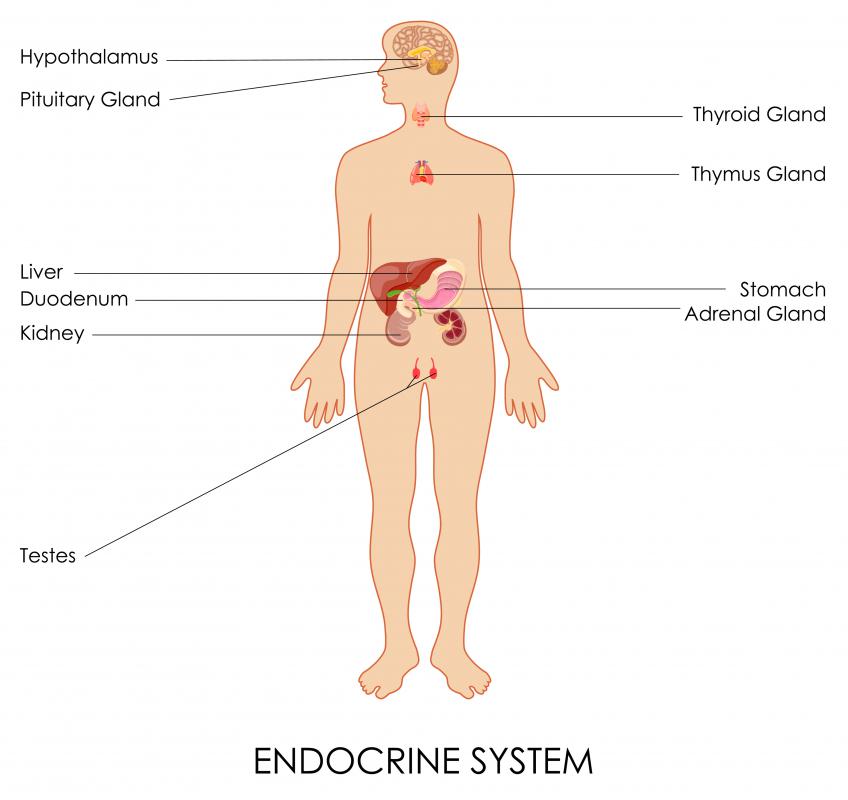
The kidney also plays a crucial role in the endocrine system. It is responsible for the activation for erythropoietin, a hormone that is needed for the production of red blood cells. The organ also is needed for regulating calcium metabolism, because it activates vitamin D to regulate calcium metabolism.
Although humans are born with two kidneys, it is possible for a person to survive with only one. This is because each is packed with renal tissue, which is more than enough for daily use and is quite capable of carrying out the necessary functions all on its own. Kidney trouble will result when this renal tissue is below the required amount needed for the organ to be able to carry out its daily functions.
AS FEATURED ON:
AS FEATURED ON:


-
![Man reaching back and pressing on the location of his kidneys.]() By: underdogstudiosMan reaching back and pressing on the location of his kidneys.
By: underdogstudiosMan reaching back and pressing on the location of his kidneys. -
![A diagram of a human kidney.]()
A diagram of a human kidney. -
![The kidneys are part of the larger excretory system.]() By: snapgalleriaThe kidneys are part of the larger excretory system.
By: snapgalleriaThe kidneys are part of the larger excretory system. -
![The kidney plays a crucial role in the endocrine system, as it activates the hormone erythropoietin.]() By: stockshoppeThe kidney plays a crucial role in the endocrine system, as it activates the hormone erythropoietin.
By: stockshoppeThe kidney plays a crucial role in the endocrine system, as it activates the hormone erythropoietin. -
![Kidneys play a crucial role in the urinary system, electrolyte balance and blood pressure.]() By: Sebastian KaulitzkiKidneys play a crucial role in the urinary system, electrolyte balance and blood pressure.
By: Sebastian KaulitzkiKidneys play a crucial role in the urinary system, electrolyte balance and blood pressure. -
![The kidneys retain water while removing toxins from the bloodstream.]() By: Yuriy ShevtsovThe kidneys retain water while removing toxins from the bloodstream.
By: Yuriy ShevtsovThe kidneys retain water while removing toxins from the bloodstream.




Discussion Comments
I was born with polycystic kidney disease, but I didn't know I had it until I was twenty-six. I started having severe abdominal pain, and after a misdiagnosis of IBS and a CT scan, my doctor discovered that I had multiple cysts on my kidneys.
The cysts most likely will continue to grow over the years, and they will eventually choke out my kidney function. In the beginning, the only symptom I had was the pain, but in a few years, I also developed high blood pressure from the disease. I am now on blood pressure medication that has reduced it to a normal level.
My doctor told me to eat a low sodium and low protein diet. She also said to consume minimal caffeine and drink lots of water. I am doing everything I can to make my kidneys last as long as possible.
@BrickBack – Sometimes, even kidneys that come from family members can be rejected by the recipient. I worked with a man who needed a transplant, and his brother was a match, so they had the surgery.
At first, things appeared to be going well, but within the week, the man who received his brother's kidney developed complications and died. I'm not sure if it was an outright rejection or some sort of infection, but either way, it didn't work out.
Still, I would much rather receive a kidney from a living donor than from a dead donor. It would be horrible knowing that someone had to die for you to live.
I know that urinary tract infections can lead to kidney infections. I always make sure to see a doctor whenever I'm having symptoms of one so that it doesn't travel to my kidneys.
I've heard that drinking cranberry juice is good for your kidneys and the rest of your urinary tract. I've been drinking it every day, and I haven't gotten any more infections since I started.
I've read that it contains an acid that keeps bacteria from clinging to your urinary tract. I've also heard that drinking water helps flush bacteria out.
I have a friend who gets kidney stones rather frequently. He says that the kidney pain is the worst pain he's ever felt.
I've never had a kidney stone, but everyone who has had one says that the pain is unbearable. My friend has had to have his stones broken up with a laser before, and then he had to wear a catheter in order to pass them.
One thing that I've noticed about my friend and other people I know who get kidney stones is that they don't drink much water. They drink a lot of soda and caffeinated tea. I believe that if they drank more water and less other beverages, they wouldn't get stones as often.
Is it possible to retain the kidney at level stage 4?
SurfNturf-If significant damage to the kidney is done and advanced kidney disease sets in kidney treatments such as dialysis is necessary to support the kidney function.
In addition a kidney donor may be needed in order for the doctor to perform kidney transplantation.
A kidney transplant requires a long waiting period in which the patient has to place his or her name on a list of people needing a kidney.
Sometimes the wait for these new kidneys might last several years. Sometimes family members can donate a healthy kidney if they are a match.
For example, the famous comedian George Lopez had to have a kidney transplant and his wife was a donor. If a person is healthy they only really need one kidney this is why it is often done through family members.
Kidney disease has some noticeable symptoms. The most noticeable is the retention of fluids and increased edema.
Swollen ankles or legs can be a sign that the kidneys may not be working properly. If you drink additional fluids and the swelling gets worse then there is some sort of kidney damage.
Sometimes if you feel pain in your lower back to the right of the spine or to the left of the spine that is coming from your kidneys and it could be a sign that you need to drink more water.
However, if this pain occurs in conjunction with a fever and urinary problems then you may have a kidney infection because these are the kidney symptoms that are most common.
Post your comments