
At AllThingsNature, we're committed to delivering accurate, trustworthy information. Our expert-authored content is rigorously fact-checked and sourced from credible authorities. Discover how we uphold the highest standards in providing you with reliable knowledge.
What is a Jellyfish?
Jellyfish are an invertebrate species of sea dwelling animal that are so named due to their gooey gelatin-like bodies. Despite the name, they are not fish. They belong to the Cnidaria phylum, which includes other simple-bodied marine invertebrates such as sea anemones and corals. The jellyfish is considered simple-bodied because, like its Cnidarian cousins, it has no head, brain, heart, eyes, or ears. Thus it is also lacking in the sensory systems that correspond to these organs.
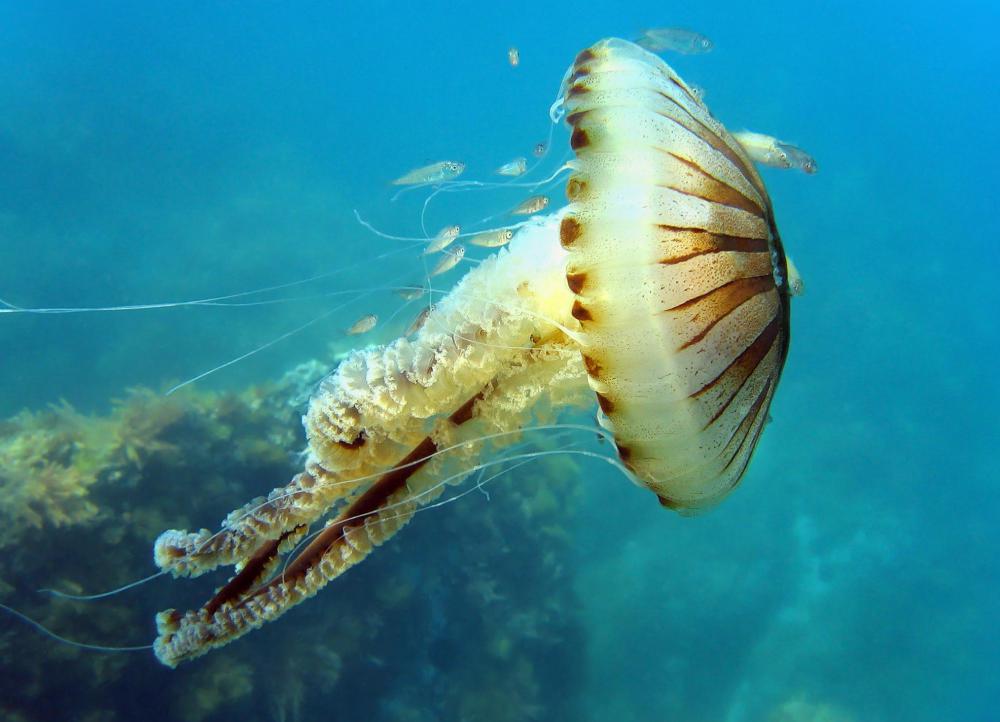
There are over 2,000 species of jellyfish, or jellies as they are sometimes called. Fossil evidence of these creatures dates back to over 650 million years ago, during the late Proterozoic Era. With so many species of cnidarians floating about, there is bound to be variety in the appearance of their body parts. However, the typical body is composed of the bell, the oral arms or feeding arms, and the tentacles. There are some species that do not have tentacles.

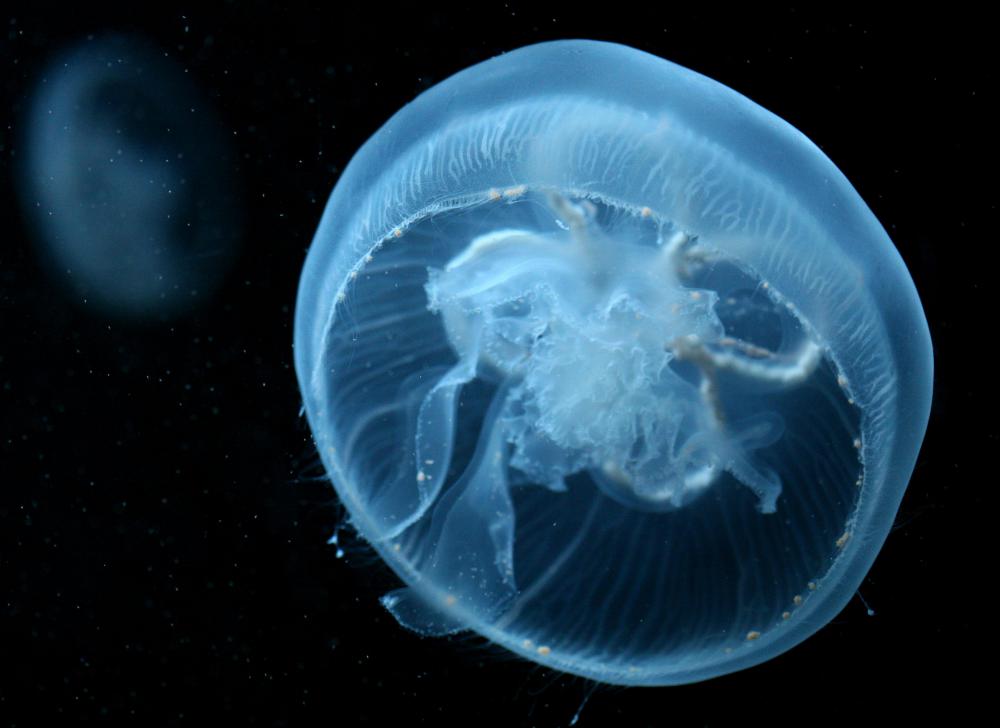
The bell of the jellyfish is the smooth umbrella-shaped body that is designed to flap or pump, in order to propel the animal around in the water. Inside the bell are the mouth and stomach cavity. The digestive system is very simple. It takes in food and expels waste through the same opening. The stomach cavity, which can be considered the jellyfish’s “inside,” is lined with cells called gastrodermal cells. These cells are involved in digesting food, and are separated from the “outside,” or epidermis, by a layer of jelly-producing mesoglea. The edge of the bell-shaped body called the rhopalial lappet, and is the location where the tentacles are usually attached.

The jellyfish has no brain, but it does have a simple nervous system called a nerve net, which spreads throughout the epidermis of the animal. When the tentacles come in contact with potential prey, the cells of the nerve net respond by shooting out the many stinging cells contained in the tentacles. This is how the creature reacts to touch stimuli.
Likewise, although the jellyfish does not have sensory organs, per se, it does possess tiny simple sensory structures that allow it to respond to other external stimuli. Ocelli are simple but specialized structures in the body that react to light. Thus the jellyfish, lacking a brain and eyes, can respond to sunlight shining through the water. It should be noted that, although it can perceive light, without eyes it cannot see images. This animal might also have a statolith structure, which allows the animal to respond to gravity.
Jellyfish, because of their stinging tentacles, can be dangerous to humans. Of the more than 2,000 species, roughly 70 are thought to be potentially dangerous to humans. The stings of some of these can even be fatal to humans, and may leave permanent scars on any victim lucky enough to survive. The most dangerous species are the Lion’s Mane jelly, the Sea Nettle jelly, the Sea Wasp jelly, and the Portuguese Man-of-war.
Frequently Asked Questions
What exactly is a jellyfish?
A jellyfish is a free-swimming marine animal with a gelatinous umbrella-shaped bell and trailing tentacles. The bell can pulsate for locomotion, while tentacles can be used to capture prey. Jellyfish are part of the phylum Cnidaria, which includes creatures that possess cnidocytes, specialized cells for capturing prey.
How do jellyfish reproduce?
Jellyfish have a complex life cycle that includes both sexual and asexual reproduction. According to the Smithsonian Institution, adult jellyfish, known as medusae, release eggs and sperm into the water, where fertilization occurs. The resulting larvae, called planulae, settle on the seafloor and develop into polyps, which can asexually produce new jellyfish through a process called strobilation.
Can all jellyfish sting?
Most jellyfish have stinging cells called cnidocytes that contain nematocysts to capture and subdue prey. However, not all jellyfish stings are harmful to humans. For example, the sting of the common moon jellyfish (Aurelia aurita) is generally not strong enough to penetrate human skin, while others, like the box jellyfish, can be extremely dangerous.
What do jellyfish eat?
Jellyfish are typically carnivorous, feeding on a diet of small fish, plankton, crustaceans, and even other jellyfish. Their stinging cells immobilize prey, which is then moved to the mouth for digestion. According to the National Ocean Service, jellyfish are not picky eaters and will consume food items as they encounter them.
How long do jellyfish live?
The lifespan of a jellyfish varies widely depending on the species. Some small jellyfish may live only a few days, while larger species can live for several months to years. The immortal jellyfish (Turritopsis dohrnii) is an exceptional case; it can potentially reverse its aging process and theoretically live indefinitely under the right conditions, as noted by marine biologists.
Are jellyfish populations increasing, and if so, why?
There is evidence suggesting that jellyfish populations are increasing in some areas of the world. Factors contributing to this rise include overfishing, which reduces their predators and competitors, climate change, and ocean acidification. The increase in coastal development also provides more substrates for jellyfish polyps to attach to and grow, as reported by studies in marine ecology.
AS FEATURED ON:
AS FEATURED ON:









-
![A colorful jellyfish.]() By: vilainecrevetteA colorful jellyfish.
By: vilainecrevetteA colorful jellyfish. -
![Bioluminescent jellyfish often populate the aphotic zone of the ocean and produce their own light.]() By: Vladimir WrangelBioluminescent jellyfish often populate the aphotic zone of the ocean and produce their own light.
By: Vladimir WrangelBioluminescent jellyfish often populate the aphotic zone of the ocean and produce their own light.
Discussion Comments
So, it sounds to me like a jellyfish is one big ball of nerves! I wonder how jellyfish predators keep from getting stung inside while eating them. I've heard that sea turtles and sharks eat them, but I don't see how.
@healthy4life – It feels like nothing else. The pain that they inflict will cause goose bumps to come up on your skin and remain there for hours, and you may get purple streaks in the area from the tentacles.
When I got stung, my skin felt like it had been frozen and burned at the same time. Because you get lasting chill bumps, you think that your skin is cold, but the stinging and burning are so intense that you wonder if it is instead burning off.
There are medications that you can take to the beach with you to lessen the pain. Also, I've heard that putting baking soda on the area after a sting will lessen it. I've also heard that the first thing you should do is scrape off any remaining tentacles with a credit card or similar object so that you won't get a continual dose of pain.
What does it feel like when a nonlethal jellyfish stings you? I'm going on vacation in a spot that doesn't have the kind that will kill you, but I've heard that stings are still painful. What sort of pain is it, and does it compare to anything else that you may have experienced?
There is more jellyfish information in this article than I have ever known. I actually feel a little silly that I have run from jellyfish now, because they have no eyes, so it's not like they are headed toward me in order to attack.
It's a little sad that I can be bested by something with no brain and no heart. I certainly feel like these creatures have an evil scheme once they hit me with their tentacles and shoot pain through my body.
Jellyfish are so squishy and hurt like hell when they sting you!
@chrisinbama: The box jellyfish was actually included in the article under its other name, the sea wasp. They primarily live off of the coastal waters of Northern Australia and throughout the Indo-Pacific. Their color is pale blue and transparent.
Box jellyfish are said to be highly advanced among the jellyfish world. They have developed their ability to move, rather than just drift. They have eyes grouped in clusters of six on the four sides of their bell. Each cluster has a pair of eyes with a highly sophisticated lens, retina, cornea, and iris. Scientists aren’t sure how they process what they see because they do not have a central nervous system.
@chrisinbama: That is true. The box jellyfish has venom that is considered to be among the most deadly in the world. In the ocean, this is a great tool for the jellyfish to instantly kill or stun prey such as fish or shrimp.
The venom of the box jellyfish contains toxins that attack the nervous system, the heart, and skin cells. It is said that the sting from this creature is one of the most painful things a human can experience. Many people have gone into shock or died of heart failure before they ever reach shore. People who are fortunate enough to survive the sting of the box jellyfish will experience excruciating pain for many weeks and often have significant scarring where the tentacles touched the skin.
I thought the box jellyfish was one of the deadliest.
Post your comments