
At WiseGEEK, we're committed to delivering accurate, trustworthy information. Our expert-authored content is rigorously fact-checked and sourced from credible authorities. Discover how we uphold the highest standards in providing you with reliable knowledge.
What is a Hospital Gown?
 Tricia Christensen
Tricia Christensen
Tricia Christensen
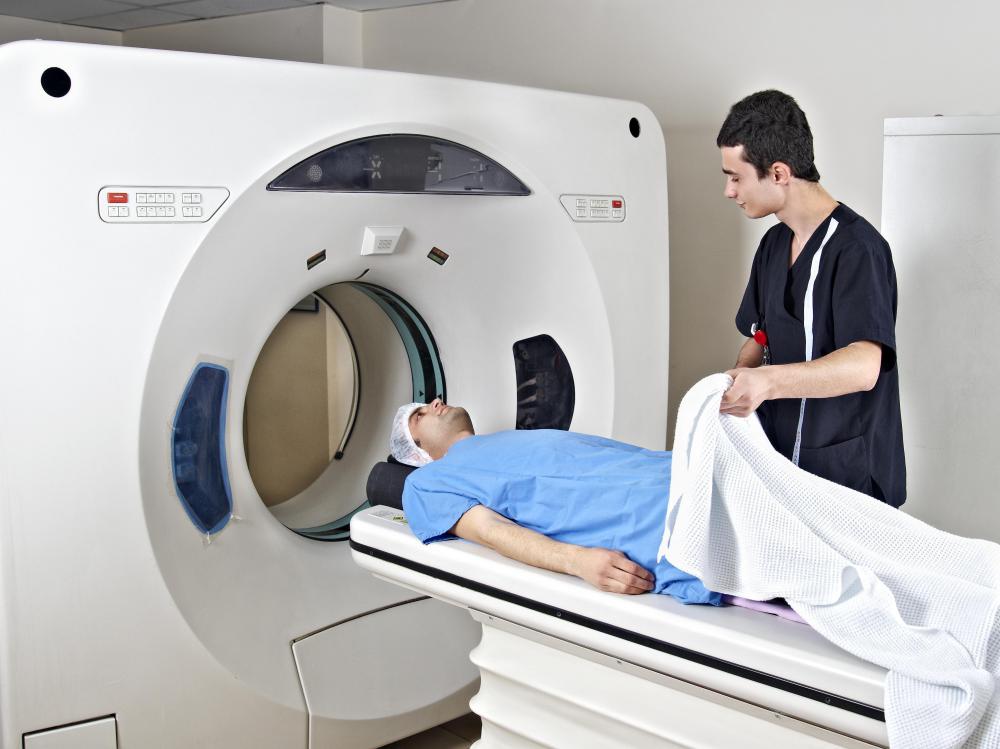
A hospital gown is a thin gown that has back ties. It may be made of cotton or paper and is frequently worn by patients in the hospital setting. Doctors offices may also request patients don a hospital gown prior to examinations, and hospital gowns are common attire for a number of outpatient tests and procedures, such as mammograms, CAT scans, or sonograms.
Paper, or paper/plastic disposable hospital gowns are most commonly used in doctor’s offices, since if a patient has to wear one for a few hours he/she may get cold and uncomfortable. Using cotton gowns is more cost effective and environmentally friendly because they can be rewashed and used again. Though gowns come in a variety of sizes, to accommodate anything from babies to small and large adults, few would call a hospital gown flattering attire. They are designed primarily for the convenience of doctors and nurses, instead of to suit the fashion or even privacy needs of patients.

One frequent complaint regarding the hospital gown is that even with back ties or snaps, the rear end is seldom covered completely. On the one hand, this gives doctors and other medical professionals easy access to giving shots in the rear, or to changing patients who have toileting needs. On the other hand though, getting out of bed, especially in a shared room with another patient, can reveal more about you than you’d feel comfortable letting a host of strangers (or friends and family) know. You may want to ask whether you can keep underwear on if you’re staying in a hospital; choose large full coverage undies or boxer shorts, rather than revealing thongs or bikini style pairs. Another option is to bring a robe, but it may be difficult to get one on if you have IV (intravenous) lines in your arms.

Sometimes, when a hospital stay is lengthy, you may not need to wear a hospital gown the entire time, though there are certainly now some “designer” gowns, which might give you some range in fabric patterns. However, you may be able to wear your own clothing, pajamas, nightgowns or robes, and some believe this elevates mood and makes hospital patients feel less like victims or sick people. If you do need to stay in a hospital gown, and feel a little bare, you could wear two of them, one that closes in front, and one in back for more privacy. When privacy is not only a personal but religious need, there are some gowns that provide greater coverage. In the 2000s, a burqa gown was developed to give Islamic women who wear the burqa a better feeling of privacy.

People visiting others in the hospital often find they are a little embarrassed by the frequent nudity caused by inadequate covering. While nudity in other settings and public places is not generally acceptable, in hospitals, it is totally expected. It may take a bit of imagination, but you simply must behave and pretend as though the person is not nearly nude, or that there is nothing abnormal about such a state. Even Miss Manners, suggests that the only polite course of action is to ignore anything you might accidentally see, so as not embarrass a person wearing a hospital gown.
Tricia Christensen
Tricia has a Literature degree from Sonoma State University and has been a frequent WiseGEEK contributor for many years. She is especially passionate about reading and writing, although her other interests include medicine, art, film, history, politics, ethics, and religion. Tricia lives in Northern California and is currently working on her first novel.
Learn more...
Tricia Christensen
Tricia has a Literature degree from Sonoma State University and has been a frequent WiseGEEK contributor for many years. She is especially passionate about reading and writing, although her other interests include medicine, art, film, history, politics, ethics, and religion. Tricia lives in Northern California and is currently working on her first novel.
Learn more...AS FEATURED ON:
AS FEATURED ON:









-
![Hospital gowns usually have snaps or ties.]() By: Andrea ArnoldHospital gowns usually have snaps or ties.
By: Andrea ArnoldHospital gowns usually have snaps or ties. -
![Hospital gowns may not be required for a lengthy stay.]() By: uwimagesHospital gowns may not be required for a lengthy stay.
By: uwimagesHospital gowns may not be required for a lengthy stay. -
![Hospital gowns will usually be worn during CAT scans.]() By: Hakan KızıltanHospital gowns will usually be worn during CAT scans.
By: Hakan KızıltanHospital gowns will usually be worn during CAT scans. -
![Patients may be required to wear hospital gowns during examinations.]() By: WavebreakmediaMicroPatients may be required to wear hospital gowns during examinations.
By: WavebreakmediaMicroPatients may be required to wear hospital gowns during examinations. -
![The central supply of a hospital typically stocks a variety of hospital gown sizes, and may also have several styles.]() By: Carolina K Smith MDThe central supply of a hospital typically stocks a variety of hospital gown sizes, and may also have several styles.
By: Carolina K Smith MDThe central supply of a hospital typically stocks a variety of hospital gown sizes, and may also have several styles. -
![Cotton hospital gowns are more cost-effective than paper gowns.]() By: WavebreakMediaMicroCotton hospital gowns are more cost-effective than paper gowns.
By: WavebreakMediaMicroCotton hospital gowns are more cost-effective than paper gowns. -
![Hospital gowns come in all sizes, including those that will fit a baby.]() By: JorgeAlejandroHospital gowns come in all sizes, including those that will fit a baby.
By: JorgeAlejandroHospital gowns come in all sizes, including those that will fit a baby.






Discussion Comments
As a lifelong naturist, I am more than comfortable with my naked body. Neither do I get fussed, fazed or embarrassed about any bodily function, clinical or investigative procedure. So as I have an upcoming colonoscopy my preference would be not to wear anything. I am sure that I don't have any 'man-bits' that the medical staff haven't seen many times before.
So what reasons can I give not to wear the gown?
My wife is an RN at the local hospital so we both understand medical necessity. Today she had outpatient surgery on her left ring finger to repair a tendon. When she was returned to outpatient recovery, her gown had been totally removed and just laid over her while she was being wheeled from surgery to recovery. Why was it medically necessary to remove her gown to repair an injured finger?
Hospital personnel are human beings first, professionals second.
Indeed, some are not really even professionals, but "assistants" of various sorts, who view (in American culture, at least) nudity as human beings,
with the natural interest which springs from our cultural habit of being constantly covered. So the innate biological/sexual feelings are aroused, even though they are suppressed outwardly.
As a person with nearly two dozen surgeries and far more office and technician exams, I have seen this time and time again. Whether being examined, or showering, or having urinary catheters inserted, or being used as a "display patient" for medical students, it has become obvious from facial expressions, excessively long periods of nudity, positioning, up-close viewing of "private areas" and the virtual certainty that complete nudity is the rule as soon as one is under anesthesia, all these and more demonstrate that medical personnel are not automatons who have nothing other than medical necessity in mind when requiring patients to be excessively or unnecessarily exposed to view.
Even such authorities as Menninger have observed that mentally, our interest in sex is much the same in old age as when young. The history of human (and animal) behavior makes our need to mentally pursue sexual interest virtually unshakable and unremitting. The average person thinks of sexual situations (involving nudity) more than a score of times daily.
"Assistance" while showering in hospitals, changing gowns, getting bed baths, being left fully exposed when the patient is thought not to have the ability to bring about repercussions -- all these and more make medical personnel no less sexual -- or interested in nudity -- than the rest of humankind.
Redmont is right. The hospital is all about the convenience of the personnel and not at all about the convenience of the patient. It's sad, since the patient is the one financing the entire circus, but so often hospitals will provide too little privacy, too little care and too non-sterile conditions, all because "it's the way it's done".
I was in a situation where, after an operation involving spinal anesthesia, a nurse wanted to give me a urethral catheter. For those that don't know what it is, it involves sliding a long tube through one's privates. I refused, and was totally enraged and scared, felt like someone was about to rape me and I was prepared to physically defend myself if need be. Half an hour later, I was able to pass urine normally, but later, I've learned that they prefer to mount Foley catheters because then there's less chance urine will spill. Lazy nurses!
Hospital gowns are cotton, paper or plastic pajamas you wear during your stay at the hospital. There are many different hospital gowns, like surgery gowns. A pajama, a surgery cap and a pair of plastic socks.
it boils down to its easier and more convenient for the providers therefore if it is a problem for you so what? While in general i find medical staff to be very considerate, when it comes to patient modesty they really don't care that much. they have this superior attitude that because it isn't a problem for them, it isn't a problem for you, that I find disgusting and insensitive.
Where can I purchase paper pajamas?
Redmont is more correct than incorrect. Certainly there are some practical preferences for hospital staff. These might be particularly beneficial for helping a patient who is unable to assist him or herself.
For other patients it is at least, in part, the practice of letting you know "you are in their territory" and they are in control . . . not the patient who is purchasing their services.
Hi redmont,
It sounds like you've had terrible experiences in the hospital. I've had some pretty tough ones when my son was hospitalized, but I'd have to disagree with your assessment that gowns are used to intimidate. In fact, the hospital encouraged me to place regular clothing on my son, since his stay was very long, and the staff (nurses and doctors alike), could not have been more accommodating.
There was some difficulty with normal things like PJs because of IVs. Once these are in, you can't quickly get a shirt or pants off, and he had numerous IVS going on arms and legs at different times. Sometimes I found the gowns easier to deal with because if they were soiled, they could be slipped off.
I realize you've got a good point and that some people have tremendously negative experiences in hospital settings. Although ours (4 hospitalizations thus far) have been terrifying because of fear of outcome, I have found so many people to be grateful to, and my experiences were mainly opposite of negative, where I fully participated in medical decisions regarding my child, was included in on discussions, and where both my child and myself were treated with incredible respect, compassion and care. There was no "Patients be damned." I don't doubt the validity of your experiences, but I don't believe they are universal.
Best to you though and thanks for commenting,
Tricia E-C
The only reason to force patients to wear a hospital gown is to intimidate, humiliate and degrade them and show them that the medical personnel are in charge. Otherwise why has not the "gown" changed in style or design in about 85 years? During this time for example the nurses' outfits have changed radically to accord them dignity and respect--but NOT so the patients. Velcro and plastic snaps have all been invented in the last 80 years so why have not these technologies been used to protect privacy and dignity? The answer is simple --the medical profession fights every day to intimidate and humiliate patients--that keeps the staff in charge--patients be damned.
Post your comments