
At EasyTechJunkie, we're committed to delivering accurate, trustworthy information. Our expert-authored content is rigorously fact-checked and sourced from credible authorities. Discover how we uphold the highest standards in providing you with reliable knowledge.
What is a Hi-Speed USB Host Controller?
Universal Serial Bus (USB) is an input/output port standard for computers and digital equipment, which allows easy transfer of data via a direct connection or cable. The original USB standard version has been superceded by hi-speed versions. A hi-speed USB host controller refers to the hardware inside the computer that provides hi-speed USB functionality to the ports.
USB first hit the market in November 1995, but the new standard had compatibility problems. These bugs were addressed and the subsequent USB version is now referred to as “original” USB 1.1. The data transfer rate (DTR) for USB 1.1 was impressive at 12 megabits per second (mbps), and it was intended to replace slower parallel and serial ports for peripheral devices. The first devices to be widely adopted for USB ports were keyboards and mice. Printers, scanners, external tape drives and other devices followed.

As demands for faster data transfer increased, a newer version of USB answered the call. USB 2.0 boasts maximum data rates of 480 mbps, 40x faster than original USB. Computers that supported the old standard required a new hi-speed USB host controller to take advantage of the faster speeds. Devices made for the new 2.0 standard, such as memory sticks and digital cameras, would default to the old, slower transfer speeds if plugged into a computer with a USB 1.1 controller installed.
A hi-speed controller is built into modern computers, while older computers can be updated with the hardware. A controller is inexpensive and can be purchased anywhere computers are sold. It is a card that easily installs into any available slot in the motherboard. The back-facing plate of the controller provides two or more hi-speed USB ports.
To take advantage of USB 2.0 speeds, both the computer and the device plugged into the USB port must both support the 2.0 standard. A hi-speed USB host controller cannot make a USB 1.1 device operate at 2.0 speeds. Hi-speed controllers are backward compatible, however, falling back to the slower 1.1 standard for devices that require it.

One of the many advantages of USB ports is that they can operate in a daisy chain, and one controller can control several USB ports. If a computer doesn’t have enough ports for the user's needs, a USB hub can be added. The hub plugs into a single USB port while offering a “bay” of additional ports. Some devices might require a direct port or a powered hub, however. Powered hubs have their own A/C adapters.
AS FEATURED ON:
AS FEATURED ON:









-
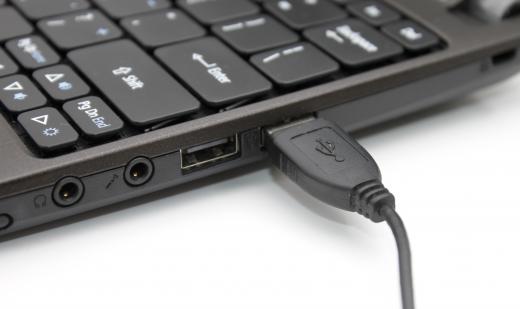
![A USB cable.]() By: michaklootwijkA USB cable.
By: michaklootwijkA USB cable. -
![USB cables are used to connect devices -- such as printers, keyboards and music players -- to computers.]() By: macbrianmunUSB cables are used to connect devices -- such as printers, keyboards and music players -- to computers.
By: macbrianmunUSB cables are used to connect devices -- such as printers, keyboards and music players -- to computers. -
![The data transfer rate USB 1.1 was impressive at 12 megabits per second (mbps), and it was intended to replace slower parallel and serial ports for peripheral devices.]() By: kanvagThe data transfer rate USB 1.1 was impressive at 12 megabits per second (mbps), and it was intended to replace slower parallel and serial ports for peripheral devices.
By: kanvagThe data transfer rate USB 1.1 was impressive at 12 megabits per second (mbps), and it was intended to replace slower parallel and serial ports for peripheral devices.


Discussion Comments
Actually there is no need to pay $30 just because they cost $30 at Best Buy. Try eBay. I got a USB wi-fi device there for under $7, just like the one my friend paid $35 for at Walmart.
Great article. It certainly clears up my lack of understanding concerning the messages that I've been getting, as well as how to resolve this.
If a PVR has a USB host i/o, will it output to a hard drive or only input from a hard drive or USB stick?
@1 If there truly are no other motherboard slots, a new motherboard may be your only option. You may also, however, remove a device from the motherboard such as an unused disk drive to free up space for the USB 2.0 hardware.
@2 You consider $30 to be expensive? Even if you do, in the world of electronics, surely, you can admit that that is a fair price.
@3 You can only download the drivers for a High Speed USB Host Controller. The device itself must be purchased and installed outside of the virtual world.
@4 Your comment made little grammatical sense, but if you are asking for installation directions, I would suggest searching for those directly; however, a brief description of the process varies by your type of computer. On a desktop, it is generally much easier to install such a device because the casing is easily removed by unscrewing a few screws, whereas if you have a sturdy laptop you may want to have it professionally installed because many are built to prevent such hardware upgrades.
@5 If you have a computer that works with USB 2.0, a USB 2.0 hub, and a USB 2.0 compliant device, that device will run at USB 2.0 speeds. This person, when he or she said "A hi-speed USB host controller cannot make a USB 1.1 device operate at 2.0 speeds," he or she meant that if you have a hi-speed USB host controller, a computer with the proper drivers, and a device that is not compliant with USB 2.0, it will not work.
thanks for the info. I'm a bit ignorant about this. thanks.
Thank you for your explanation. Please forgive my ignorance. My laptop has 1 USB 1.1 port. Hence I thought that buying a host controller or PCMCIA card would enable me to convert my laptop to a USB 2.
However, I am perplexed by your statement: "A hi-speed USB host controller cannot make a USB 1.1 device operate at 2.0 speeds." I want to know whether I should or should not buy the PCMCIA card, for which my machine does have a slot? Is it worthwhile, or does the laptop (with the card in)continue to operate at 1.1 speeds, as it does now although I may have a USB 2 gadget (e.g. a flash drive, or a printer)on it? Thank you in advance.
how can install my computer that hi speed usb port?
how do i download HI-Speed USB Host Controller?
Very helpful advice on the high-speed USB host controller, except you say "inexpensive" but the required PCMCIA card (which you should mention is necessary when a laptop is involved) costs $30 plus tax at Best Buy.
hi, thank you for the nice article. But I am still wondering how I can boost speed of the USB ports of my laptop. My laptop has USB 1.1 ports and does not have any empty slot in the motherboard to install a USB 2.0 host controller. Is there any way?
Post your comments