
At TheHealthBoard, we're committed to delivering accurate, trustworthy information. Our expert-authored content is rigorously fact-checked and sourced from credible authorities. Discover how we uphold the highest standards in providing you with reliable knowledge.
What is a Hep Lock?
A hep lock is a small tube that a medical professional inserts into the arm or other site on a patient's body. The tube has a catheter on one end. The healthcare provider administers medication or fluids in an efficient manner through the catheter lock, which works by keeping a vein accessible.
The device is referred to as a hep lock because a medication called heparin or a similar blood thinner is injected to flush the site and keep the vein open by stopping a clot from forming. When medication is not being administered, the tube must be flushed with heparin and saline on a regular basis to keep the site viable. With this slight maintenance, the site is kept viable for days longer than a traditional IV. Although saline locks are often used to secure administration sites, many in the medical profession also refer to them as hep locks because they accomplish the same goal.

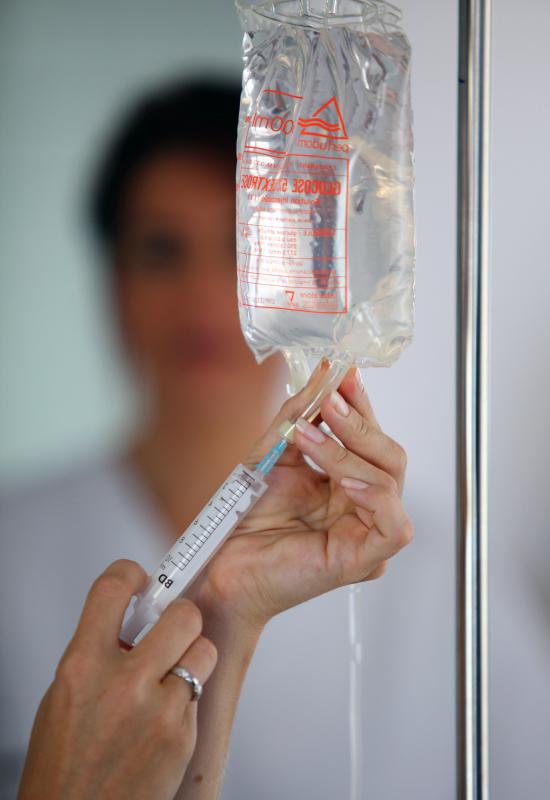
In many instances, this tube is a viable and preferred alternative to an intravenous line (IV). In patients who require multiple but not continuous doses of medication, for example, it allows the administration of medication without the hassle of a cumbersome IV. Medication can be administered through a lock injection directly with a syringe or by hooking up IV to the catheter.

When quick access to veins is imperative, such as with pregnant women or patients in critical condition, a hep lock makes administration of emergency medications easier and faster. This reduces the risk that a patient might not get lifesaving medicine quickly enough. Medical professionals commonly use this procedure and device for pregnant women, in order to be able to quickly administer saddle block or epidural medication, as well as to administer medications needed because of a hemorrhage or emergency caesarian section.

Patients and nurses often praise the hep lock because it does not have to be moved as often as an IV. This means fewer needle sticks and, therefore, less pain for patients. Nurses can administer medications without disturbing sleeping patients. There is also no line attached when medication is not flowing, so the site allows the patient greater mobility.

Experts warn that hep locks should not be used for patients who have thrombocytopenia or for those who have active, uncontrollable bleeding, unless it is because of disseminated intravascular coagulation. For patients on full-dose heparin, appropriate and periodic tests should be performed in order to assess clotting time and other important statistics related to the use of blood thinner medication. Otherwise, a heparin lock usually is a viable and cost-saving alternative to a traditional IV.
AS FEATURED ON:
AS FEATURED ON:


-
![Medication is administered through the hep lock, which keeps veins accessible to the health care provider.]() By: Aleksandrs JermakoviMedication is administered through the hep lock, which keeps veins accessible to the health care provider.
By: Aleksandrs JermakoviMedication is administered through the hep lock, which keeps veins accessible to the health care provider. -
![A hep lock may be used with pregnant women to administer medications more quickly.]() By: LanaKA hep lock may be used with pregnant women to administer medications more quickly.
By: LanaKA hep lock may be used with pregnant women to administer medications more quickly. -
![A hep lock is usually inserted into the arm of a patient's body.]() By: skampixelleA hep lock is usually inserted into the arm of a patient's body.
By: skampixelleA hep lock is usually inserted into the arm of a patient's body. -
![A hep lock is a good alternative to an intravenous line for patients who receive multiple medications.]() By: auremarA hep lock is a good alternative to an intravenous line for patients who receive multiple medications.
By: auremarA hep lock is a good alternative to an intravenous line for patients who receive multiple medications. -
![Medical professionals commonly use a hep lock for pregnant women.]() By: jovannigMedical professionals commonly use a hep lock for pregnant women.
By: jovannigMedical professionals commonly use a hep lock for pregnant women.



Discuss this Article
Post your comments