
At EasyTechJunkie, we're committed to delivering accurate, trustworthy information. Our expert-authored content is rigorously fact-checked and sourced from credible authorities. Discover how we uphold the highest standards in providing you with reliable knowledge.
What is a Gigabit Switch?
In computer networking, an Ethernet switch connects multiple devices, such as computers, servers, or game systems, to a Local Area Network (LAN). Small business and home offices often use such a switch to allow more than one device to share a broadband Internet connection. A gigabit switch operates in the same manner, only at data rates much greater than standard or Fast Ethernet. People can use these switches to quickly transfer data between devices in a network, or to download from the Internet at very high speeds.
Purpose

Broadband Internet connections to streaming audio and video have increased the demand for faster and more stable transmissions. Gigabit Ethernet transmits at approximately one gigabit per second. That is at speeds nearly 100 times those of Fast Ethernet, which transfers data at approximately 10 megabits per second. The gigabit switch is designed to work at these increased speeds, without signal loss or transfer rate reduction.
Difference Between a Switch and Hub
When shopping for a gigabit switch, it is important to ensure the item purchased truly is a switch and not a hub. An Ethernet switch and a hub are similar in their function, but operate quite differently. The primary feature that sets the switch apart is that each connection to it has its own dedicated bandwidth and does not share lines of transmission with other connected devices; this is called "Full Duplex." This leads to less data collision and faster, more reliable communication speeds compared to hubs that share bandwidth among connected devices.
Functionality With Other Devices
A gigabit switch can be used in conjunction with other network devices. Broadband modems, such as those used with Digital Subscriber Line (DSL) or cable Internet services, have only one wired connection available. Users can install a gigabit switch along with a modem to allow multiple connections, or to create a local network among different devices. Although these switches were initially quite expensive, they have become increasingly available for use in home offices and for entertainment setups.
Proper Setup
When setting up a gigabit Ethernet network, users should ensure that all of the components are designed for high gigabit speeds. Using a slower-rated modem can reduce transfer rates, even if the other networking devices, like a computer and gigabit switch, are geared for gigabit speeds. People setting up this type of system should also ensure they have the fastest Internet speeds available from their service providers.
Usually, a Category 6 (CAT6) Ethernet cable is optimal for connecting other network devices or computers to a gigabit switch. Category 5 (CAT5) cables are only rated for Fast Ethernet or 10 megabits per second. People can use some Category 5E (CAT5E) Ethernet cables for connection to a gigabit switch, but they are often less reliable than CAT6 cables.
AS FEATURED ON:
AS FEATURED ON:









-
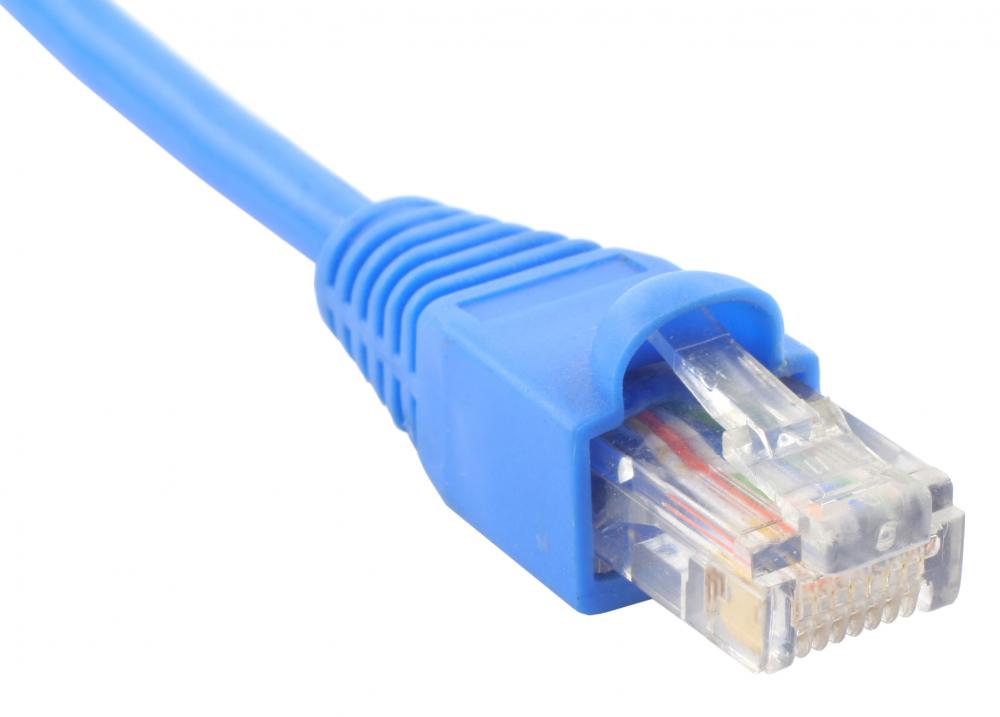
![Cat 5 cable with RJ45 plug.]()
Cat 5 cable with RJ45 plug.
Discussion Comments
I have a garage sale find I would like to modify for another purpose: an Amer SR48G2i switch. Can I use it to connect all of the phones in a small hotel? It has 48 outports (more than we need) Can I connect a phone line to it to be shared by all of the phones?
A gigabit switch is handy for allowing devices that are all inside the house to fling bits at each other at a gigabit per second rate. So if you're streaming a video from your home server to your HDTV, a gigabit switch will not slow the stream down as it passes through from the server to the TV.
A video stream that originates from outside the home, however, has to go through your ISP, and usually that shows up in your house as either a DSL or a cable internet connection. DSL connections typically are no faster than 16 megabits per second into the home, and cable internet is usually no faster than 50 megabits per second. In the US, usually much, much slower.
Even optical fiber connections are typically limited to under 100 megabits per second. However, a gigabit switch does not slow the stream down once it gets there. Older switches (and hubs) provide 100, 10, and even 3 megabits per second.
i have an Apple wireless network at home. i have read recently where the internet connection via my wireless hub is slow compared to having my computer wired directly to the modem.
if this is true, could i purchase a gigabit switch and send one output directly to my main desktop computer and another output to my wireless hub? would this improve the speed of my main desktop?
If your modem/router isn't rated for gigabit, no it will not "convert". You can only truly achieve gigabit speeds when all equipment is rated for that. Hope that helps.
If I purchase a gigabit switch and connect it to my wireless modem/router netgear dgn 1000, will this convert my speeds top gigabit? I have a gigabit ethernet adapter.
Post your comments