
At TheHealthBoard, we're committed to delivering accurate, trustworthy information. Our expert-authored content is rigorously fact-checked and sourced from credible authorities. Discover how we uphold the highest standards in providing you with reliable knowledge.
What is a Fluid Bolus?
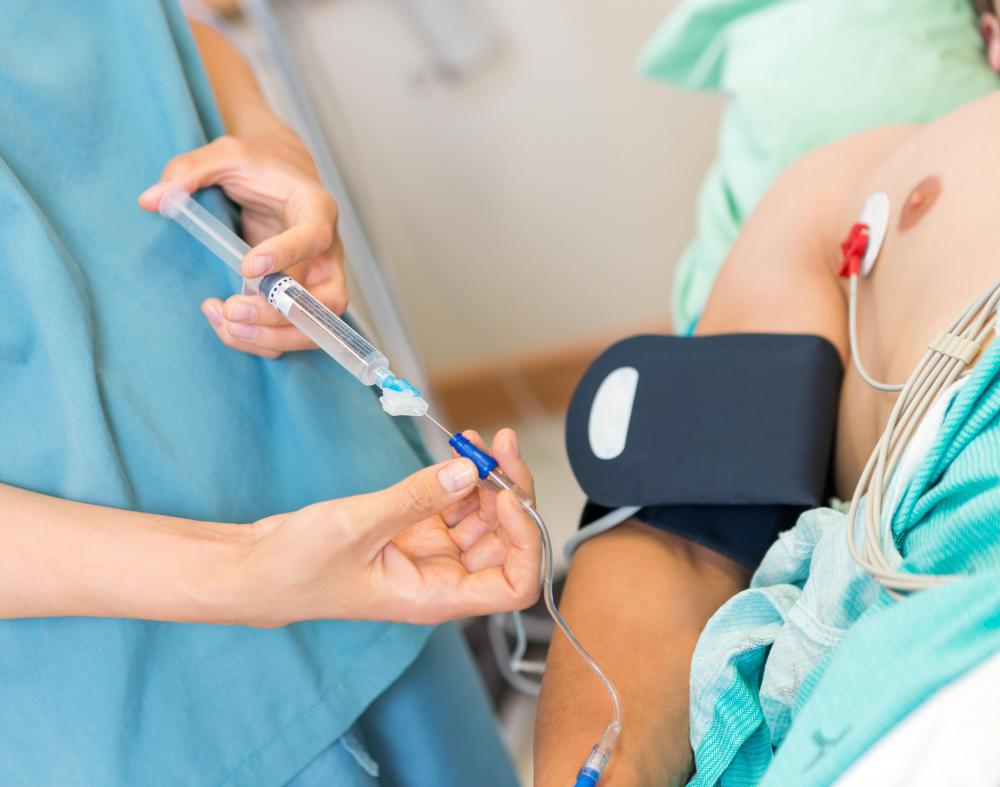
A fluid bolus is a rapid infusion of intravenous fluid or medication that is usually administered to correct a life-threatening condition. When an individual receives this treatment, he must be carefully monitored by properly trained health care personnel.
There are many conditions that require the administration of fluids rapidly through an intravenous (IV) line. An IV bolus may be given to an individual who is severely dehydrated, such as after a long period of vomiting or diarrhea. In most cases, this fluid loss will be replenished with normal saline.

Normal saline is simply a mixed solution of salt and water, and it is usually the first solution used for an IV bolus because it is considered the safest. If an individual has a health condition that affects the pumping action of his heart, however, he must be monitored closely. If the heart cannot pump effectively enough, the excess fluid can build up in his lungs and cause breathing problems.

If an individual suffers from trauma or any other condition in which he is losing a large amount of blood, then a fluid bolus may be ordered until he can receive a blood transfusion. The may consist of normal saline or another type of intravenous fluid. It is up to a medical professional to decide the type of fluid needed based on the individual's health condition.

Certain medications may require a bolus or a loading dose before a continuous drip of the medicine is administered. This dose may be delivered by direct intravenous injection over two or three minutes, or it may be given through an intravenous pump over a longer period of time. Intravenous medications that affect the heart are just one example of medicines that may require this method.
The fluid bolus is administered by a trained healthcare personnel. The heart and lungs of the patient are assessed prior to, during, and after the administration of the IV. Blood pressure is carefully monitored during the infusion as well.

The bolus equipment used during an intravenous administration of fluid consists of a large-size needle that is placed into a large vein. This needle will be attached to a long plastic tube, which is connected to a bag that contains the prescribed bolus solution. An intravenous pump may or may not be used, but faster administration is accomplished if the fluids are not delivered with an infusion pump.
AS FEATURED ON:
AS FEATURED ON:


-
![A fluid bolus is administered through an intravenous line.]() By: Tyler OlsonA fluid bolus is administered through an intravenous line.
By: Tyler OlsonA fluid bolus is administered through an intravenous line. -
![An intravenous drip drip may be required after a fluid bolus injection.]() By: griezeAn intravenous drip drip may be required after a fluid bolus injection.
By: griezeAn intravenous drip drip may be required after a fluid bolus injection. -
![Bolus equipment may include an infusion pump.]() By: Max TacticBolus equipment may include an infusion pump.
By: Max TacticBolus equipment may include an infusion pump. -
![A saline solution may be administered intravenously to patients suffering from dehydration.]() By: KadmyA saline solution may be administered intravenously to patients suffering from dehydration.
By: KadmyA saline solution may be administered intravenously to patients suffering from dehydration. -
![A fluid bolus is often used because the medication needs to get into the bloodstream quickly in order to correct a life-threatening condition.]() By: tawesitA fluid bolus is often used because the medication needs to get into the bloodstream quickly in order to correct a life-threatening condition.
By: tawesitA fluid bolus is often used because the medication needs to get into the bloodstream quickly in order to correct a life-threatening condition. -
![A fluid bolus may be necessary to buy time before a blood transfusion can be performed.]() By: sudok1A fluid bolus may be necessary to buy time before a blood transfusion can be performed.
By: sudok1A fluid bolus may be necessary to buy time before a blood transfusion can be performed.





Discussion Comments
@tomislav - I wondered the same thing and found out - a bolus can also be talking about a completely non-food or non-drinkable item - it can be talking about wax or paraffin that can be used in a specific radiation application! Will have to make sure to keep our different boluses straight from the bolus into an iv to a bolus describing food after it has been chewed and mixed with saliva (yet another bolus definition)!
This was interesting to learn about. In the speech therapy field we describe the different types of food and consistency of food being a such and such bolus (we use these for swallow studies that are done typically in a hospital setting).
I thought I had missed a step in what I had learned by not remembering learning what a fluid bolus was. (When we administer fluid we just call them a thin liquid, thick liquid, etc. not a bolus - usually the word bolus indicates food). But now I know it is a completely different field using the term bolus.
Does the term bolus have any other uses in other fields?
Post your comments