
At HomeQuestionsAnswered, we're committed to delivering accurate, trustworthy information. Our expert-authored content is rigorously fact-checked and sourced from credible authorities. Discover how we uphold the highest standards in providing you with reliable knowledge.
What is a Floor Buffer?
 Malcolm Tatum
Malcolm Tatum
Malcolm Tatum
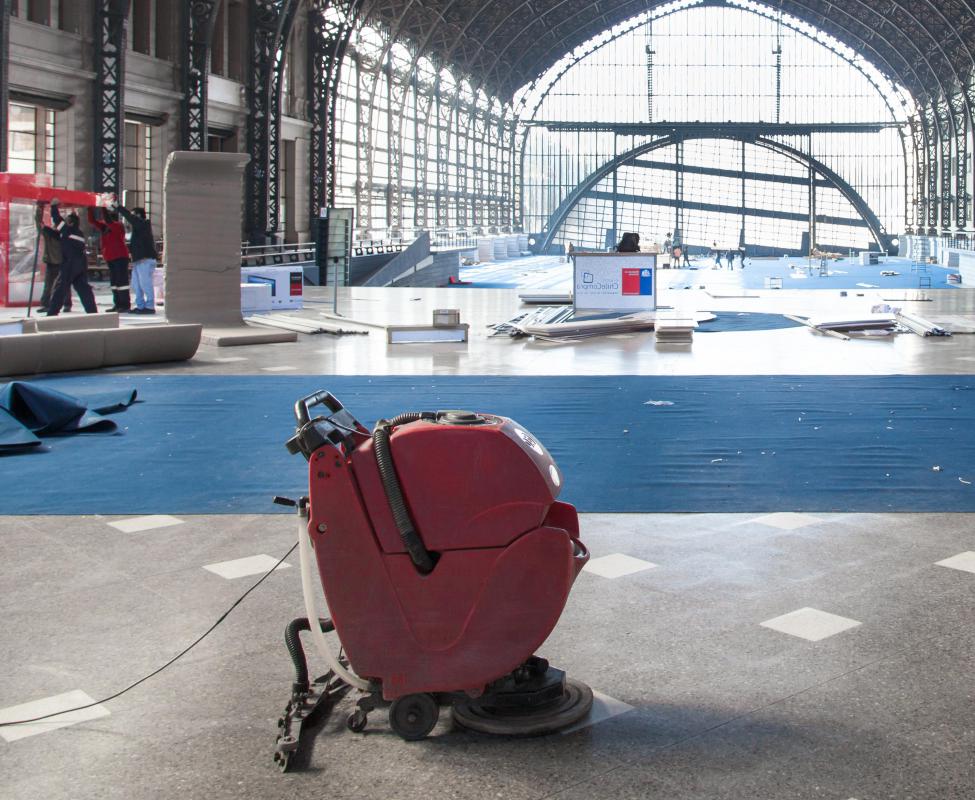
A floor buffer is a machine that is designed to both clean and protect wood, marble and linoleum floors. It gently dislodges dirt and leaves behind a glossy finish in the floor surface. This machine typically resembles a large upright vacuum cleaner and has soft brushes that rotate underneath it to buff the floor.
Features

The rotary brushes on a floor buffer can operate at varying speeds, depending on the type of floor. The buffer has a steering handle and a set of controls that are used by its operator. The controls are used to manage the direction and speed of the rotary brushes.
Use of Cleansers
Floor buffers usually are employed along with some sort of a cleaning agent. It is not unusual for the liquid cleanser to be sprayed on a section of the floor just before the buffer is used on that area. The cleaning agent will help to loosen any dirt and grime from the surface of the floor, making the process of obtaining a clean and glossy floor much easier.
Industrial Models
Buffing floors in different settings will require a variety of speeds and mobility, so there are different sizes of floor buffers available. Commercial or industrial buffers usually are larger and can cover a wider area of the floor with each pass. Some commercial models also double as floor strippers. Increasing the speed and the pressure employed by the rotary brushes can change the floor buffer's effects from simply cleaning the surface to stripping off wax buildups or stains. These combination floor strippers and buffers tend to be very expensive, but they are almost an essential for maintaining floors in public buildings.
Home Versions
For home use, smaller versions of floor buffers often work very well. Designed to buff floors that receive the usual amount of home traffic, they operate at lower speeds that commercial or industrial buffers and often do not include a stripping feature. Instead, they simply work in conjunction with a cleaning agent to lift dirt and grime and leave behind a clean and shiny floor surface. A home floor buffer is much less expensive than an industrial version, and it tends to be a bit smaller. This allows the home floor buffer to easily get into tight areas, such as in a bathroom, between furniture or in nooks and crevices in a kitchen.
Malcolm Tatum
After many years in the teleconferencing industry, Michael decided to embrace his passion for trivia, research, and writing by becoming a full-time freelance writer. Since then, he has contributed articles to a variety of print and online publications, including HomeQuestionsAnswered, and his work has also appeared in poetry collections, devotional anthologies, and several newspapers. Malcolm’s other interests include collecting vinyl records, minor league baseball, and cycling.
Learn more...
Malcolm Tatum
After many years in the teleconferencing industry, Michael decided to embrace his passion for trivia, research, and writing by becoming a full-time freelance writer. Since then, he has contributed articles to a variety of print and online publications, including HomeQuestionsAnswered, and his work has also appeared in poetry collections, devotional anthologies, and several newspapers. Malcolm’s other interests include collecting vinyl records, minor league baseball, and cycling.
Learn more...AS FEATURED ON:
AS FEATURED ON:


-
![Floor buffers are machines designed to both clean and protect wood, marble and linoleum floors by gently dislodging dirt and leaving behind a glossy finish on the floor surface.]() By: bruno135_406Floor buffers are machines designed to both clean and protect wood, marble and linoleum floors by gently dislodging dirt and leaving behind a glossy finish on the floor surface.
By: bruno135_406Floor buffers are machines designed to both clean and protect wood, marble and linoleum floors by gently dislodging dirt and leaving behind a glossy finish on the floor surface.
Discussion Comments
I invested close to $300 for a Hoover floor buffer. It seemed like a lot of money at the time, but I have been pleased with the way it cleans and polishes my floors.
It is a little bit heavy when I am hauling it up and down stairs, but once I have it situated, it is easy to use.
The buffer does all the work and all I do is guide the machine where I want it to go. The buffer is a round shape and easily gets in small spaces.
It also has a smooth finish to it, so if I happen to bump the wall or any furniture, it doesn't do any damage.
I only have carpet in two rooms of my house, and the rest is either hard wood floor or tile. I bought a floor buffer polisher mainly to use for my hard wood floors, but it works well on the tiled floors too.
This buffer has a long cord so it will reach a long ways before I have to plug it in to a different outlet.
Once I plug it in, it is so easy to just stand there are move it back and forth. The pad underneath is machine washable, so is easy to keep clean as well.
I carry a bottle of spray cleaner as I use the polisher and when I am done my floors look really clean and shiny.
This is similar to a commercial floor buffer, but is a smaller size and perfect for smaller homes. This leaves my floors looking so much cleaner than other things I have used in the past.
nice explanation, thanks.
Floor buffers are a great way to speed up the scrubbing and cleaning of your hard floors or even carpeted surfaces.
Post your comments