
At HomeQuestionsAnswered, we're committed to delivering accurate, trustworthy information. Our expert-authored content is rigorously fact-checked and sourced from credible authorities. Discover how we uphold the highest standards in providing you with reliable knowledge.
What is a Dethatching Rake?
A dethatching rake breaks up and removes thatch manually. Thatch forms an unattractive and interfering layer of dry grass, tangled roots, and dead leaves between soil and fresh grass. The handheld dethatching rake, like an ordinary rake, helps to eliminate thatch and make a lawn ready to absorb fertilizer and water.
A homeowner can use a dethatching rake to make his lawn look greener and more robust. A dethatching rake resembles a sharp, two-sided rake with wide, sharp blades instead of tines. These gently curving blades are designed to cut apart intertwined roots and grass and yank the pieces to the surface. Once loosened, the dead material can be removed with a regular rake.

After thatch gets a chance to build up, water gets absorbed by this layer of plant waste, rather than sinking into soil. Fertilizer also has less of a chance to reach the roots of grass where it will make a real difference. Employing a dethatching rake can cut down on insect infestations, because they'll no longer have a damp, hidden place to live. It can also reduce the length and frequency of watering. On a cosmetic level, dethatching lets the grass spring up, looking fuller and healthier because the brown, dead vegetation underneath cannot be seen.
A homeowner can make a few passes across his yard with a dethatching rake just twice a year. He should wait until the growing seasons, when the lawn can withstand some hacking. The best time is in spring and fall. The lawn should be mown to a lower height than usual, about 1 inch (2.5 cm). Holding the tool like a hoe, he should bite down into the ground and pull up at a steeper angle. The user should see threads of dead roots and clumps of dead grass come to the surface.
Specialty dethatching rakes make the chore even easier. Some come as one tool that's part of a set. It screws onto an adaptable handle that might also attach a rake, broom, shovel, or other gardening instruments. Pendulum mounted varieties have springs and hinges that let the bladed head rotate so the user doesn't need to apply as much pressure or change his angle of raking.
AS FEATURED ON:
AS FEATURED ON:


-
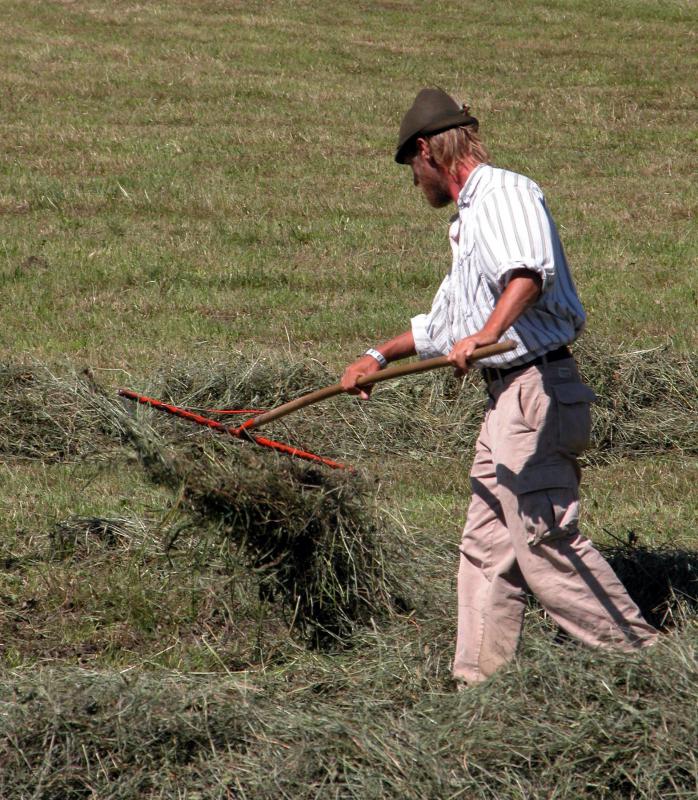
![A dethatching rake is designed to break up and remove thatch.]() By: viappyA dethatching rake is designed to break up and remove thatch.
By: viappyA dethatching rake is designed to break up and remove thatch.
Discussion Comments
I have used an aerator before but knew little about lawn dethatchers. Now I understand the role this kind of rake plays in keeping your garden healthy, I'm going to give it a try.
@angelBraids - There is a gas powered alternative, known as a power rake dethatcher (or sometimes just called a power rake.) They may make the task easier but there are a few things to think about.
Because you won't use it very much most people just hire one for a day or two. It's quite a heavy piece of machinery so you'd have to have it delivered. Plus you really should wear special things to protect your eyes and ears.
I did all this once and then went out and bought a regular lawn dethatching rake! It seems to me like your grandparents would be better off doing the same thing. They could always hire a local person to actually do the work.
My grandparents have neglected their yard for a while due to ill health. Last week I had a closer look and it isn't in very good shape, though thankfully they are both much better now.
I'm thinking a dethatching lawn rake would be a good buy for them, but it could be a bit physical. Is there any kind of electric model available?
i used a dethatching rake on a small bit of lawn that i have in the sideyard, and it made a huge difference in the appearance.
initially the lawn looked mostly brown, but after dethatching, most of the dead grass was removed, and the lawn looked significantly greener.
if you have a lot of dead grass at lower layers of your lawn, dethatching is one of the simplest and quickest things you can do to improve your lawns appearance (and its health).
Post your comments