
At TheHealthBoard, we're committed to delivering accurate, trustworthy information. Our expert-authored content is rigorously fact-checked and sourced from credible authorities. Discover how we uphold the highest standards in providing you with reliable knowledge.
What is a Dental Filling?
 Tricia Christensen
Tricia Christensen
Tricia Christensen
A dental filling is usually a two-part step. It is first the removal of decaying tooth matter, caused by cavities, or alternately, the removal of damaged tooth matter caused by injury. Secondly, the dentist applies different materials, to fill the removed portion of the tooth, which allows the person to have full function of that tooth.
In some cases, tooth decay is so severe, that a crown must be constructed outside of the mouth, which is then fit onto the tooth. This is called indirect restoration. Most commonly, though, the dental filling occurs completely in the mouth, called direct restoration, without need for molds, crowns or bridges to be placed.

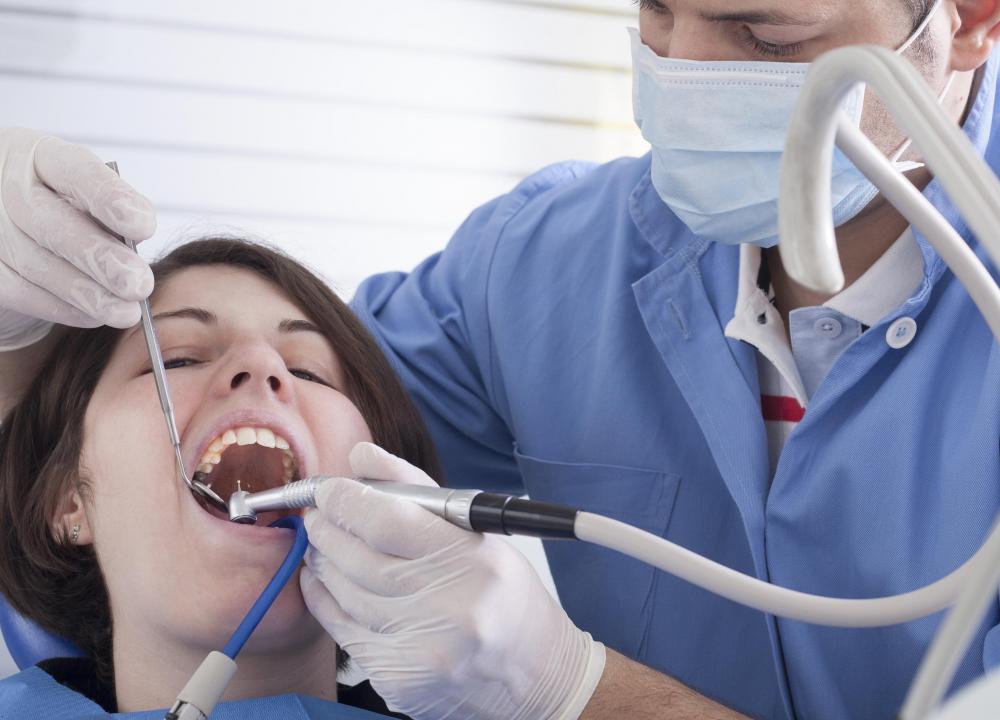
The first part of the dental filling is often the most uncomfortable and most dreaded by patients. Dentists normally have to drill into a tooth to get to and excise decaying portions of the tooth. Generally, dentists use novocaine to numb the sensation of having the drill applied to the tooth, but both the sound and smell of the dental drill is enough to cause anxiety in many patients. Some patients have adverse reactions to novocaine, and go without it during drilling. The procedure is described as somewhat to very painful depending upon individual perception.

A new way of reducing anxiety for people having a dental filling or other dental procedures is called sleeping or sedation dentistry. With certain medications, like versed, a person can be in what is called conscious sedation. They will generally not be conscious during the procedure and usually have no memory of it. Dental filling of teeth with conscious sedation is usually more expensive and not covered by insurance.

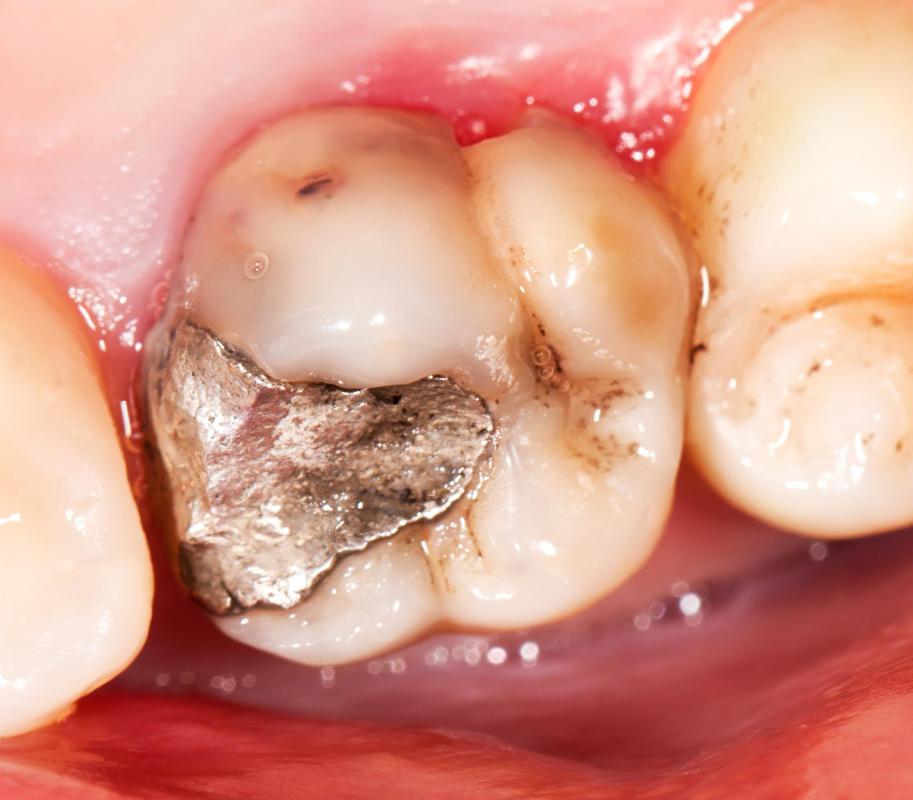
The easier second half of the dental filling procedure is filling the tooth. Materials for fillings differ. In the US, dental amalgam, and polymer resins are most common. Dental amalgam is made of mercury mixed with metal. Concern about placing mercury into the mouth has been a matter of some debate, since some mercury clearly leeches from the dental filling and is ingested.

This has led some dentists to prefer plastic polymers instead, and some parents to insist on children never receiving a dental filling that contains mercury. As yet, controversy over mercury present in dental amalgam has not subsided. Glass ionomer cements may also be used instead of dental amalgam.
After a dental filling, some people report minor discomfort, once the novocaine wears off. Discomfort may actually derive more from the injection of the novocaine than from the actual dental procedure. Patients may be sent home with instructions for eating soft foods for the remainder of the day, and for avoiding very hot foods while the novocaine remains in effect. By the next day, most people feel no discomfort, and can indulge in any food or drink they like.
Tricia Christensen
Tricia has a Literature degree from Sonoma State University and has been a frequent TheHealthBoard contributor for many years. She is especially passionate about reading and writing, although her other interests include medicine, art, film, history, politics, ethics, and religion. Tricia lives in Northern California and is currently working on her first novel.
Learn more...
Tricia Christensen
Tricia has a Literature degree from Sonoma State University and has been a frequent TheHealthBoard contributor for many years. She is especially passionate about reading and writing, although her other interests include medicine, art, film, history, politics, ethics, and religion. Tricia lives in Northern California and is currently working on her first novel.
Learn more...AS FEATURED ON:
AS FEATURED ON:


-
![Silver amalgam is a popular material for filling decayed teeth.]() By: Zsolt Bota FinnaSilver amalgam is a popular material for filling decayed teeth.
By: Zsolt Bota FinnaSilver amalgam is a popular material for filling decayed teeth. -
![For patients who are apprehensive, dental fillings can be done under conscious sedation.]() By: KadmyFor patients who are apprehensive, dental fillings can be done under conscious sedation.
By: KadmyFor patients who are apprehensive, dental fillings can be done under conscious sedation. -
![Some people experience minor discomfort after a dental filling.]() By: yanmingzhangSome people experience minor discomfort after a dental filling.
By: yanmingzhangSome people experience minor discomfort after a dental filling. -
![Fillings made of alloys are typically designated for teeth in the back of the mouth, where they are not easily seen.]() By: Jeremys78Fillings made of alloys are typically designated for teeth in the back of the mouth, where they are not easily seen.
By: Jeremys78Fillings made of alloys are typically designated for teeth in the back of the mouth, where they are not easily seen. -
![Dentists normally have to drill into a tooth to excise decaying portions of the tooth.]() By: patrisyuDentists normally have to drill into a tooth to excise decaying portions of the tooth.
By: patrisyuDentists normally have to drill into a tooth to excise decaying portions of the tooth.


Discussion Comments
@pleonasm - The longer you put it off, the more expensive it might be. If you happen to be going on vacation anywhere where the dentistry is cheaper (but still safe) maybe try to get it done then? I've heard that major procedures are so much cheaper in some countries that it costs less to buy a plane ticket and get the procedure done, than to just stay home and do it. I doubt that is true for dental fillings, but you never know.
@clintflint - As long as the new filling doesn't stop me from being able to use floss or anything like that, it doesn't bother me. I haven't had all that many though, so maybe I've never hit on one that changed my mouth all that much. I generally try to get white dental fillings so that you can't really see them all that well either.
I probably need to go to the dentist and get another one soon, as one of my teeth hurts a bit when I bite into something cold. But it's always so expensive, I tend to put it off longer than I should.
I absolutely hate having anything done to my teeth because my mouth just feels wrong afterwards. I guess I kind of fiddle with my teeth with my tongue when I'm bored, so I know what they are supposed to feel like and when I get a dental tooth filling it just makes me uncomfortable until I get used to the change.
When I went into the Peace Corps, my dentist insisted on drilling half my mouth just in case I ended up with cavities and it drove me nuts how different it felt.
I don't know if this is the same for everyone or if I'm just strange.
Post your comments