
At TheHealthBoard, we're committed to delivering accurate, trustworthy information. Our expert-authored content is rigorously fact-checked and sourced from credible authorities. Discover how we uphold the highest standards in providing you with reliable knowledge.
What is a Defibrillator?
A defibrillator is a machine used to shock the victim's heart and restore the heart's normal rhythmic patterns. When this machine is used, it in effect kicks the heart into action again, causing it to resume pumping blood throughout the body.
According to the American Heart Association, 700 Americans die every day as the result of sudden cardiac arrest (SCA). Some people confuse SCA with a heart attack, but they are by no means the same. With a heart attack, caused by blockage of the arteries, the victim feels severe chest pains but almost always remains conscious; however, SCA victims will always lose consciousness. Researchers state that SCA is the result of a "ventricular fibrillation," a quivering of the heart which prevents the heart muscle from pumping blood to the body. To overcome this condition, the victim will need various forms of help in order to survive, the most important of which may well be the assistance of a defibrillator. Each minute that passes without defibrillation decreases the victim's survival chances by 10%.

Those used in hospitals are expensive machines that send voltage through two paddles that a medical professional places on a heart attack victim's chest area. Automated External Defibrillator's (AEDs) have become the norm in schools, gymnasiums, city offices, and workout facilities. An AED is a compact device contained in a box roughly the size of a child's lunchbox.

These valuable tools are automated and offer voice assistance to aid a volunteer in successfully using them. Two pads connected to the wires are the primary tools contained in the AED. One of these pads will be placed over the victim's heart area and the other nearby on the chest. After everyone is clear of the victim and the pads and wiring are set properly, the AED will charge itself and then send voltage to the victim's heart. The machine will then check the heart rhythms to determine if a second shock should be sent. Though these machines walk the user through the steps, training in AED administration is still recommended.
The American Heart Association states that 4 steps are necessary to save someone who has experienced SCA:
AS FEATURED ON:
AS FEATURED ON:


-
![A defibrillator.]() By: beerkoffA defibrillator.
By: beerkoffA defibrillator. -
![A defibrillator with the paddles out.]() By: RenewerA defibrillator with the paddles out.
By: RenewerA defibrillator with the paddles out. -
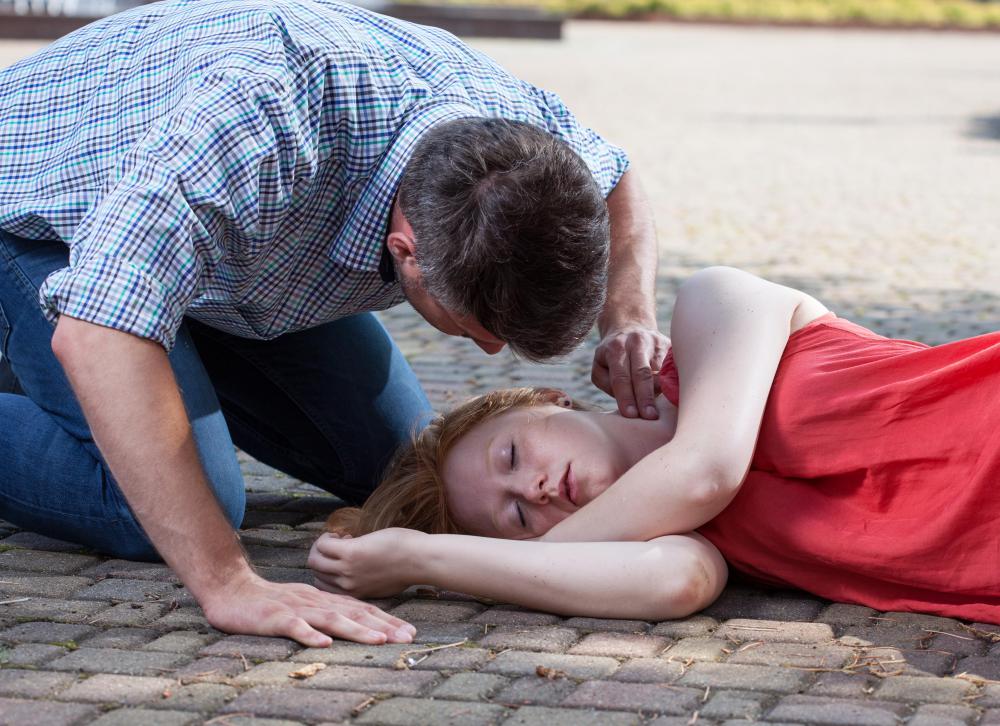
![Sudden cardiac arrest victims always lose consciousness.]() By: Photographee.euSudden cardiac arrest victims always lose consciousness.
By: Photographee.euSudden cardiac arrest victims always lose consciousness. -
![CPR should be started immediately in order to make defibrillation as effective as possible.]() By: Photographee.euCPR should be started immediately in order to make defibrillation as effective as possible.
By: Photographee.euCPR should be started immediately in order to make defibrillation as effective as possible. -
![Body fluid barriers are important because they protect rescuers from bloodborne pathogen exposure.]() By: Thomas PerkinsBody fluid barriers are important because they protect rescuers from bloodborne pathogen exposure.
By: Thomas PerkinsBody fluid barriers are important because they protect rescuers from bloodborne pathogen exposure.




Discussion Comments
Can you please answer my following question: how have defibrillators impacted medical science?
@anon54852, Post 7: Yes, they can. A taser is pretty much the same thing. The only thing different is the control circuitry. With a defibrillator, you have to somehow trick it into thinking the heart is quivering, then it will charge and shock. By that time you'd be pounded to a pulp by the person you wanted to "taser" with the defibrillator. That is, if you could trick the device into thinking a heart was quivering in the first place. Most devices are pretty good at discerning between noise and a real heart quivering.
@anon30239, Post 5: A defibrillator will provide a measured and controlled voltage across the heart. This is usually at 800V, 3Amps, for 10ms. You can't control the household outlet to do that. It will simply dump 10's of amps at 110V into you and kill you.
@anon139459, Post 9: A pacemaker simply provides stimulation so the heart will beat. A defibrillator will provide a huge shock when it detects the heart to be quivering. Nowadays, all defibrillators have a pacemaker inside but pacemakers don't have a defibrillator inside.
@Ebony, post 3: The machine says "Stand Back" for two reasons. One is so the other person isn't electrocuted with the high voltage. The second is that the patient, when getting shocked, will most of the time, violently jump. This could injure someone who is too close.
@anon165101, Post 10: Voltage isn't "sent" anywhere! They really mean "apply" voltage. They just said "sent".
Where can I get an Automated External Defibrillator (AED) in India? Can anyone help out?
Is it safe to use AED's on oil and gas rigs?
Voltage isn't "sent" anywhere!
What is the difference between a defibrillator and a heart pacemaker?
How do I use a defibrillator?
Can defibrillators be used as a weapon, because apparently someone went on a rampage with one in america in 2008, and do you have to be qualified to get one?
If you run a day care for the elderly do you need to have one, just in case?
What is the voltage range on the machines?
If a Defibrillator is not available, why can't we use a household outlet?
When having a defibrillator on your heart does it have a battery to keep it working? If it does, does the battery every go out and you need to keep it charge always?
Ebony asks:
When using a defibrillator on person why do they say stand clear,will person touching interfere with person being shocked or will you also receive a shock?
when was this article published?
Post your comments