
At DelightedCooking, we're committed to delivering accurate, trustworthy information. Our expert-authored content is rigorously fact-checked and sourced from credible authorities. Discover how we uphold the highest standards in providing you with reliable knowledge.
What is a Crumb Coat?
 Tricia Christensen
Tricia Christensen
Tricia Christensen
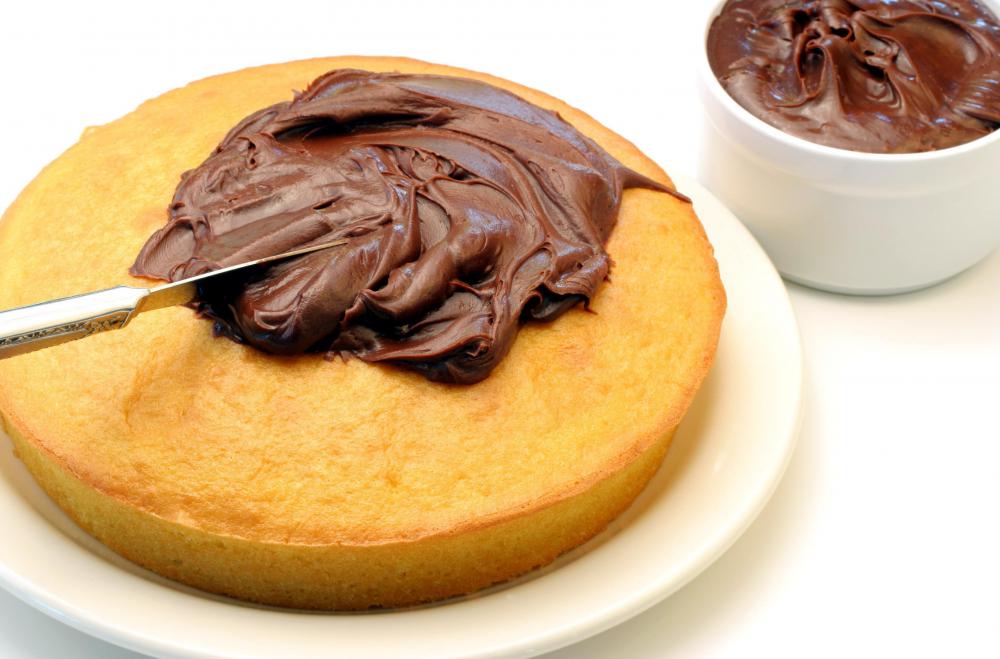
A crumb coat is a baker’s trick for sealing in the moisture of a cake, and for making frosting the cake easier. It is a thinned layer of frosting applied to the cake, as it is almost cool, or just cooled. This layer is allowed to set for one to two hours before the cake is frosted and decorated. It seals in any crumbs so they don’t show up later when the cake is frosted.
Any type of frosting can be used to create a crumb coat, but it should not interfere with the taste of the frosting that later be used to frost the cake. Bakers can use either commercially prepared or homemade frosting, although homemade is often easier to thin than commercial from a can because it doesn’t contain fillers that can break down when extra liquid is added. If the baker plans to use a frosting made with egg whites, she might want to make a simple buttercream glaze for the crumb coat.

The consistency of crumb coat frosting should be just barely thick enough to spread on a cake. Here, the goal is not to provide the wonderful thick frosting that will later top the cake, but instead merely the thinnest of layers. A baker can thin the frosting by adding either water or milk until it resembles a glaze. Once the baker has applied the thin coat, patience is required because it must be left to set until it feels hard to the touch. Bakers who skip this part often find that the coating doesn't provide the desired results, and the cake may actually be harder to frost.

Adding a crumb coat is also an important step for cake decorators who plan to cover a cake with fondant. Fondant will work much better when it can adhere to the thin layer of frosting. Patience is again required to allow the frosting to set. Some bakers suggest applying two layers, sometimes called a sticky coat, to cakes topped with fondant. Decorators should wait about two hours between applying the first and second coat.

With fondant, the undercoat can also be made out of jam, which can add a nice flavor to the cake. Alternately, lemon, orange, or another flavored glaze can be used to boost the total flavor of the cake. Fondant is usually simply sweet and not very flavorful, so it helps to have a base that tastes good.
Cooks don’t need to use a crumb coat on cupcakes or on any cake that will be served quickly. Square or oblong cakes that are not taken out of the pan don’t require this coating either. For those cakes where the baker really wants to showcase the frosting, however, the crumb coat remains a great way to start a beautifully frosted cake.
Tricia Christensen
Tricia has a Literature degree from Sonoma State University and has been a frequent DelightedCooking contributor for many years. She is especially passionate about reading and writing, although her other interests include medicine, art, film, history, politics, ethics, and religion. Tricia lives in Northern California and is currently working on her first novel.
Learn more...
Tricia Christensen
Tricia has a Literature degree from Sonoma State University and has been a frequent DelightedCooking contributor for many years. She is especially passionate about reading and writing, although her other interests include medicine, art, film, history, politics, ethics, and religion. Tricia lives in Northern California and is currently working on her first novel.
Learn more...AS FEATURED ON:
AS FEATURED ON:


-
![A crumb coat seals in the moisture of a cake.]() By: RoJo ImagesA crumb coat seals in the moisture of a cake.
By: RoJo ImagesA crumb coat seals in the moisture of a cake. -
![A decorated chocolate cake.]() By: Michael GrayA decorated chocolate cake.
By: Michael GrayA decorated chocolate cake. -
![Fondant adheres much better to a thin layer of frosting.]() By: arinahabichFondant adheres much better to a thin layer of frosting.
By: arinahabichFondant adheres much better to a thin layer of frosting.


Discussion Comments
Where do you buy crumb coat at or how do you make it? can someone please help me? i am confused and i am trying to make a red velvet and cream cheese icing cake with fondant. If anyone has answers, can you please help?
Once you spread your thin coat of icing (crumbcoat) How long do I wait before I spread my actual frosting for the cake?
Can I place the cake in the fridge to wait a smaller amount of time?
A crumb coat is meant to seal in the crumbs not put them on the outside. You can use cream cheese frosting for your crumb coat just separate the frosting that you are using for frosting for the crumb coat from the frosting to be used for frosting the cake.
you don't add the crumbs to the frosting, you just add a thin coat to seal the crumbs before your thicker coat of icing.
I just want to make sure I'm understanding how to apply a crumb coat.
I take the crumbs from the cake and add to a thin layer of frosting and ice the cake. Once this has been done, can I ice the cake the next day, if so, can I cover in plastic or aluminum foil? Also, if I'm using Cream Cheese as my frosting, can I crumb coat w/a thin layer of Butter Cream? Thanks, Tonia
Post your comments