
At PracticalAdultInsights, we're committed to delivering accurate, trustworthy information. Our expert-authored content is rigorously fact-checked and sourced from credible authorities. Discover how we uphold the highest standards in providing you with reliable knowledge.
What is a Crime Scene Technician?
A crime scene technician is a person who works with law enforcement agencies to investigate crimes by evaluating details left on the scene. Their primary responsibilities are to collect evidence, analyze data in lab settings, and present findings in both written and oral reports. Many technicians are employed directly by police departments although they can also work independently, contracting out their services on a freelance basis.
Types of Work and Job Environments

Examining crime scenes is usually an important part of figuring out exactly what happened in the moments leading up to a crime, particularly in cases where the facts are somewhat fuzzy or there were no witnesses on hand. Crime scene technicians are typically in high demand by police and fire departments, crime laboratories, and government agencies, to name a few. The field is generally very broad, and technicians can choose to specialize in a number of different areas.
Securing and Examining the Scene

Technicians who work directly with police and fire investigators are usually dispatched directly to crime scenes. They work alongside forensic experts to study the surrounding area, taking note of its dimensions and features as well as collecting evidence. There are often multiple technicians assigned to a case under the leadership and direct supervision of a “lead” or “chief” technician. Some will take photographs of the scene, while others will collect physical evidence like blood droplets or bullet casings. Working in this sort of environment can be unsettling, particularly when the case involves death or brutal assault.
Evidence Collection and Lab Work

Direct fieldwork is not always required. Many crime scene technicians work only with already-collected evidence, running tests and analyzing things like hair and blood samples in laboratories. Every crime laboratory has very specific protocols surrounding the identification, collection, and recording of evidence. It is the crime scene technician’s responsibility to follow these instructions precisely, as the methods of evidence identification are critical to determining who is responsible and must be defensible when presented in a court of law.
Reporting and Administrative Duties

The final responsibility of the crime scene technician is to write a report detailing the evidence collected, the process used, and the conclusion of any tests. This report must follow a specific format in order to ensure that all standard questions are answered and a proper, logical trail is provided. Should the case go to trial, the crime scene technician may be called to testify about the information in the report.
Required Training and Education

Crime scene technicians must usually hold both a high school diploma and a specialized certification or degree in forensics, criminal procedure, or crime scene investigation. Community colleges and technical schools frequently offer these sorts of certification programs, usually as two-year associate’s degrees. Candidates can also complete four-year bachelor’s degrees, which can sometimes qualify them for a higher pay grade — but is rarely ever required. Depending on the jurisdiction, crime scene technicians may also have to pass licensure or certification exams in order to handle evidence or view police files.
Personal Skills and Helpful Characteristics

People who enjoy working independently, are detail oriented, and take pride in their organizational skills tend to have the highest levels of satisfaction in the crime scene technician field. Excellent communication, willingness to follow instructions, and a commitment to accuracy are also very important. Maintaining a professional level of emotional detachment is necessary, too, as personal bias can negatively impact the quality of the work.
AS FEATURED ON:
AS FEATURED ON:


-
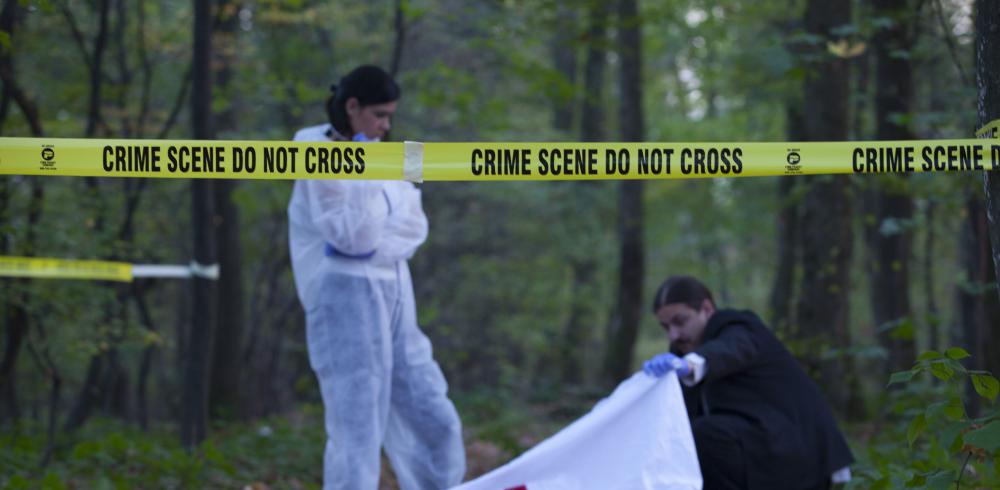
![A crime scene technician evaluates evidence at the scene.]() By: corepicsA crime scene technician evaluates evidence at the scene.
By: corepicsA crime scene technician evaluates evidence at the scene. -
![Crime scene technicians may be responsible for taking photographs of a crime scene.]() By: Luis LouroCrime scene technicians may be responsible for taking photographs of a crime scene.
By: Luis LouroCrime scene technicians may be responsible for taking photographs of a crime scene. -
![A crime scene tech may be responsible for gathering fingerprints at a crime scene.]() By: Peter KimA crime scene tech may be responsible for gathering fingerprints at a crime scene.
By: Peter KimA crime scene tech may be responsible for gathering fingerprints at a crime scene. -
![Blood splatter can be used as evidence.]() By: mizinaBlood splatter can be used as evidence.
By: mizinaBlood splatter can be used as evidence. -
![A crime scene technician will collect evidence from the scene of a crime.]() By: LukaTDBA crime scene technician will collect evidence from the scene of a crime.
By: LukaTDBA crime scene technician will collect evidence from the scene of a crime. -
![One role of a crime scene technician is to testify in court.]() By: Stephen CoburnOne role of a crime scene technician is to testify in court.
By: Stephen CoburnOne role of a crime scene technician is to testify in court.




Discussion Comments
I'm just finishing up my small business management degree and am seriously considering going back for something in forensics. I'm trying to gather more information on it though, as I'm not entirely sure if I want to.
I am looking into a website for this training. They seem to offer everything that I need, however, is what they offer the correct license I would have to have in order to be certified? Also, some sources say you must have a license. Others say that you don't. I am confused on what to do.
what do you need to major in to become a crime scene technician? and what are some good colleges that offer that?
to fiorite: a crime scene technician makes about $51,204-$63,444 a year.
What is an average crime scene technician salary? I was searching for information on the field online, but could not find much information available. Beyond trying to find information on the Bureau of Labor and Statistics website, I am at a loss of places to look.
I would think that a career in crime scene investigation would be very interesting. I don't think you necessarily need to get a crime scene technician degree to do the job however. You could be a specialist in a certain field which would be useful to different areas of law enforcement. You could focus on sociology and psychology to become an expert in behavioral analysis. You could also go the route of biology, pursuing a graduate degree in entomology. Entomologists are important in solving murder cases, especially complicated cases where the body is not found immediately after the time of death. My best advice would be to talk to an academic adviser and to visit discussion boards for people in the criminal investigation field.
Are there any crime scene investigators out there who can answer a couple of questions for me? I want to know if the jobs that you do are anything like what you see on television? Are there that many clues in a crime scene? Are the methods used to investigate crime scenes as sophisticated as the shows make it seem? I have been thinking about trying to pursue a degree in criminal justice or crime scene investigation. I really just want to know what a future career in this field would look like.
Post your comments