
At WiseGEEK, we're committed to delivering accurate, trustworthy information. Our expert-authored content is rigorously fact-checked and sourced from credible authorities. Discover how we uphold the highest standards in providing you with reliable knowledge.
What is a Condenser Microphone?
Capturing sound for live performances or recording purposes can be a tricky proposition, as several outside factors — such as background noise, humming, and distortion — will affect the clarity and quality of the tone captured. Therefore, it is necessary to choose the best microphone for each individual job. For some jobs, a dynamic mic or directional mic may work best, but in other applications, a condenser microphone will produce the clearest and most nuanced sound.
The name condenser microphone actually refers to a capacitor system, in which two plates with voltage between them are used to create sound. The outer plate, or diaphragm, is typically made of a thin material that vibrates when sound waves strike it. The vibration changes the distance between the two plates, thereby changing the capacitance.

In order for this to occur, however, a voltage must be present between the two plates, so this type of microphone must be powered. Many variations require phantom power, which is supplied by a mixing board or other external power source. Others, however, are powered by a self-contained battery. In either case, the voltage supplied to the condenser microphone allows the capacitance process to work. It also causes the microphone to be extremely sensitive to vibration, making it a good choice for some applications but a poor one for louder projects.

A condenser microphone is a good choice for recording vocals in a studio environment. It may also be used in a live setting, but it is much more sensitive than a dynamic microphone and may pick up undesired sound from other noise in the room. This type of microphone is not the best choice for recording louder instruments or amplified instruments, as the louder frequencies passing through it tend to cause unwanted distortion.

Condenser mics tend to be more expensive than dynamic microphones, as well as more fragile. They are best used in studio settings, though they may also be used in live settings as drum mics. This microphones generally come in two varieties: large and small diaphragm. A large diaphragm microphone will produce a much warmer sound suitable for vocals, while a small diaphragm one will produce a brighter sound, best for recording stringed instruments. Some microphones combine the two diaphragms, with a large diaphragm on one side and a small one on the other to increase the versatility of the unit.
AS FEATURED ON:
AS FEATURED ON:









-
![A condenser microphone will produce the clearest and most nuanced sound.]() By: Tiler84A condenser microphone will produce the clearest and most nuanced sound.
By: Tiler84A condenser microphone will produce the clearest and most nuanced sound. -
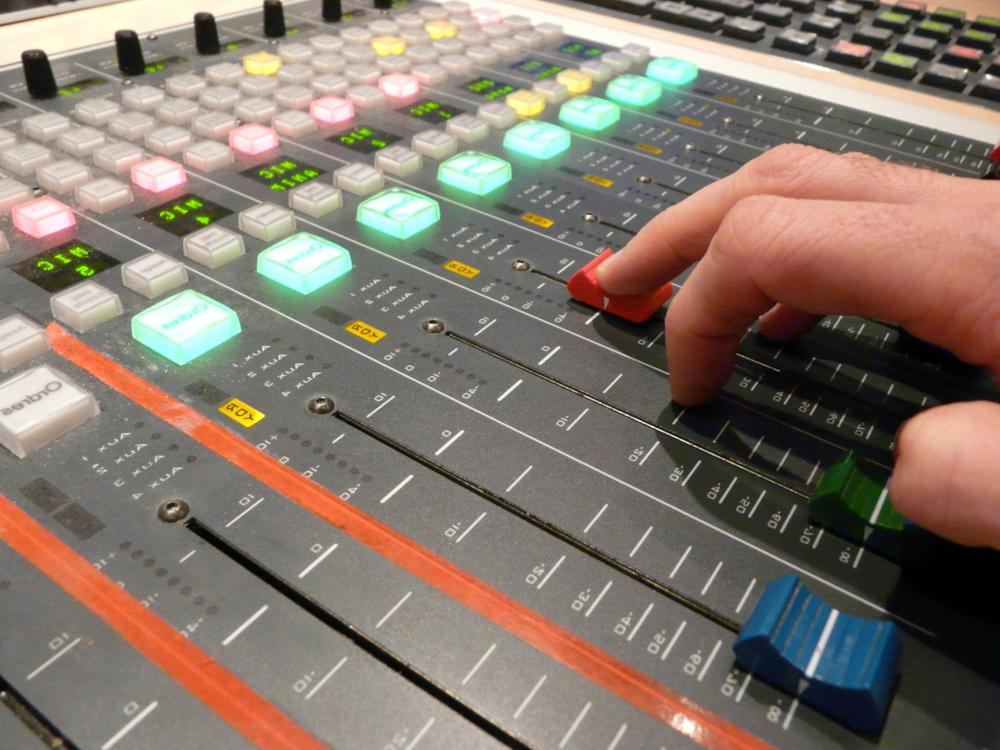
![Condenser microphones often get additional power from a mixing board.]() By: franz massardCondenser microphones often get additional power from a mixing board.
By: franz massardCondenser microphones often get additional power from a mixing board. -
![Electric instruments and microphones can be plugged into mixing boards by using traditional music cables with quarter-inch plugs.]() By: Alexey LaputinElectric instruments and microphones can be plugged into mixing boards by using traditional music cables with quarter-inch plugs.
By: Alexey LaputinElectric instruments and microphones can be plugged into mixing boards by using traditional music cables with quarter-inch plugs. -
![Condenser microphones are more generally sensitive than dynamic microphones.]() By: soundsnapsCondenser microphones are more generally sensitive than dynamic microphones.
By: soundsnapsCondenser microphones are more generally sensitive than dynamic microphones.



Discussion Comments
I used a vocal condenser microphone in a recording studio while recording my first CD, and the quality was unlike anything I had ever encountered. I had been using cheap microphones for stage performances that often generated feedback, and sometimes even the sound manager at the venue could not get the correct balance between treble and bass.
The condenser mic made my voice sound crystal clear. It also picked up on the little inflections in my voice. Any time I had a slight growl or a breathy sigh, the mic caught it.
I was so happy with the way the recording turned out. I knew that a condenser mic would not work as well on stage as it would in a studio, and that was the only thing that kept me from buying one for myself.
Post your comments