
At TheHealthBoard, we're committed to delivering accurate, trustworthy information. Our expert-authored content is rigorously fact-checked and sourced from credible authorities. Discover how we uphold the highest standards in providing you with reliable knowledge.
What Is a Colon Neoplasm?
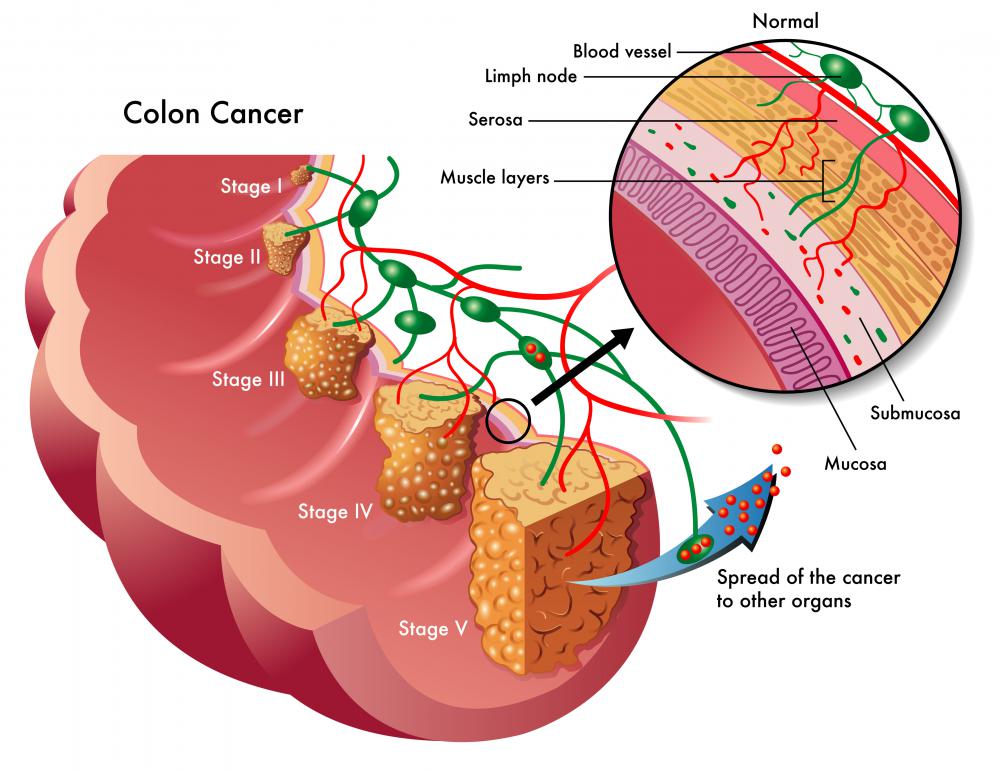
A colon neoplasm is a tumor, or abnormal growth, occurring in a part of the large bowel known as the colon. Neoplasia does not always mean cancer, because the term means new growth. The neoplastic cells that make up the growth can be benign or malignant, which is the same as saying they can be cancerous or non-cancerous. Doctors are able to carry out investigations to determine whether a colon neoplasm is a benign or malignant tumor, and treatment will vary in each case. A benign tumor can sometimes change to become malignant, and the most common colon cancer, adenocarcinoma, develops from benign tumors known as polyps.
The colon, together with the lowest section of the gut known as the rectum, is the part of the intestine in which tumors are most likely to develop. A colorectal tumor is often found to be a benign lump called a polyp. This kind of neoplasm exists in a number of different forms, with the adenomatous polyp being the most common. Although many people over 50 years of age have adenomatous polyps, only a few of these are likely to develop into cancer.

A polyp is a fleshy protuberance that grows from the gut lining. It may not cause any symptoms, but sometimes bleeding from the rectum can occur. Occasionally this may cause the patient to develop anemia. The neoplasm might also be associated with symptoms of constipation or diarrhea and, if the gut is narrowed by the tumor, the stools may appear thinner than usual. Malignancy can cause similar problems and, if colon cancer progresses to an advanced stage, additional symptoms of decreased appetite, weight loss, pain and intestinal blockage may occur.

Diagnosing a colon neoplasm usually involves a procedure known as a colonoscopy, where a flexible instrument with a camera is inserted into the colon through the rectum. In an alternative investigation, a capsule containing a tiny camera is swallowed and takes images of the gut as it travels the length of the intestine. Stool tests may be taken to look for blood in feces, and blood tests for anemia may be carried out.

The treatment of a colon neoplasm depends on the type of tumor involved. Polyps grow and change slowly, so if they are removed during a colonoscopy, or in a later operation, this prevents cancer from developing. If a colon neoplasm has already become malignant, the tumor is usually removed surgically. When the cancer is in its early stages, this treatment could cure it, but more advanced cancers may not be curable. At that point, the outlook may improve if chemotherapy is used as well as surgery.
AS FEATURED ON:
AS FEATURED ON:


-
![Diagnosing a colon neoplasm may involve stool tests.]() By: luchschen_shutterDiagnosing a colon neoplasm may involve stool tests.
By: luchschen_shutterDiagnosing a colon neoplasm may involve stool tests. -
![Colon neoplasms may be associated with symptoms of diarrhea or constipation.]() By: ID1974Colon neoplasms may be associated with symptoms of diarrhea or constipation.
By: ID1974Colon neoplasms may be associated with symptoms of diarrhea or constipation. -
![Diagnosing a colon neoplasm usually involves a procedure known as a colonoscopy.]() By: rob3000Diagnosing a colon neoplasm usually involves a procedure known as a colonoscopy.
By: rob3000Diagnosing a colon neoplasm usually involves a procedure known as a colonoscopy. -
![Intestinal blockage may occur as a result of advanced colon cancer.]() By: inesbazdarIntestinal blockage may occur as a result of advanced colon cancer.
By: inesbazdarIntestinal blockage may occur as a result of advanced colon cancer. -
![An ultrasound can be used to detect a colon polyp.]() By: acherstAn ultrasound can be used to detect a colon polyp.
By: acherstAn ultrasound can be used to detect a colon polyp.




Discussion Comments
Having a tumor or neoplasm in your colon is not what anyone wants to hear about, but at least medicine is coming up with newer and better medicines every day.
A tumor isn't as dire as it was at one time. It is getting easier to identify the bad ones at an earlier stage, which is the best option to stop it in it's tracks.
A cancerous tumor is still a possible life issue and having surgery in such a blood rich area is risky, but it is getting better.
Post your comments