
At WiseGEEK, we're committed to delivering accurate, trustworthy information. Our expert-authored content is rigorously fact-checked and sourced from credible authorities. Discover how we uphold the highest standards in providing you with reliable knowledge.
What is a Clique?
 Tricia Christensen
Tricia Christensen
Tricia Christensen
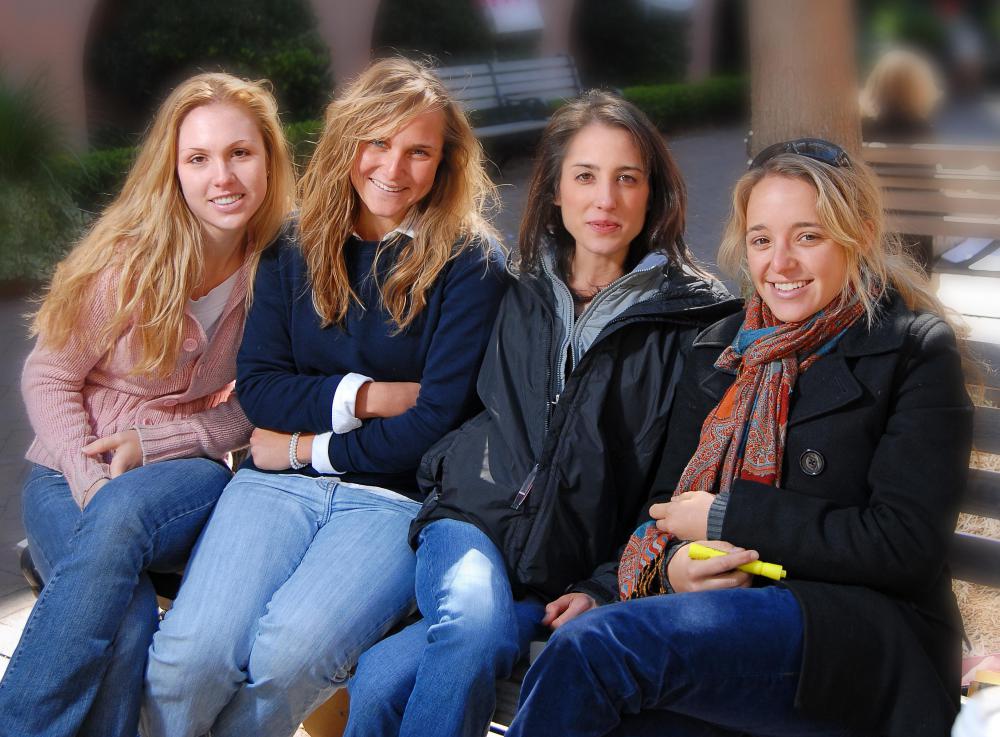
A clique is a social group most often seen in junior high or high school settings, and generally more often noted among girls than boys. However, adults can certainly belong to a clique as well, and one might see these characteristics displayed particularly in the upper echelons of society. The adult group might also be called a “set.”
Generally, the clique is organized among younger children by those who appear to have enough in common to befriend each other. Unfortunately, friendship can quickly give way to power struggle, peer pressure and ostracization of those outside the group. In fact, outsiders targeted by a clique may be subject to insults and bullying, which can be psychologically damaging.

Often the group has a defined leader, though leadership may change from time to time. The clique may extend informal membership to younger girls in order to perpetuate it beyond the original members remaining in a particular school setting. This group may be seen as the “in crowd," and may have a corresponding male group with which they exclusively socialize.

Though it is often thought that there can be only one clique in a school setting, cliques may organize along lines of interest. For example, cheerleaders may form one group while band kids may form another. Socially, pre-teens and teenagers appear to group within areas of interest, or access to each other. A clique may begin innocently enough with families who belong to the same social group or simply live near enough to each other to organize frequent play dates when children are young.

Difficulty exists for those outside any defined grouping. A non-cheerleader, non-band kid, may be challenged by not finding a large enough social group and may desperately wish to gain entry into a certain clique. This can be painful, and may make the person a target of its members.
A nasty part of this power structure may involve bullying, harassment, or playing jokes on non-clique members. Fear of no longer being part of the group may force children to behave in ways that are immensely hurtful to others. Failure to go along with the leaders, often called "queen bees," can result in becoming an outcast.

Many films have documented this type of infrastructure and its potentially destructive force in a social setting. Movies like Mean Girls, Heathers, and Jawbreaker all take a darkly comic view of the clique. Those who have been the victim of their politics many not find cliques a laughing matter.
Though some cliques may act in mean and emotionally destructive ways toward outsiders, others are far less threatening. Not every clique or member chooses to govern by being cruel to other people. They may simply not notice the needs of outsiders, which is often an insensitive, but not unusual, position of teenagers.

Cliques in their most innocent form may merely represent a group of friends who are envied for their social graces, wealth, or attractive qualities. The exclusive nature of the group is rather like a sorority in this respect. It can still be hurtful for those outside who wish to belong, but it may not be intentionally so.
Tricia Christensen
Tricia has a Literature degree from Sonoma State University and has been a frequent WiseGEEK contributor for many years. She is especially passionate about reading and writing, although her other interests include medicine, art, film, history, politics, ethics, and religion. Tricia lives in Northern California and is currently working on her first novel.
Learn more...
Tricia Christensen
Tricia has a Literature degree from Sonoma State University and has been a frequent WiseGEEK contributor for many years. She is especially passionate about reading and writing, although her other interests include medicine, art, film, history, politics, ethics, and religion. Tricia lives in Northern California and is currently working on her first novel.
Learn more...AS FEATURED ON:
AS FEATURED ON:









-
![Cliques are typically seen in junior high or high school settings.]() By: Monkey BusinessCliques are typically seen in junior high or high school settings.
By: Monkey BusinessCliques are typically seen in junior high or high school settings. -
![A group of people that does many things together may be viewed by others as a clique.]() By: Patrick HallA group of people that does many things together may be viewed by others as a clique.
By: Patrick HallA group of people that does many things together may be viewed by others as a clique. -
![Cliques sometimes involve power struggles and bullying.]() By: micromonkeyCliques sometimes involve power struggles and bullying.
By: micromonkeyCliques sometimes involve power struggles and bullying. -
![Cliques can sometimes occur in the workplace, making other employees feel ostracized.]() By: lightwavemediaCliques can sometimes occur in the workplace, making other employees feel ostracized.
By: lightwavemediaCliques can sometimes occur in the workplace, making other employees feel ostracized. -
![In the classroom, cliques can make other students feel unwelcome and alienated.]() By: HemeroskopionIn the classroom, cliques can make other students feel unwelcome and alienated.
By: HemeroskopionIn the classroom, cliques can make other students feel unwelcome and alienated. -
![A group of cheerleaders may form a clique.]() By: ViewApartA group of cheerleaders may form a clique.
By: ViewApartA group of cheerleaders may form a clique. -
![Teenagers that find themselves outside of a clique may feel like outcasts.]() By: Scott GriesselTeenagers that find themselves outside of a clique may feel like outcasts.
By: Scott GriesselTeenagers that find themselves outside of a clique may feel like outcasts. -
![People in cliques are more comfortable socializing with each other.]() By: DeklofenakPeople in cliques are more comfortable socializing with each other.
By: DeklofenakPeople in cliques are more comfortable socializing with each other. -
![A group of people involved in a common organization, such as a sorority, may become a clique.]() By: HalfpointA group of people involved in a common organization, such as a sorority, may become a clique.
By: HalfpointA group of people involved in a common organization, such as a sorority, may become a clique. -
![Cliques tend to stay together and exhibit similar behavior in social settings.]() By: biker3Cliques tend to stay together and exhibit similar behavior in social settings.
By: biker3Cliques tend to stay together and exhibit similar behavior in social settings.






Discussion Comments
It is easy to talk about the cliques and honey bees but it is very hard to find out that your daughter is a target of them simply because she does not follow any stupid act or give a nonsense compliment to the honey bee. We as mothers have to stop this form of "mafia" in our schools. I do not care if your daughter belong to one of them or not if you as a parent do not step in and teach your child to stop bullying others you are responsible, I know in fact some of you moms out there enjoy the fact that your child is in the clique, you need to go for a therapy yourself if this is the fact you must have some self confident issue yourself.
If you are a responsible parent, stop your children of enjoying the pain and suffering of another human being.
Post your comments