
At DelightedCooking, we're committed to delivering accurate, trustworthy information. Our expert-authored content is rigorously fact-checked and sourced from credible authorities. Discover how we uphold the highest standards in providing you with reliable knowledge.
What is a Cheese Wheel?
 Mary McMahon
Mary McMahon
Mary McMahon
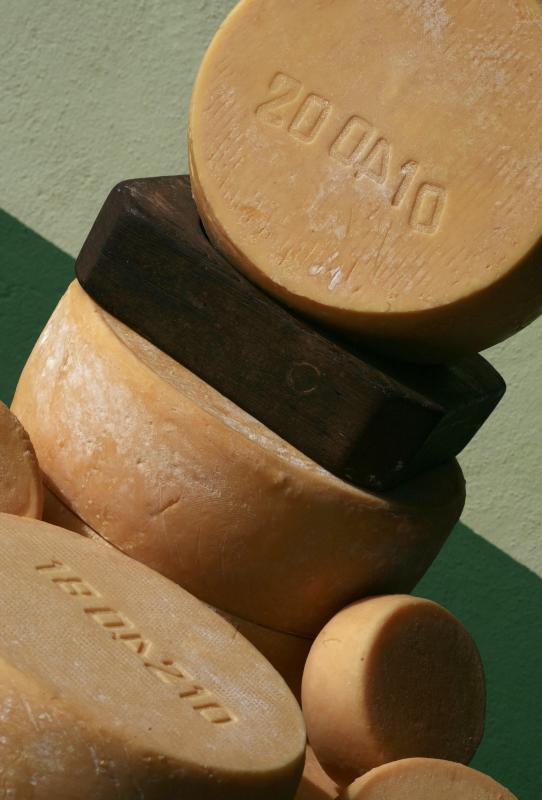
A cheese wheel is a wheel or block of cured cheese that is typically still covered in a protective rind. Most cheeses are made in the shape of wheels, with cheese shops cutting out wedges when clients request a particular cheese. Some cheese producers also make smaller personal wheels that are designed to be sold whole, rather than chopped up. Some blocks can reach a formidable size, as a glance in the shop window of many cheese shops will show.
It may help to know a bit about the cheesemaking process to understand a cheese wheel. When cheese is made, milk is heated and curdled, with many cheese producers introducing some desired bacteria during the curdling stage. The curds are tightly packed into large molds that have traditionally been wheel-shaped to make them easier to handle. The first stage of curing is accomplished in the mold, and once the cheese is firm enough, it is removed and stored on a curing rack in a cave or climate-controlled room to allow it to cure.

Depending on the style of cheese, a wheel may be covered in wax during the curing process to help retard invasion by unwanted bacteria, although it can also be loosely wrapped in cheesecloth or banded with thin strips of wood. Typically, as the cheese cures, it forms a rind which makes up the exterior of the wheel. The rind may be edible, or it may be pared away when someone wants to consume the cheese.

The shape of a cheese wheel makes it possible for cheese makers to literally roll their cheeses around to move them. When cheeses weigh hundreds of pounds (or kilograms), maneuverability is a vital characteristic. Cheese may need to be turned or relocated at various stages during the curing process, and it needs to be taken to market eventually.
As long as a cheese remains whole in the form of a wheel, it will continue to cure, and it will resist unwanted visitors like insects and bacteria. In some cases, a cheese wheel can be stored at or close to room temperature, which was useful in eras before refrigeration. Once it is cracked open, however, the clock starts ticking, since the cheese is exposed to the elements. It is important to handle cheese carefully once the wheel has been opened, and to consume it in a timely fashion.

Many cheese wheels are stamped with information about the type of cheese, region of origin, and when it was made. Many factors can impact the cheese's flavor, and many cheese shops like to have this information available for discerning consumers. These consumers might prefer, for example, a November Parmesan to one from May, since the November cheese may have a more rich and complex flavor.
Mary McMahon
Ever since she began contributing to the site several years ago, Mary has embraced the exciting challenge of being a DelightedCooking researcher and writer. Mary has a liberal arts degree from Goddard College and spends her free time reading, cooking, and exploring the great outdoors.
Learn more...
Mary McMahon
Ever since she began contributing to the site several years ago, Mary has embraced the exciting challenge of being a DelightedCooking researcher and writer. Mary has a liberal arts degree from Goddard College and spends her free time reading, cooking, and exploring the great outdoors.
Learn more...AS FEATURED ON:
AS FEATURED ON:


-
![Wedges of cheese are cut from a larger wheel when ordered by a customer.]() By: Tim URWedges of cheese are cut from a larger wheel when ordered by a customer.
By: Tim URWedges of cheese are cut from a larger wheel when ordered by a customer. -
![Cheese wheels are stamped with information about the product, such as when it was made.]() By: luluCheese wheels are stamped with information about the product, such as when it was made.
By: luluCheese wheels are stamped with information about the product, such as when it was made. -
![Cheese wheels aging on shelves.]()
Cheese wheels aging on shelves. -
![Cheese-making factory.]()
Cheese-making factory. -
![Cheesecloth is traditionally used in making cheese.]() By: Andrew KazmierskiCheesecloth is traditionally used in making cheese.
By: Andrew KazmierskiCheesecloth is traditionally used in making cheese.



Discussion Comments
Buying a whole cheese wheel is usually way more cheese than I need, but there have been a few times when I have thrown large parties and having an entire wheel was both economical and attention grabbing.
If you are going to have a lot of guests, having an entire wheel of brie or some other good cheese just makes sense. Guests can serve themselves and they will eat as much as they want. It is terrible to go to a party and feel like you need to restrain yourself.
Other reasons that the wheel is the shape used.
Cheese needs to be pressed to eliminate the whey and form the block, round is the proper engineering shape for a strong press, and angular shapes are harder to keep clean.
In addition to reducing the surface ares (which reduces the percentage of rind, which, while edible, is usually not preferred by many.)
The wheel shape also allows equal proportioning of the rind to buyers, as wedges all contain the same percentage.
The most efficient shape is spherical, as the Edam and some other cheeses are formed--absolutely the lowest proportion of rind, but a three-foot diameter ball is much harder to handle than the wheel, which after being rolled, can be stacked on their sides for storage.
Cheese wheels were rounded for another reason as well; a fact well understood by those with a smattering of mathematics. A round or spherical shape contains the largest volume for the least surface area.
This is why your head is round, oranges, oil tanks, if cost of steel is a factor, tree trunks, rain drops -- look around. --Robert
Post your comments