
At TheHealthBoard, we're committed to delivering accurate, trustworthy information. Our expert-authored content is rigorously fact-checked and sourced from credible authorities. Discover how we uphold the highest standards in providing you with reliable knowledge.
What is a Cell-Mediated Immunity?
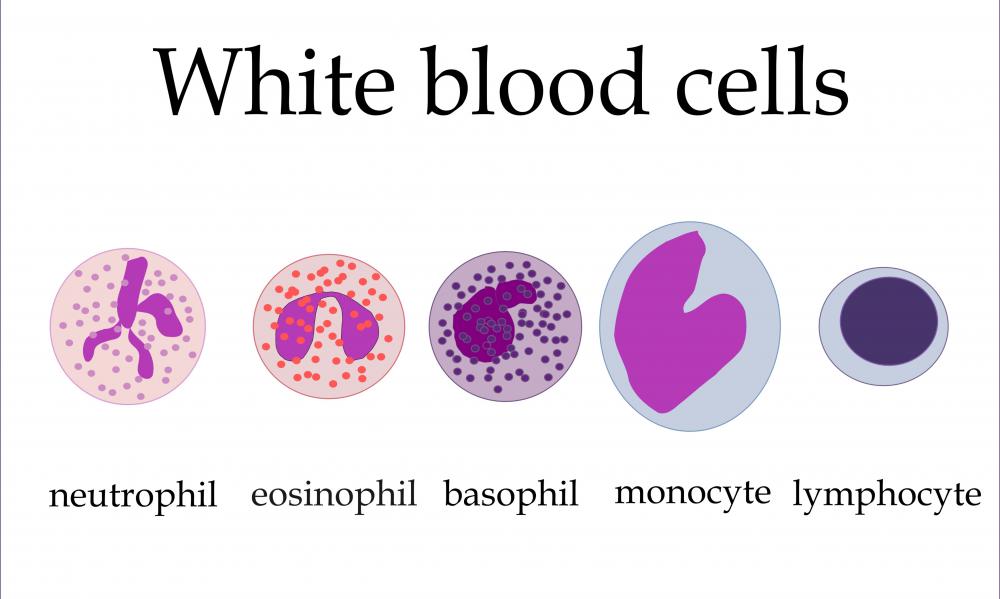
Cell-mediated immunity, also known as cellular immunity, is one of the two types of the adoptive immune system inside the body. It is mostly responsible for fighting microbes and antigens or foreign substances inside the cells. The T lymphocytes, or thymus-derived lymphocytes, are a key part of cell-mediated immunity. They are produced in the bone marrow and stay in the thymus gland for maturation. When the T lymphocytes in the thymus mature, approximately 60% to 70% of them circulate in the blood, while the rest are found in the lymph nodes and the spleen.
The presence of microbes and antigens inside the body usually triggers the body's immune response. Phagocytes, cells capable of engulfing microbes, are often the first to approach these substances. After engulfing the antigens, phagocytes then present with specific receptors in their cell membranes which specific T lymphocytes are capable of recognizing. These phagocytes are also known as antigen-presenting cells. When T lymphocytes recognize and bind to the receptors of the antigen-presenting cells, cell-mediated immunity then occurs inside the body.

As part of the immune response, various cytokines are created, which are important in further activation of other cells of the immune system such as the interleukins, tumor necrosis factor, and interferons. Cytokines are proteins that help regulate immunity. Cytotoxic T lymphocytes, natural killer cells, and macrophages, which are capable of destroying infected cells, are also activated. The end result of these various events is the destruction of cells infected with the antigen or the destruction of engulfed microbes such as viruses, bacteria, and fungi.

Delayed hypersensitivity is the negative effect of cell-mediated immunity inside the body. This is usually seen in the rejection of tissue or organ transplants, contact dermatitis, and graft-versus-host disease. Transplanted tissues and organs are identified by the body as foreign, and this can result in an immune response against the foreign substance. In contact dermatitis, T cells are activated by the presence of certain chemicals in the skin, leading to the development of rashes. T lymphocytes of donor cells often play a role in the development of graft-versus-host disease in many patients.

The other type of the adoptive immune system is the humoral immunity. This is mostly mediated by B lymphocytes, which are produced in the bone marrow. Approximately 10% to 20% of mature B lymphocytes are found circulating in the blood. They are mostly responsible in producing antibodies which are important in fighting against microbes and antigens outside the cells.
AS FEATURED ON:
AS FEATURED ON:


-
![The presence of microbes and antigens inside of the body usually triggers the body's immune response.]() By: robyelo357The presence of microbes and antigens inside of the body usually triggers the body's immune response.
By: robyelo357The presence of microbes and antigens inside of the body usually triggers the body's immune response. -
![Lymphocytes are a type of white blood cell produced by the immune system.]() By: apple1Lymphocytes are a type of white blood cell produced by the immune system.
By: apple1Lymphocytes are a type of white blood cell produced by the immune system. -
![T lymphocytes are a key part of cell-mediated immunity, and about 30 to 40 percent of them are found in the lymph nodes and spleen.]() By: stockshoppeT lymphocytes are a key part of cell-mediated immunity, and about 30 to 40 percent of them are found in the lymph nodes and spleen.
By: stockshoppeT lymphocytes are a key part of cell-mediated immunity, and about 30 to 40 percent of them are found in the lymph nodes and spleen.

Discussion Comments
Does the intracellular microorganism like Mtb which initiate cellular mediated immune response can also initiate humoral immune response?
I am trying to understand this topic, but i end up getting more confused the difference between cell mediated and humoral immunity.
Would you say that cell mediated immunity is an acquired immunity, or is it a passive immunity, like those that children get from their parents?
I have been reading up on the different kinds of immunity for a project for my immunology class, and it's really a lot more complicated than I thought.
Could you help me to understand more about the status of cell mediated immunity, i.e., it is active or passive, or an innate immunity or an acquired immunity?
Thanks.
I have a question -- so I was looking up the difference between cell mediated immunity and humoral immunity, and I was confused about the role of B cells.
I know that B cells are crucial for working with the cytokine in humoral immunity, but I then I read about something called B cell mediated immunity.
Is B cell mediated immunity another word for humoral immunity, or is is a different kind of immunity altogether? Because I thought that cell mediated immunity was more about T cells than B cells. Or is T cell mediated immunity a different kind of cellular immunity than B cell mediated immunity?
I am totally confused about this. Can you help me out?
Could you give me a little more information on the difference between humoral immunity and cell mediated immunity? I actually didn't know that the immune system was so complex, and I'd like to know how these two types of immunity work together, and how I can boost my immune response.
Thanks.
Post your comments