
At TheHealthBoard, we're committed to delivering accurate, trustworthy information. Our expert-authored content is rigorously fact-checked and sourced from credible authorities. Discover how we uphold the highest standards in providing you with reliable knowledge.
What is a CAT Scan?
 Tricia Christensen
Tricia Christensen
Tricia Christensen
A Computerized Axial Tomography (CAT) scan or CT scan is a way of X-raying a mass in the body that allows for one to see three-dimensional views of the mass. It can allow a neurologist to essentially look at "slices" of the brain for better diagnostics in locating cranial bleeds or the presence of a tumor. This type of imaging of other organs can reveal a great deal more information than a regular X-ray, which is two-dimensional.
A CAT scan tends to be completely painless, though it may require people to lie still for a period of time. Depending on the area for which one is having the scan, the patient may have to fast for four to six hours prior to the scan. This is particularly the case if one is having an abdominal/pelvic scan. In this case, one may also be asked to drink barium, a substance that shows up on the scan to identify any trouble or blockages in the intestines.

The CAT scan picture taking process usually only lasts a few minutes or less. It is usually the in-between time when pictures are not being taken that consumes the most time. A scan of the body can be completed in only about 30 minutes, in many cases.
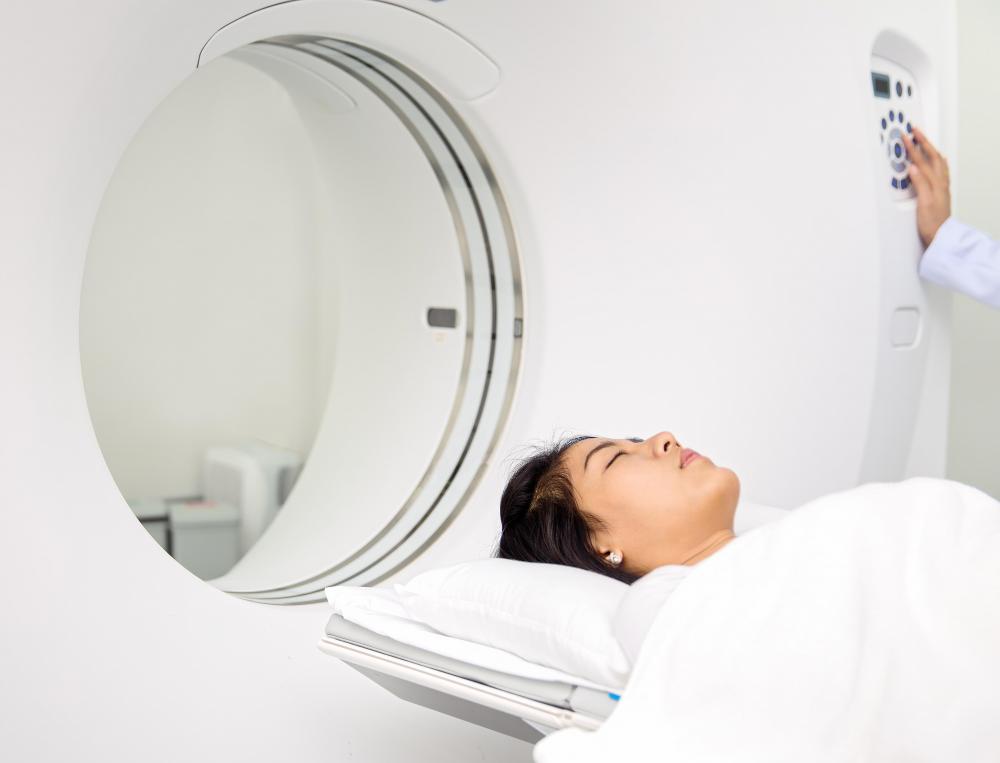
A CAT scanner looks like a bed, or tube with a rounded device over the top. This device looks a bit like the handle of a light saber, and easily fits over the body. This is the picture taking part of the scan, and it can move both up and down, and from side to side.
While one is taking a CAT scan, one may be instructed to hold one's breath for short periods of time, and then to breathe out. This will be the case with those have abdominal/pelvic or chest scans.

People are concerned that the amount of radiation used in a CAT scan may be dangerous. It is true that radiation used is considerably higher than that of an X-ray. For this reason, physicians don't normally request this type of imaging study unless it is necessary to rule out or rule in a serious illness. Physicians have also worked on reducing radiation exposure to the absolute minimum to avoid dangerous exposure.

For those who might undergo a single CAT scan, radiation exposure is thought to pose very limited risk. Even a few scans are unlikely to have long-term effects. Those who must undergo scans on a frequent basis may have a greater risk from radiation exposure. Usually, benefits of multiple scans outweigh risks.
Once the CAT scan is finished, patients are usually able to get up and pursue regular activities, unless the scan is used on someone with injuries impairing normal activities. Radiologists read the scan, and then report findings to a person's specialist or general practitioner. Unless a serious problem is noted right away, results can take up to a week. In fact for most, not being contacted immediately is a good sign, as it means that the problem suspected may not exist, or may not require further treatment.
Tricia Christensen
Tricia has a Literature degree from Sonoma State University and has been a frequent TheHealthBoard contributor for many years. She is especially passionate about reading and writing, although her other interests include medicine, art, film, history, politics, ethics, and religion. Tricia lives in Northern California and is currently working on her first novel.
Learn more...
Tricia Christensen
Tricia has a Literature degree from Sonoma State University and has been a frequent TheHealthBoard contributor for many years. She is especially passionate about reading and writing, although her other interests include medicine, art, film, history, politics, ethics, and religion. Tricia lives in Northern California and is currently working on her first novel.
Learn more...AS FEATURED ON:
AS FEATURED ON:


-
![A cat scan is a medical diagnostic tool that doctors can use to identify what may be causing a particular health condition.]() By: svedoliverA cat scan is a medical diagnostic tool that doctors can use to identify what may be causing a particular health condition.
By: svedoliverA cat scan is a medical diagnostic tool that doctors can use to identify what may be causing a particular health condition. -
![Patients are usually encouraged to get a CT scan if their ailments are life-threatening, regardless of the potential risks.]() By: Monkey BusinessPatients are usually encouraged to get a CT scan if their ailments are life-threatening, regardless of the potential risks.
By: Monkey BusinessPatients are usually encouraged to get a CT scan if their ailments are life-threatening, regardless of the potential risks. -
![Neurologists are trained to interpret a patient's Computerized Axial Tomography (CAT) scan.]() By: s_lNeurologists are trained to interpret a patient's Computerized Axial Tomography (CAT) scan.
By: s_lNeurologists are trained to interpret a patient's Computerized Axial Tomography (CAT) scan. -
![A patient must lay down and stay still during a CT scan.]() By: anekohoA patient must lay down and stay still during a CT scan.
By: anekohoA patient must lay down and stay still during a CT scan.


Discussion Comments
anon135552, did they tell you, with your reaction that you could die? They used the Iodine, right? Ask your doctor!
@StarJo – I had a kidney CAT scan once. After my doctors figured out what was wrong with me, they decided to give me an ultrasound every few years instead.
I was glad to avoid all that radiation. Though it isn't particularly pleasant to have someone apply pressure to your kidneys, I feel safer with the ultrasound than I do with the CAT scan.
I had a CAT scan several years ago so that my doctor could see what was causing my abdominal pain. I had been having persistent pains around my belly button and on either side of it, and she thought I might have an intestinal issue.
Instead, she found that I had polycystic kidney disease. These cysts on my kidneys can rupture from time to time, and that was what caused my pain.
Now that I know I have it, I have to have a CAT scan every three years. This disease makes me more vulnerable to getting kidney cancer, so I get scanned to screen for that.
That barium that you have to drink before a CAT scan is pretty nasty stuff! They try to distract you from its extremely chalky texture by making it fruit flavored, but it still goes down pretty slowly. I somehow managed to drink all of mine without vomiting, but some people can't!
@dafreit – I would think that a doctor would encourage you to have a lung cat scan. Smokers and people who used to smoke but have stopped should get checked, because you need to catch lung cancer early, before it has a chance to spread.
My uncle was 55 when he had his scan. Since he had stopped smoking twenty years prior to that, his lungs were okay. They didn't look as good as those of someone who had never smoked, but he didn't have any cancer.
His doctor told him that anyone older than 55 should be scanned every few years if they used to smoke. I think this is a great idea.
@anon264165: No, you do not lose your hair if you have a CAT scan. It's not like having full-body radiation for cancer or something. It's just a diagnostic test.
Do you lose your hair when you have a CAT scan? Someone told me you would!
I would like to know how much a CAT scan will cost me?
There are natural ways to help your body repair radiation damage. Doctors are CT scan happy. You need to learn to say no and find someone who cares enough to protect you from excessive testing.
There are new ways to diagnose without radiation but the hospitals keep doing the same things. Too many patients-too little time.
Pray, read the Bible and ask God to help you. Hospitals are not good places to be unless you need surgery. Try to find an MD who knows about nutrition because most of them have no clue.
I had an endoscopy and colonoscopy last week. They then decided to do a CT scan and after drinking the necessary liquid I had the CT scan done. As far as I can understand, the results were OK, but I started getting a terrible itch all over my body about two hours after.
I am on cortisone and steroids now as the hospital are treating me for an allergic reaction to the dye in the CT scan. They don't really know, but they say as they have never seen a reaction to a CT scan. Hard to believe, as the surgeon has worked in US for many years and only came back to Ireland recently.
I found the whole hospital experience very disappointing. I have spent a terrible week, skin all over broken out and still on this medication that I don't even know if I should be taking. I am trying to cure myself with hot baths of soda and salts etc. My patience is running out and I have nowhere else to turn to. I have had loads of tests in my lifetime and never had a reaction to anything. Has anybody ever come across anything similar. Please help me as I am very down over it all.
I've had 5 ct scans in two years and I'm worried about getting cancer from it. can someone help me please? can i go somewhere to have a radiation check up?
To Anon36055: Plain x-ray films would be better to detect fractures and to tell if the knee replacement is loose. The plain x-ray film will show if the replacement is still snug in the bone.
I was in the hospital four times last year and in that time I was given seven cat scans, 21 xrays, and two qv scans involving radiation.
I was in an extremely weak condition, had internal bleeding, and was on IVs and had lost 42 pounds when I was subjected to all of this radiation.
One doctor would order a cat scan and another would order one two days later, and they didn't seem to care to communicate with each other. I never in my life feared cancer, but now I am terrified beyond words. I honestly feel that the doctors just don't care. And now I'm just waiting for the shoe to drop.
Depressed and hopeless? More than there are words to say. I cry all the time.
Can you lose hair after a cat scan?
I had a cat scan in 2008 and today, on Fox news they reported that having a chest cat scan is the same as 400 x-rays and can cause cancer. Using so much radiation, they tell us. --Norma
can a CAT Scan be taken on a knee replacement to see if there are any fine fractures of the bone or if the replacement is loose?
I have smoked for 30 years - Is it possible to ask your Dr. to prescribed a Cat Scan so I can see if I have any early detections of Lung Cancer ? Or do you have to have symptoms for them to prescribe?
Why do they tell you to have something salty the day before and the day after an abdominal cat scan?
Post your comments