
At WiseGEEK, we're committed to delivering accurate, trustworthy information. Our expert-authored content is rigorously fact-checked and sourced from credible authorities. Discover how we uphold the highest standards in providing you with reliable knowledge.
What is a Cat Call?
 Michael Pollick
Michael Pollick
Michael Pollick
The history of theater is not always pretty, as evidenced by the arrival in the 16th century of the derisive whistle known as a cat call. Audience members who wanted to express their displeasure at a specific actor would often launch into a loud and jeering whistle said to resemble the plaintive wail of a cat. This noise could be heard onstage, much to the chagrin of the targeted performer or playwright. Instead of a receptive curtain call, a number of actors received a cat call at the end of an unpopular performance.
The cat call remained part of an unreceptive audience's arsenal for centuries. Modern audiences have largely abandoned the practice, but an occasional jeer or Bronx cheer may still be heard whenever a performer fails to win over the crowd or deliberately insults his or her audience. Hecklers at a comedy show, for example, may still issue a piercing call whenever a comedian's material fails.

A cat call is often paired in people's minds with the wolf whistle, a two-toned whistling noise usually directed at attractive members of the opposite sex. A cat call may be a series of loud cries used as an attention getter, while the salacious wolf whistle essentially seals the deal. The noise isn't always meant to be derisive, but it is meant to be noticed. Whoops, hollers, Bronx cheers and other rude noises could all fall under this term.

The expression can be a little confusing, since most cat owners will attest that calling an actual cat is nearly impossible. It is more likely that the term came from "caterwauling, the incredible amount of noise generated by cats who congregate in alleys at night. The sound is unmistakably harsh, much like the loud jeers and whistles created during a audience's cat call.
Michael Pollick
A regular WiseGEEK contributor, Michael enjoys doing research in order to satisfy his wide-ranging curiosity about a variety of arcane topics. Before becoming a professional writer, Michael worked as an English tutor, poet, voice-over artist, and DJ.
Learn more...
Michael Pollick
A regular WiseGEEK contributor, Michael enjoys doing research in order to satisfy his wide-ranging curiosity about a variety of arcane topics. Before becoming a professional writer, Michael worked as an English tutor, poet, voice-over artist, and DJ.
Learn more...AS FEATURED ON:
AS FEATURED ON:









-
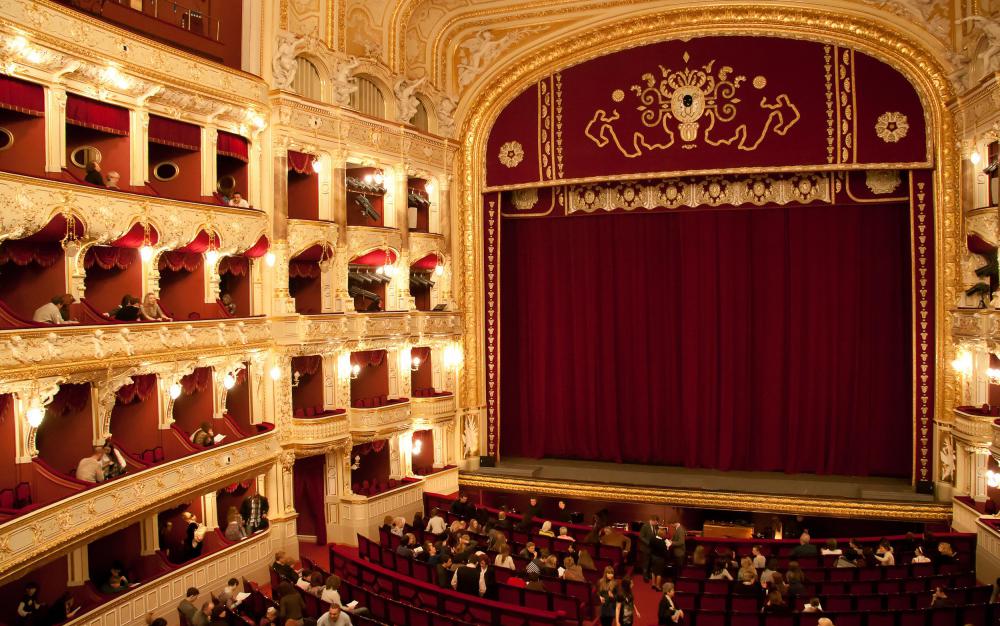
![A jeering whistle meant to portray the displeasure of a theater's audience members is referred to as a cat call.]() By: ivanukhA jeering whistle meant to portray the displeasure of a theater's audience members is referred to as a cat call.
By: ivanukhA jeering whistle meant to portray the displeasure of a theater's audience members is referred to as a cat call. -
![Performers on stage who give an unpopular performance may be subjected to cat calls.]() By: diego cervoPerformers on stage who give an unpopular performance may be subjected to cat calls.
By: diego cervoPerformers on stage who give an unpopular performance may be subjected to cat calls.

Discussion Comments
I've been to a few comedy shows, and I've never witnessed any cat calling and heckling. These days, it seems to be the other way around: the comedian finds ways to pick on members of the audience.
In fact, at the last show I went to, I feel like my table was the only table the comedian didn't pick on! I was pretty glad, because I didn't go out to see a comedy show to get insulted by the comedian I paid money to see!
@sunnySkys - Wow, that sounds like a great way to deal with street harassment and cat calls. Confronting a group of men might not be safe, but you could easily snap a picture to post online later.
Anyway, I think it's interesting that this type of behavior actually originated in the theater! I imagine performers don't appreciate this behavior any more than a woman walking down the street minding her own business does.
I find this type of behavior rude on the street or in the theater. Why can't people just have some respect for each other?
@golf07 - Sorry, but a cat call or wolf whistle from a group of men has absolutely nothing to do with the way a woman is dressed. I have received unwanted attention out in public dressed in sweats and a tank top and wearing no makeup. When men make cat calls at women in public, it's a way for them to feel powerful while making the woman feel uncomfortable.
And actually, there is something you can do about it. A few website have sprung up over the last few years where you can submit a picture of your harasser and an account of what happened.
Social media is extremely powerful, and I think this is a great way to embarrass the perpetrators of this unwanted behavior.
When I hear the word cat call I am reminded of the calls or wolf whistles I hear toward attractive women who are walking down the street or seen passing by.
I heard a few of these when I was younger, but those days are long gone. A person can view a cat call either positively or negatively.
For some, it may be positive as they realize they look good and feel good about themselves and somebody notices.
Others may feel somewhat offended by the wolf whistle and feel that this type of attention is uncalled for.
No matter what your feelings are, there isn't much you can do about it as when you hear a cat call in a situation like this, it is pretty random.
Young women who are nicely dressed will probably always hear cat calls from time to time depending on what the situation is.
I have cats of my own, and there are also stray cats that roam our neighborhood. If you have ever heard a bunch of cats howling at each other in the night, you know how strange this sound can be.
It definitely gets your attention and makes you listen. Sometimes it is hard to believe these loud sounds come from something so small as a cat.
I am sure the distinct sounds have certain meaning to the cats. Some sounds would be to establish territory and others would be to get the attention of the opposite sex.
Either way, whenever I hear cat sounds like this at night, I usually get up to see what is going on and am glad that my cats are indoors.
I usually expect to hear some cat calls and heckling when I go to a comedy show. I think most performers are used to this, and probably even expect it.
I think there is a difference between hearing a cat call at a comedy performance as opposed to a theater production.
I have done some community theater and the reaction of the audience can play a part in how well the actors perform.
If the audience responds with encouraging laughs and sounds, that also encourages the cast and crew. If they hear cat calls or other displeasing remarks, that can have an effect as well.
Even though there are some performances that I like much better than others, I still think it's kind of rude.
It takes a lot of nerve to get up in front of an audience and try to make them all laugh. There are always going to be people who don't agree with you and some of them will show that with a cat call.
On the other hand, if you are going to try to make it as a comedian, you know that you have to pretty thick skinned, as the crowd can be ruthless as well as encouraging.
@doppler - I think that is a common misconception a lot of people share. Just look at all the movies that use the wolf whistle and then call it a cat call. I think that's where a lot of things get misinterpreted to tell you the truth.
@anon55859 - That is awful, but in a funny way.... I think his personal choices are a little... uh, should we say off... as well. Aside from that, I am glad that the article informs us of the difference between a cat call and a wolf whistle because the wolf whistle is always what I have associated with a cat call.
I will be using a catcall next time I see Tiger Woods at a gold Tournament for Tiger is the tramp.
Post your comments