
At WiseGEEK, we're committed to delivering accurate, trustworthy information. Our expert-authored content is rigorously fact-checked and sourced from credible authorities. Discover how we uphold the highest standards in providing you with reliable knowledge.
What is a Card Catalog?
 Mary McMahon
Mary McMahon
Mary McMahon
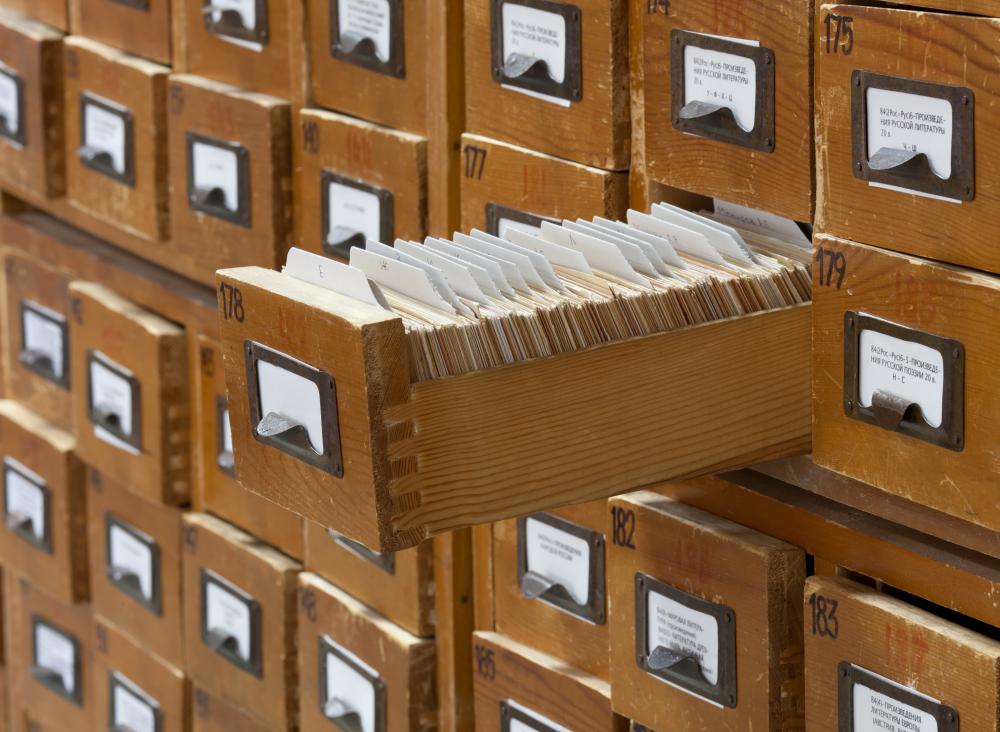
A card catalog is a physical listing of all of the contents of a library, organized with a single card for each item in the library. It was a familiar navigational hazard and blessing in all libraries well through the late 20th century, when physical catalogs began to be displaced by computerized versions. Some libraries have kept them, often as sentimental mementos, and a few actively maintain their listings, although this is most common in small, remote libraries.
The need to catalog books in some way has been present since they were invented. A good catalog enables people to know which publications a library has and where to find them, and many contain additional information that could be assistance to scholars. Early library catalogs were kept on scrolls or in ledgers, and they were often printed and distributed so that distant scholars could know which books a library had.

The concept of the card catalog was introduced in the 1800s, and it was a great help to scholars. These catalogs can be configured in a number of ways, and their organization makes it easy to add or remove books, and to find particular ones. Every time a new book enters a library, a card is created for it, with information like the title, author's name, subject, and location of the book.

There are a number of ways to set up the listing. A dictionary catalog lists every single book in a library in alphabetical order, so in order to find a book, a patron must know what the title is. They can also be organized alphabetically by author's name, or by keyword or subject. It is also possible to find systematic catalogs, also called classified catalogs, that list the books according to the library's categorization system.

As anyone who has used a card catalog knows, it can be a challenge to navigate one until the user gets the hang of it, especially in a new library. Many patrons were forced to call on the librarian for help while navigating a difficult catalog, but once a person became acquainted with the system, the listing was a huge help, allowing patrons to quickly identify the books they wanted and find them on the shelves.

Computerized catalogs are the norm at most libraries today, because they have a number of obvious advantages over physical catalogs, including space efficiency, searchability with multiple parameters, and the ability to easily update it with realtime data.
Mary McMahon
Ever since she began contributing to the site several years ago, Mary has embraced the exciting challenge of being a WiseGEEK researcher and writer. Mary has a liberal arts degree from Goddard College and spends her free time reading, cooking, and exploring the great outdoors.
Learn more...
Mary McMahon
Ever since she began contributing to the site several years ago, Mary has embraced the exciting challenge of being a WiseGEEK researcher and writer. Mary has a liberal arts degree from Goddard College and spends her free time reading, cooking, and exploring the great outdoors.
Learn more...AS FEATURED ON:
AS FEATURED ON:









-
![In most libraries, old fashioned card catalogs have been replaced with computer systems.]() By: Andrey KuzminIn most libraries, old fashioned card catalogs have been replaced with computer systems.
By: Andrey KuzminIn most libraries, old fashioned card catalogs have been replaced with computer systems. -
![A card catalog may be utilized to help patrons find library books.]() By: Lisa F. YoungA card catalog may be utilized to help patrons find library books.
By: Lisa F. YoungA card catalog may be utilized to help patrons find library books. -
![Most library's have transferred their card catalogs onto computer systems.]() By: dellMost library's have transferred their card catalogs onto computer systems.
By: dellMost library's have transferred their card catalogs onto computer systems. -
![Many public libraries and library branches have searchable card catalogs that can be accessed online by the public.]() By: WavebreakmediaMicroMany public libraries and library branches have searchable card catalogs that can be accessed online by the public.
By: WavebreakmediaMicroMany public libraries and library branches have searchable card catalogs that can be accessed online by the public.


Discussion Comments
I work in a private school and we have both. As a librarian, it is often boring to file the cards but I still like the old card catalogs.
I remember using card catalogs constantly when I was younger. Although big and bulky you could find exactly what you wanted in under a minute. I get frustrated with the electronic versions I've used. It takes a long time to find what you want, and sometimes doesn't even list all options, or you have to wade through pages of information where if you make a wrong selection it sends you back to the beginning to start over. Generally, I find computers very useful, but in this case I miss the old days.
@backdraft - I agree that the card catalog is basically a thing of the past. There are a lot of free and easy programs available online that allow you to create simple electronic catalogs. You still have to put in the effort of cataloging, but if you have a relatively small number of materials you can avoid the cost and hassle of trying to buy a professionally built cataloging database software.
Obviously card catalogs are pretty rare here in the US. But do they still use them in parts of the developing world, especially in places where people might have spotty access to electricity or technology?
It is pretty rare to find a card catalog these days but not entirely unheard of. If you go to some rural libraries or small school libraries you might still see a card catalog in use.
But even if they still have the cards, most libraries offer some kind of electronic search. Libraries might seem old fashioned, but they have been modernized almost everywhere, even in the most remote places.
I've used traditional card catalog files and computerized card catalogs, and I think the computerized way is far superior. Instead of having to flip through a ton of cards to try and find what you're looking for, you can just type a few words in a search bar on the computer.
Most people can easily learn how to use a computerized card catalog, and the best part is you don't have to spell everything correctly. If you're using a physical card catalog, you really do need to know how to spell the title or author's name. However, a computerized search will bring records that are close to what you asked for.
@strawCake - That's funny about your mom. My mom isn't very computer savvy either, although I don't remember her having any trouble when the library stopped using the card catalog with drawers. Maybe she got some help one day when I wasn't there.
I remember using a card catalog file when I was younger. Computerized card catalogs were in libraries starting when I was in elementary school, but for awhile, a lot of libraries had both. Also, I remember my middle school library didn't have a computerized card catalog even when the regular library did.
I didn't have too much trouble with computerized card catalogs when they first came out, because I took computer classes in school. However, I remember my mom having a lot of trouble using them and having to ask a librarian for help.
@origami - That's so cool. I would love to have a card catalog cabinet somewhere in my home, although I'm not sure what I would store in it. Also, I don't really have room at the moment. But I can still dream right?
To all my students in english 11, please, read this message about the defunition of a card catalog.
"A card catalog is a physical listing of all of the contents of a library, organized with a single card for each item in the library." Not true. A single item (e.g book) has multiple cards with a particular access point printed as the top line of the card: author(s), title, subjects, and more..
old card catalogs are often put up for sale on auction sites and at estate sales. although its sad to see them go, its good that new owners can put them to other uses.
the really good ones are beautifully worn. if they could talk, they would probably have dozens of stories to tell after decades in service.
Post your comments