
At TheHealthBoard, we're committed to delivering accurate, trustworthy information. Our expert-authored content is rigorously fact-checked and sourced from credible authorities. Discover how we uphold the highest standards in providing you with reliable knowledge.
What Happens to Cervical Mucus During the Luteal Phase?
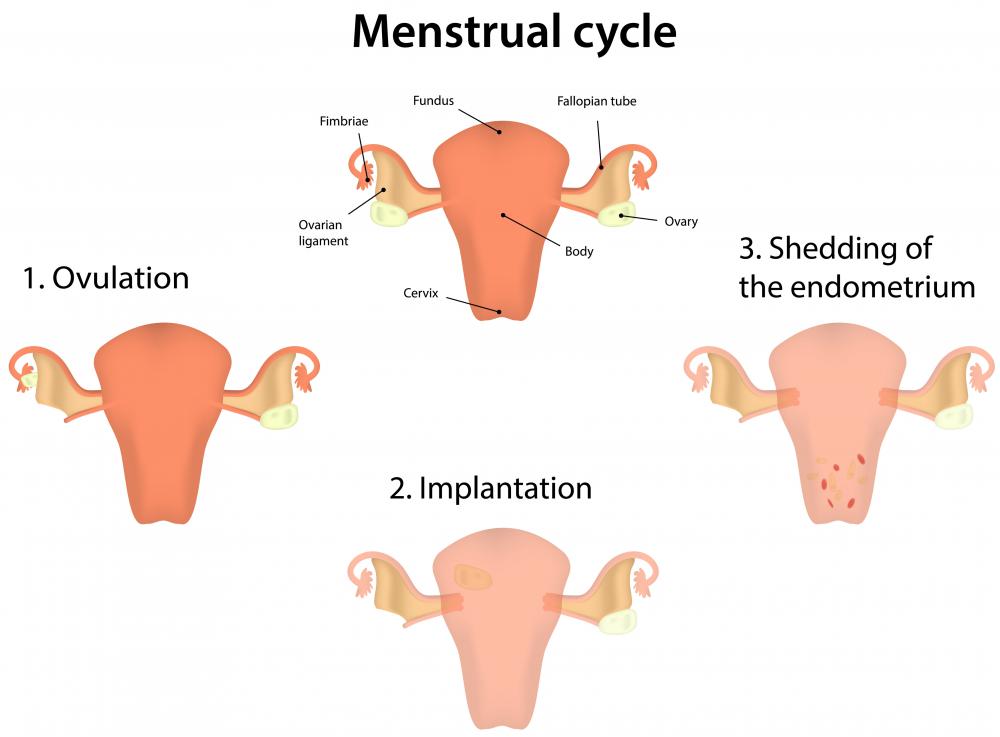
The luteal phase of the menstrual cycle describes the time period from the first day after ovulation and ends during the first day of menstruation. The length of this phase can vary from woman to woman and sometimes from month to month within a woman's cycle, but it generally stays the same. The minimum amount of time the luteal phase will last is ten days, but it generally lasts 12 to 16 days. Levels and consistency of cervical mucus during the luteal phase can change, as cervical mucus changes throughout the menstrual cycle.
Just before and during ovulation, before the luteal phase, cervical mucus is abundant. It is likely that a woman will pick up cervical mucus when wiping her vagina with toilet paper during and just before ovulation. The consistency of the mucus at this point is very wet, clear, and slippery. It is often described as resembling raw egg whites and may be stringy. The amount and consistency of cervical mucus during the luteal phase, however, changes quite a bit.

Cervical mucus changes a lot following ovulation. During ovulation, the mucus is at its most fertile. It needs to be abundant and fluid in order for sperm to survive and travel all the way up the the egg. The mucus provides protection for the otherwise sperm-killing acidic environment of the vagina. During the luteal phase, however, the cervical mucus transitions to non-fertile.

During the first few days of the luteal phase, remnants of fertile cervical mucus are likely to be found. A person is likely to find a wide variety of colors and consistencies of cervical mucus at this point. Just after ovulation, fertile mucus may still be present, but the majority of the phase produces non-fertile mucus, which creates an acidic and inhospitable environment for sperm.

Cervical mucus during most of the luteal phase tends to be scant. At some points, depending on the particular woman's biology, there may be no traces of it to be found. If it is found, it will likely be in small amounts. During this phase, it is often described as dry, sticky, and thick. The coloring of the mucus generally changes from clear during ovulation to white during the luteal phase.

The changes in cervical mucus during the luteal phase are caused by changes in hormone production. Progesterone starts to be produced during the luteal phase, which is responsible for drying up the cervical fluid. If a woman is pregnant, it forms a sticky mucus plug that protects the growing fetus. Progesterone also warms body temperature for incubation if conception is successful.
AS FEATURED ON:
AS FEATURED ON:


-
![The luteal phase refers to the part of the menstrual cycle that starts at ovulation and ends the day before a woman's next period.]() By: blueringmediaThe luteal phase refers to the part of the menstrual cycle that starts at ovulation and ends the day before a woman's next period.
By: blueringmediaThe luteal phase refers to the part of the menstrual cycle that starts at ovulation and ends the day before a woman's next period. -
![Cervical mucus dries up within a few days prior to implantation or menstruation.]() By: joshyaCervical mucus dries up within a few days prior to implantation or menstruation.
By: joshyaCervical mucus dries up within a few days prior to implantation or menstruation. -
![Progesterone starts to be produced during the luteal phase.]() By: logos2012Progesterone starts to be produced during the luteal phase.
By: logos2012Progesterone starts to be produced during the luteal phase. -
![Most girls start to menstruate between the age of 10 and 15 years old.]() By: Maya KruchancovaMost girls start to menstruate between the age of 10 and 15 years old.
By: Maya KruchancovaMost girls start to menstruate between the age of 10 and 15 years old. -
![By learning to recognize what fertile cervical mucus looks like, women may be able to track ovulation to either become pregnant or prevent a pregnancy.]() By: Photographee.euBy learning to recognize what fertile cervical mucus looks like, women may be able to track ovulation to either become pregnant or prevent a pregnancy.
By: Photographee.euBy learning to recognize what fertile cervical mucus looks like, women may be able to track ovulation to either become pregnant or prevent a pregnancy.



Discussion Comments
@Azuza - I totally agree with you. It can only be a good thing to be informed about your own fertility and natural cycles. I know a lot of women who seem to be pretty uninformed about their own bodies too!
Fortunately, there are a lot of great books out there that you can get at the library to learn more about this. And of course, there are tons of resources on the Internet too! So even if you didn't learn about this in a health class, it's not too late.
The cervical mucus cycle is really interesting, but I'm always surprised how many women just don't know about it. I feel like they should teach this stuff to young women in health class in high school! It's always good to be informed about what's going on with your body, especially your reproductive system.
@indemnifyme - Paying attention to cervical mucus during ovulation and afterward is a good way to track your fertility. As you alluded to in your comment, the fertile days can vary from woman to woman.
Saying that ovulation occurs an exact number of days after a woman has her period is fairly helpful but it really just provides a ballpark window of time. By paying attention to what's going on with your cervical mucus, you can tell for sure when you're fertile. Taking your basal body temperature in the morning is also a good idea.
One of my friends is trying to get pregnant, and she was telling me the other day about ovulation cervical mucus and how different it is from when you're not fertile. Apparently, paying attention to your body instead of just looking at the calendar is the best way to figure out when you're fertile or not.
Post your comments