
At WiseGEEK, we're committed to delivering accurate, trustworthy information. Our expert-authored content is rigorously fact-checked and sourced from credible authorities. Discover how we uphold the highest standards in providing you with reliable knowledge.
What does the Lymphatic System do?
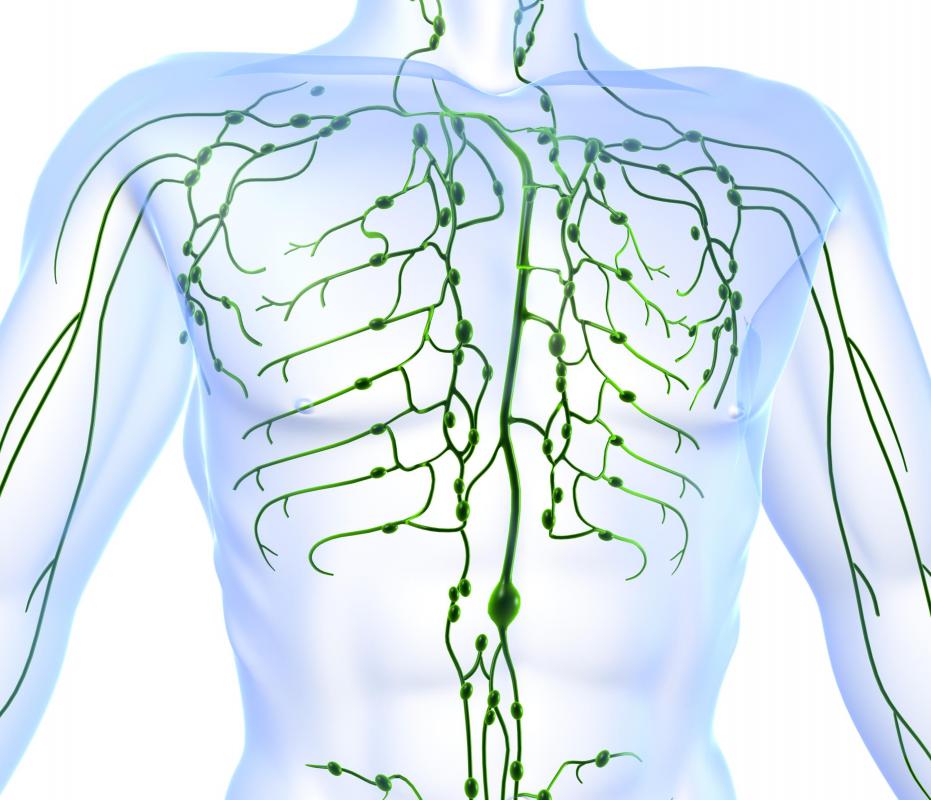
The lymphatic system is a network that runs throughout the human body, which has a number of different functions. Serving as one of the body’s main vessels of immunity, the lymphatic's primary function is to create immune cells. The system also helps to shuttle away fluids from tissue in the body, as well as absorb fat and move that fat to the circulatory system.
It is easiest to think of the lymphatic system as being, in many ways, analogous to the circulatory system. Both are extensive networks of tubes that go virtually everywhere in the body. But where the circulatory system moves blood around the body, the lymphatic system moves a clear liquid known as lymph throughout the body.

Lymph is full of white blood cells, also known as lymphocytes, which are the body’s main tools in the immune response. When plasma is released into tissue to help the body, the lymph vessels are where it ultimately drains, so that they can transport it away from the tissue to the thoracic duct, where it is returned to the circulatory system.
At a point along the body within the lymphatic system there are small nodes, known as lymph nodes. These lymph nodes are full of white blood cells, and act as vessels to filter out foreign matter. When the body fights off sickness, the white blood cell count increases dramatically to help battle the virus or bacteria, and the white blood cells collect in the lymph nodes. This is why the lymph nodes may swell when a person has an infection. There are hundreds of lymph nodes found throughout the human body, but they tend to be found in large clusters in the groin, chest, neck, abdomen, and armpits.

Unlike the heart for the circulatory system, the lymphatic system isn’t pressurized by a muscle and therefore lymph doesn’t flow at nearly the same speed. Instead, the flow of lymph through the system is fairly slow, driven by small valves, and the slight contraction of muscles around the skeleton. Because the pressure involved is so slight, it is actually fairly easy to hamper the flow of lymph throughout the body. Since the results are not nearly as drastic as, for example, hampering the flow of blood would be, many people do not immediately notice a change. Even wearing very tight clothing for long periods of time can slow down the functioning of the lymphatic system, resulting in the fluid buildup usually referred to as edema.

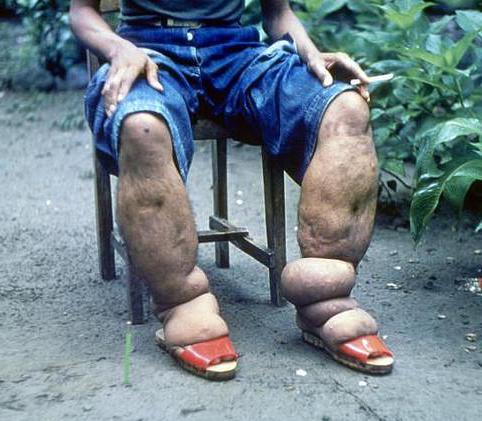
There are a number of various medical conditions in which the lymphatic system is either hampered or is acting incorrectly. Lymphoma is perhaps the most well-known of these conditions, in which the system becomes cancerous. Lymphedema is also fairly common, with nearly 200 million people suffering from it worldwide. Lymphedema is usually caused either by an inherited condition, or by some sort of trauma to lymph nodes, such as after radiation therapy or surgery. Fluid begins to accumulate in an area, the skin may discolor, and limbs may become extremely heavy and full of fluid. If left untreated, lymphedema can become elephantiasis, where the skin thickens greatly and limbs or localized regions of the body become incredibly swollen.
AS FEATURED ON:
AS FEATURED ON:









-
![The lymphatic system, shown in green.]() By: Sebastian KaulitzkiThe lymphatic system, shown in green.
By: Sebastian KaulitzkiThe lymphatic system, shown in green. -
![Large clusters of lymph nodes exist under the arms.]() By: Artem FurmanLarge clusters of lymph nodes exist under the arms.
By: Artem FurmanLarge clusters of lymph nodes exist under the arms. -
![Swollen lymph nodes are one of the first signs of illness.]() By: ShakzuSwollen lymph nodes are one of the first signs of illness.
By: ShakzuSwollen lymph nodes are one of the first signs of illness. -
![Elephantitis refers to the abnormal enlargement of extremities as a result of blockages in the lymphatic system.]() By: YasserElephantitis refers to the abnormal enlargement of extremities as a result of blockages in the lymphatic system.
By: YasserElephantitis refers to the abnormal enlargement of extremities as a result of blockages in the lymphatic system. -
![When the functioning of the lymphatic system slows down, it may result in fluid buildup known as edema.]() By: lekcejWhen the functioning of the lymphatic system slows down, it may result in fluid buildup known as edema.
By: lekcejWhen the functioning of the lymphatic system slows down, it may result in fluid buildup known as edema. -
![The lymphatic system creates immune cells in the body.]() By: robyelo357The lymphatic system creates immune cells in the body.
By: robyelo357The lymphatic system creates immune cells in the body.




Discussion Comments
Elephantitis is due to lymph fluids getting trapped. Increase the circulation through exercise, elevation and compression, massage, alternating hot and cold treatments to the area. Pray and don't give up!
Would the lymphatic system have anything to do with puffiness under the eyes?
The absolute best way to stimulate the lymphatic system is with a re-bounder (mini-Trampoline). Do a search and read the articles. NASA has also done a study on the effects of re-bounding on the Lymphatic system.
This may be a little personal, but I have to tell you, having a lymphatic system breast massage when you're pregnant is truly heaven. Anyone who's ever been pregnant knows that once you get to a certain point, your breasts are pretty much always painful and swollen -- at least mine were.
I would actually end up in tears a lot of times because they were too painful, even when I was wearing comfy clothes, until one of my friends told me about lymphatic massage and recommended a massage therapist to me.
Well, I was a little skeptical, but I was desperate, so I went to see this massage therapist. It was a little uncomfortable at first with the idea of a stranger massaging my ta-tas, but let me tell you, the results were fantastic.
The pain was gone, the swelling went down, and I just felt better about life in general. So if you are suffering like this, get yourself a breast massage -- it truly saved my life in the last months of my pregnancy.
Hi -- I was recently reading an article about the lymphatic drainage system and its relation to fat. This article that I read claimed that if you boosted the function of your lymphatic system and circulation, you could actually lose a lot of weight.
I was wondering if this is true; can you really lose weight by increasing the function of your lymphatic system? I had always thought that the lymphatic system was more connected to disease than fat, isn't that why your lymphatic system nodes get all swollen when you get sick?
So if you've got some more information about the connection between the lymphatic system and fat I would be really interested to hear about it.
Thanks!
The lymphatic system is such a crucial part of our bodies, yet so many people don't even think about it until it kicks out -- just like everything else, I guess.
However, there are many benefits to taking a proactive approach to your health in general, and your lymphatic system in particular. I like to get a lymphatic system drainage massage about every three months.
Besides being very relaxing and beneficial in terms of human touch, I have found that my immunity and overall health is much better too. I try to live a really healthy lifestyle anyway, so it's not like I've got tons of toxins floating around in my body, but living in the modern world you can't help but ingest some bad stuff, and having your lymphatics system massaged can help your body get rid of it easier.
Anyway, I'd really recommend anybody to try it at least once in their life. Who knows, you might get some great benefits!
Namaste!
i am a woman in nigeria delta state and i am living with elephantitis. please, how can i treat it with a swollen leg.
Post your comments