
At WiseGEEK, we're committed to delivering accurate, trustworthy information. Our expert-authored content is rigorously fact-checked and sourced from credible authorities. Discover how we uphold the highest standards in providing you with reliable knowledge.
What does Legally Blind Mean?
 Mary McMahon
Mary McMahon
Mary McMahon
In order to be considered legally blind, someone must have vision of 20/200 (6/60) in his or her best eye with correction, and/or have a visual field that is limited to 20 degrees or less, in contrast with the 180 degree visual field enjoyed by people with healthy eyes. This definition means that it is possible for someone to be able to see and to still be considered blind in the eyes of the law.
Governments have come up with a definition for legal blindness for the purpose of being able to determine who should receive special government benefits and assistance for blindness. Someone who meets the legal criteria may be entitled to disability payments and other assistance, such as note takers in college classes or aids such as seeing eye dogs, canes, and so forth, which will help them navigate the world.

Visual acuity is expressed in a format that compares someone's vision to “normal” vision when viewing an object at a set distance in feet or meters. For nations that use feet as a unit of measurement, someone with normal vision is said to have 20/20 vision. In the metric world, the measurement of 6/6 is used. If the second number is smaller, it means that someone has visual acuity that is better than normal, because he or she can stand further away from an object and still see it clearly, while if the second number is larger, it means that visual acuity is worse, because the person needs to stand closer to an object to see it.

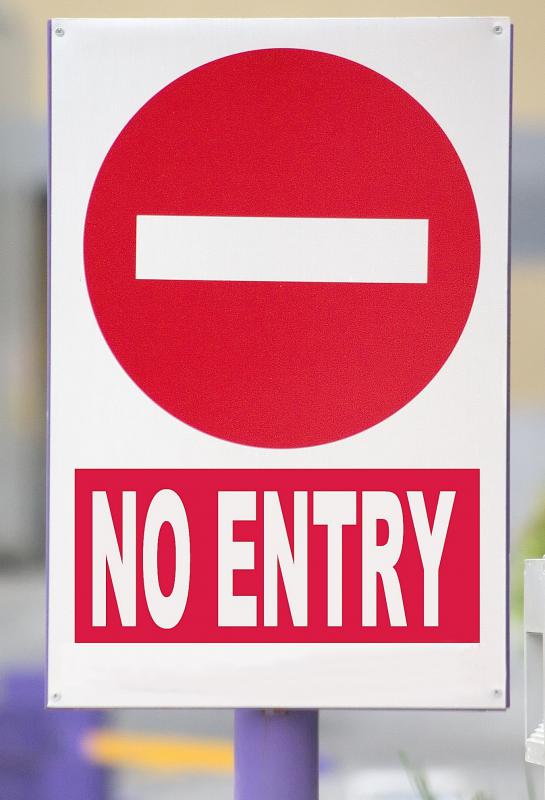
In the case of someone with 20/200 (6/60) vision, he or she needs to stand within 20 feet (6 meters) to see an object which someone with normal visual acuity can see from 200 feet (60 meters) away. This has obvious consequences, as it means that a legally blind person has trouble seeing things that other people take for granted, like road signs, traffic lights, and so forth.

People who have very poor vision are also more prone to falls and other accidents because they cannot clearly discern their surrounding environment. Someone with 20/20 (6/6) vision, for example, would notice a crack in the sidewalk and avoid it, but a legally blind individual might not be able to clearly see the crack, or might not understand what the visual disturbance meant, so he or she could trip and fall.

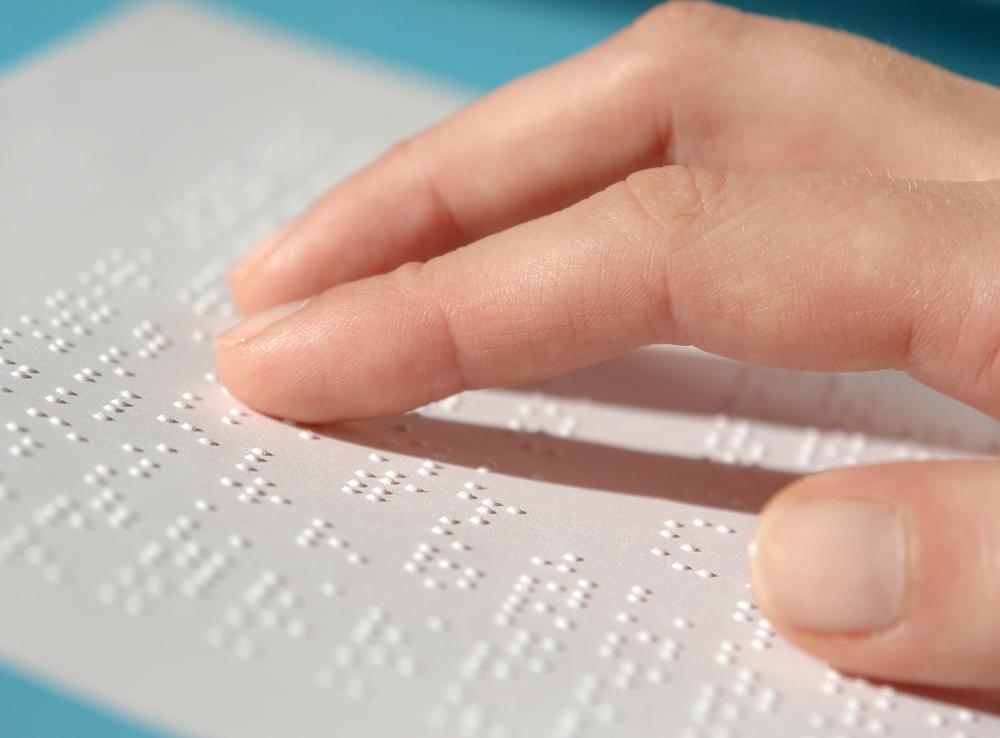
Many cities have measures in place that are designed to help such individuals, such as warning sounds on crosswalks to alert people to when it is safe to walk, and textured inserts in sidewalks that will let people know that the sidewalk elevation is about to change. Those who are legally blind can take advantage of the same tools used by people with no visual perception at all, such as screen readers for using computers, and Braille texts for reading print publications.
Mary McMahon
Ever since she began contributing to the site several years ago, Mary has embraced the exciting challenge of being a WiseGEEK researcher and writer. Mary has a liberal arts degree from Goddard College and spends her free time reading, cooking, and exploring the great outdoors.
Learn more...
Mary McMahon
Ever since she began contributing to the site several years ago, Mary has embraced the exciting challenge of being a WiseGEEK researcher and writer. Mary has a liberal arts degree from Goddard College and spends her free time reading, cooking, and exploring the great outdoors.
Learn more...AS FEATURED ON:
AS FEATURED ON:









-
![Visual acuity is determined using a Snellen chart.]() By: KelpfishVisual acuity is determined using a Snellen chart.
By: KelpfishVisual acuity is determined using a Snellen chart. -
![Among other things, legal blindness impairs the ability to read street signs.]() By: meadow2007Among other things, legal blindness impairs the ability to read street signs.
By: meadow2007Among other things, legal blindness impairs the ability to read street signs. -
![Someone who meets the legal definition of blind might be able to receive a seeing eye dog.]() By: Boris DjuranovicSomeone who meets the legal definition of blind might be able to receive a seeing eye dog.
By: Boris DjuranovicSomeone who meets the legal definition of blind might be able to receive a seeing eye dog. -
![Legally blind individuals can enhance their quality of life with methods designed for the visually impaired, such as braille.]() By: Roman MilertLegally blind individuals can enhance their quality of life with methods designed for the visually impaired, such as braille.
By: Roman MilertLegally blind individuals can enhance their quality of life with methods designed for the visually impaired, such as braille. -
![People who have poor vision are more prone to falls and accidents.]() By: Syda ProductionsPeople who have poor vision are more prone to falls and accidents.
By: Syda ProductionsPeople who have poor vision are more prone to falls and accidents. -
![Someone who is legally blind might have a hard time reading road signs.]() By: Tan Kian KhoonSomeone who is legally blind might have a hard time reading road signs.
By: Tan Kian KhoonSomeone who is legally blind might have a hard time reading road signs.



Discussion Comments
I lost my central vision in my right eye. Is that eye legally blind?
If someone said he had visibility of 30 percent in one eye and 10 percent in the other, would he be classed as being legally blind? Also, what percentage out of 100 would that translate to? Would such a person be able to legally drive a car?
Does this mean the same if a person wears contacts, I'm in a 7.5 and still don't have clear vision. What would the number in contacts be to be considered blind?
I can only see objects that are in front of me at close range. Everything is is very blurry. I wear glasses but all of my life has been spent squinting. I can't see a thing yet an optometrist never told me that I had bad vision.
I think you fail to mention one huge thing that I know as a 50 percent blind individual.
You have two eyes as a normal human. That would mean your eyes are 100 percent. Now, if you lose one of them then that is divided in half, which means 50 percent. Math concepts are in play here and common sense.
Also, we have a shorter time of energy. We as individuals being able to see out of one eye get tired and fall asleep faster than the normal person. I feel there should be a huge study done here for us on this topic to clarify what 100/2 really is -- and if I learned anything in math class, is the answer is 50!
thank you for updating. it's exactly what i need!
very helpful but i could use a better definition. I'm doing this for a school paper and a definition would be helpful in many ways
thanks, Aynsley D.
Good, exactly what I needed.
Post your comments